

Description
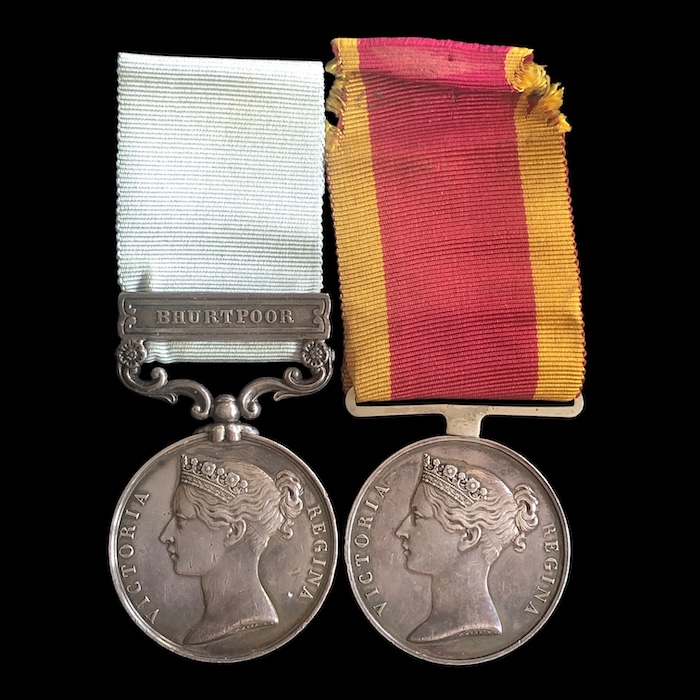
A Good Army of India and China 1842 pair to a Quartermaster in the 26th Regiment, late 14th Regiment.
Army of India 1799-1826, clasp, Bhurtpoor, Qr. Mr. Serjt. J. Goodfellow, 14th Foot (short hyphen reverse), officially impressed naming; China 1842 , J. Goodfellow Qr. Mastr. 26th Regiment Foot.( original suspension)
Joseph Goodfellow was born at Leicester on 16 December 1792.
He enlisted into the 14th Regiment on 14 May 1801, aged 17 years; Corporal, August 1811; Sergeant, January 1813; Colour Sergeant, February 1822; Quartermaster Sergeant, August 1824; Quartermaster, without purchase, into 38th Regiment, 12 February 1828; exchanged to 26th Regiment, 25 September 1835; exchanged to 10th Regiment, 27 July 1843. He served in Bengal, August 1812 to March 1840; China, March 1840 to February 1843; Bengal, February to July 1843; retired on half-pay, 3 March 1848.
He died on the 13th December 1853, Bristol.
While in India he met and married Treachy Sinny and they married in Cawnpore in April 1816 and had seven children together. While out in India.
The following services were submitted by Goodfellow for entry in Hart’s Army List: ‘Served with the 14th Regiment in the Nepaul War in 1814/15 [although the 14th were present in this campaign, very few claimed or received the Nepaul clasp]. Present at the Siege and Capture of the Fort of Hattras in 1817. Served in the Pindari & Mahratta Campaign of 1817/18. Present at the Siege and Storming of Bhurtpore in 1826. Has received the Medal for services in China having been present with the 26th Regiment at the Capture of Chusan; at the operations before Canton; repulse of the night attack of the City of Ningpo; Attack and Capture of the enemy entrenched Camp on the heights of Segoan; Attack and Capture of Chapoo; at the taking of Shanghai and Woosung; the Assault and Capture of Chin Kiang Foo and investment of Nanking.
With a good file of research.
During the early 19th century, the 1st Battalion, 14th (Buckinghamshire) Regiment of Foot served as a cornerstone of British infantry power in India. While the Anglo-Nepalese (Gorkha) War concluded in early 1816, the regiment’s service along the Nepalese frontier immediately flowed into the major Pindari and Third Anglo-Maratha Campaigns of 1817–1818.
Mobilized from Cawnpore in 1815, the 1st Battalion joined British operations along the Nepalese border. Fighting in the harsh, terrain of the Terai region of the Himalayas, the 14th Foot adapted to a challenging theater against formidable Gorkha forces.
The battalion provided vital infantry support, securing strategic supply corridors and holding northern frontiers against Gorkha incursions. Their steadfast presence supported Major-General Sir David Ochterlony’s decisive operations, which ultimately compelled Nepal to ratify the Treaty of Sugauli in March 1816.
Following the Nepalese war, the 1st Battalion was deployed directly into operations across Central India:
Siege of Hatras (1817): In February 1817, the 14th Foot took part in the siege of the massive mud fortress at Hatras. Supported by heavy artillery bombardment, the regiment helped encircle the stronghold until its capitulation.
Pindari & Maratha War (1817–1818): Attached to the Grand Army under the Marquess of Hastings, the battalion spent 1817 and 1818 undertaking grueling marches across Central India. They engaged in counter-insurgency operations against elusive Pindari raiders and secured territory against hostile Maratha forces.
Despite enduring extreme heat, sickness, and long operational marches, the 1st Battalion maintained remarkable discipline. Their continuous service across both campaigns was vital in securing British authority in Northern and Central India, later recognized with the Royal Tiger badge superscribed India.
During the Siege of Bhurtpore (December 1825 – January 1826), the 1st Battalion, 14th (Buckinghamshire) Regiment of Foot earned one of the most celebrated distinctions in its operational history.
The massive mud-walled fortress of Bharatpur in Rajasthan was widely considered impregnable, having famously repulsed a British siege under Lord Lake two decades earlier. In late 1825, General Lord Combermere assembled a force of over 20,000 men—including the 14th Foot—to breach the stronghold and resolve a succession crisis in the princely state.
Because standard siege artillery struggled to crumble the thick earthen ramparts, British engineers drove massive military mines beneath the outer walls. The 14th Foot was assigned as a primary storming column under Brigadier-General Jasper Nicolls, tasked with assaulting the main breach at the Jagina Gate.
On the morning of January 18, 1826, a gigantic mine containing 10,000 pounds of gunpowder detonated beneath the north-east bastion. As debris settled, the men of the 14th Foot—many wearing their 1815 Waterloo medals—dashed forward through the thick smoke and dust.
Climbing the steep, shattered earthen incline, the battalion met fierce resistance in close-quarters hand-to-hand fighting against the Jat defenders. Fixed with bayonets, the 14th Foot secured the top of the breach, swept along the ramparts, and established control over the interior defenses.
The fall of Bharatpur shattered the widespread myth of the fortress’s invincibility. In recognition of their central role in the assault, the regiment was awarded the battle honor “Bhurtpore” and granted permission to bear the Royal Tiger badge superscribed India on its regimental colors—a lasting emblem of their long service in the region.
The 26th (Cameronian) Regiment of Foot played a leading role in the First Anglo-Chinese War, serving as a core element of the British expeditionary force dispatched from India.
Commanded by Lieutenant-Colonel George Burrell, the 26th Foot arrived off the coast of Zhejiang and spearheaded the initial capture of Chusan (Tinghai) in July 1840. However, their early success was quickly eclipsed by tragedy: while garrisoning the island, the regiment suffered appalling casualties from malaria and dysentery, losing over 200 men to disease in a matter of months.
Rebuilt under Major Thomas Simson Pratt, the Cameronians saw continuous action as the fleet moved along China’s coastline and key waterways:
Canton Operations (May 1841): The regiment stormed and held the fortified heights overlooking Canton (Guangzhou), securing a strategic advantage that forced Chinese authorities into a truce.
Coastal Assaults (1841–1842): The 26th took part in amphibious landings and captures of fortified positions at Amoy, Ningpo, and Chapu.
Storming of Chinkiang (July 1842): In the war’s final and bloodiest land battle, the 26th participated in the assault on Chinkiang (Zhenjiang). Facing fierce hand-to-hand resistance from Manchu garrison troops, the British captured the city, effectively severing China’s vital Grand Canal supply route.
Following the fall of Chinkiang, the regiment advanced to the gates of Nanking, compelling the Qing Empire to sign the Treaty of Nanking aboard HMS Cornwallis in August 1842. For its distinguished service across the campaign, the 26th Foot was awarded the battle honor “China” and granted the right to display the Dragon badge on its regimental colors.
Condition – contact marks, otherwise very fine


