

Description
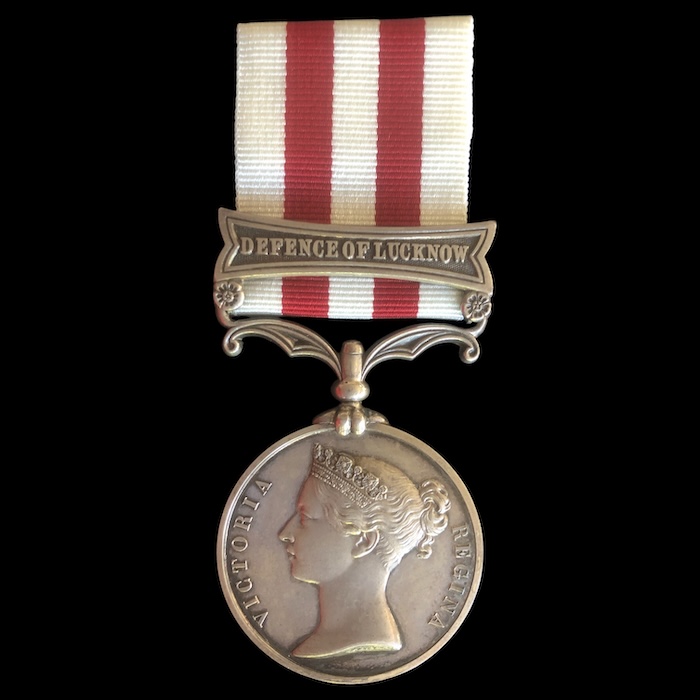
Indian Mutiny, Defence of Lucknow – 90th Light Infantry (Perthshire Volunteers) , Killed in Action 6th October 1857.
Indian Mutiny, clasp, Defence of Lucknow, R. Sutcliffe, 90th Lt Infy.
R.Sutcliffe appears on the casualty roll as being Killed in Action on the 6th October 1857
Condition – NEF
En route to China in 1857, the 90th Regiment of Foot (Perthshire Volunteers) (Light Infantry) was diverted to Bengal following the outbreak of the Indian Rebellion. Despite losing equipment when one of their transport ships, HMS Transit, was wrecked off Sumatra, the regiment arrived in India and joined Major-General Sir James Outram and Brigadier-General Henry Havelock’s force advancing to relieve the besieged British garrison at Lucknow.
In September 1857, the 90th Light Infantry played a central role in the First Relief of Lucknow. Fighting through narrow streets against entrenched rebel forces, the regiment suffered heavy casualties while securing vital entry routes and advanced positions. Following their arrival at the Residency, Outram’s force found itself unable to evacuate the non-combatants, leading to the prolonged “Second Defence” of Lucknow.
During the defense, the 90th held critical, heavily exposed sectors of the perimeter. Their light infantry training proved invaluable in urban skirmishing, counter-mining operations, and hazardous sorties launched to destroy enemy artillery positions. Members of the regiment distinguished themselves repeatedly under fire; six Victoria Crosses were awarded to men of the 90th during the campaign, including Surgeons Anthony Home and William Bradshaw for defending wounded soldiers in a stranded medical convoy.
After Sir Colin Campbell’s force relieved the garrison in November 1857, the regiment helped secure the Alambagh outpost before taking part in the final siege and capture of Lucknow in March 1858. The 90th Light Infantry remained on active pacification duty in India until 1869, having established a record of exceptional discipline and combat effectiveness throughout the rebellion.
Actions on 6th October 1857
On 6th October 1857, during the intense defense of the Lucknow Residency perimeter, a critical crisis unfolded when fire broke out along the British breastworks, threatening to destroy the defensive barrier and expose the position to enemy marksmen. Lieutenant Gibaut of the 90th Light Infantry repeatedly braved concentrated sepoy fire to carry water out to the exposed position and extinguish the flames.
During one of these hazardous runs, Lieutenant Gibaut was hit and mortally wounded, falling in the open beyond the safety of the parapet. Recognizing the immediate danger to their officer, Lance Corporal John Sinnott—who had previously accompanied Gibaut in carrying water—volunteered to rescue him.
Under heavy, continuous direct fire from rebel positions, Lance Corporal Sinnott, accompanied by Sergeants Glenn and Mullins and Private Mullins, dashed out beyond the breastworks into open ground. Despite being hit twice during the rescue effort, Sinnott and the party reached the dying lieutenant and successfully carried his body back behind cover.
For his extraordinary courage on 6th October—and by the unanimous vote of his comrades—Lance Corporal Sinnott was awarded the Victoria Cross, highlighting the fierce devotion and bravery displayed by the 90th Light Infantry during the siege.


