
Description
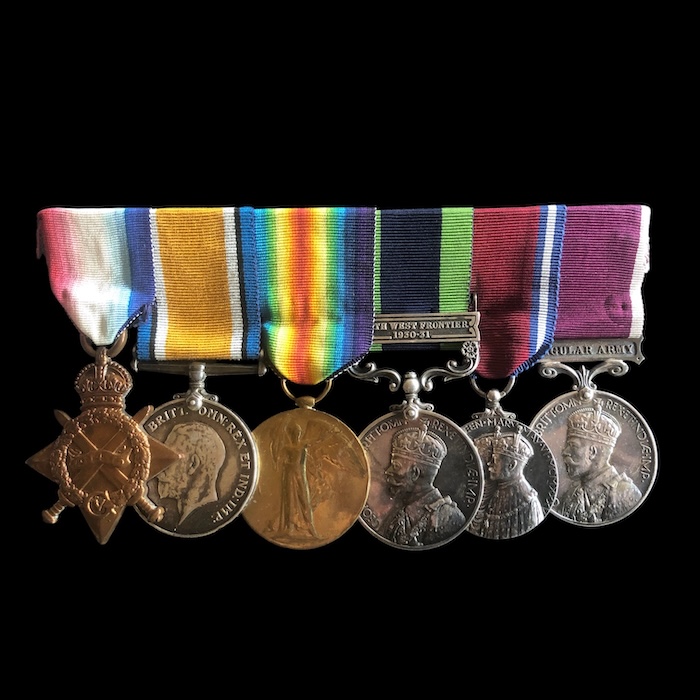
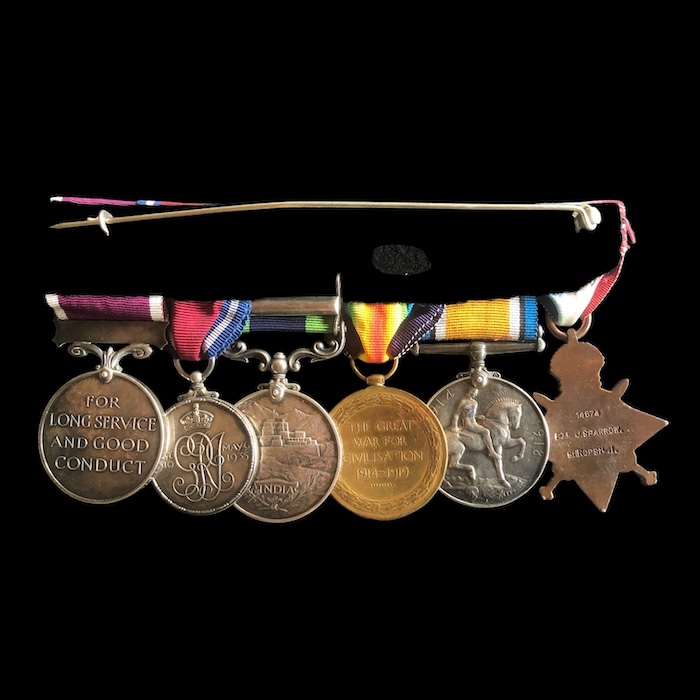
A Good WW1, and Northwest Frontier Long Service group – 7th battalion, Kings Shropshire Light Infantry.
1914-15 Star, 14674 Pte J. Sparrow. Shrops: L.I.; British War and Victory Medals, 14674 Pte. J. Sparrow. K.S.L.I.; India General Service 1908-35, clasp, North West Frontier 1930-31, 4027557 Pte J. Sparrow. K.S.L.I.; Jubilee 1935; Army L.S. & G.C., G.V.R., 4027557 Pte. J. Sparrow. K.S.L.I., Swing mounted as worn.
John Sparrow was born on the 25th December 1889.
His MIC confirms he landed in France on the 28th September 1915, and rolls only show service in the 7th battalion K.S.L.I., and he is confirmed on the roll for his I.G.S.
Condition – light contact wear and polishing throughout, otherwise very fine
7th (Service) Battalion, KSLI in World War I
Formed in Shrewsbury in September 1914 as part of Kitchener’s New Army, the 7th (Service) Battalion, King’s Shropshire Light Infantry (KSLI) deployed to France in September 1915. Attached to the 8th Brigade, 3rd Division, the battalion served continuously on the Western Front throughout the war.
The 7th KSLI participated in many of the conflict’s most severe engagements:
1916: The Battle of the Somme, suffering heavy casualties at Bazentin Ridge and Delville Wood.
1917: The Battle of Arras (First and Second Battles of the Scarpe) and Third Ypres (Passchendaele).
1918: Defensive operations against the German Spring Offensive, followed by the victorious Allied Hundred Days Offensive at Albert, Bapaume, Canal du Nord, and the Selle.
By the Armistice on 11 November 1918, the battalion was situated at Romeries, France. Following occupation duties near Cologne, it was demobilized and disbanded in June 1919. The 7th Battalion suffered 1,048 fatal casualties—the highest loss of any KSLI battalion during the Great War—and earned more battle honors than any other unit in the regiment.
KSLI on the North West Frontier of India (1930–1931)
Between April 1930 and March 1931, the 2nd Battalion, King’s Shropshire Light Infantry was actively deployed during widespread civil and tribal unrest across the North West Frontier Province (now in Pakistan), operating primarily from the garrison at Peshawar.
The deployment coincided with a dual threat: coordinated armed incursions by hostile Afridi tribesmen into the Peshawar district and civil disobedience spearheaded by the anti-colonial “Red Shirt” movement (Khudai Khidmatgar). The 2nd KSLI carried out tactical operations to secure the Khajuri Plain, defend perimeter fortifications, clear mountain passes, and deploy mobile columns to suppress insurgent activity in harsh, mountainous terrain.
For their role in defending the strategic borderlands and restoring imperial control, participating personnel from the 2nd KSLI were awarded the India General Service Medal with the clasp “North West Frontier 1930–31”.


