
Description
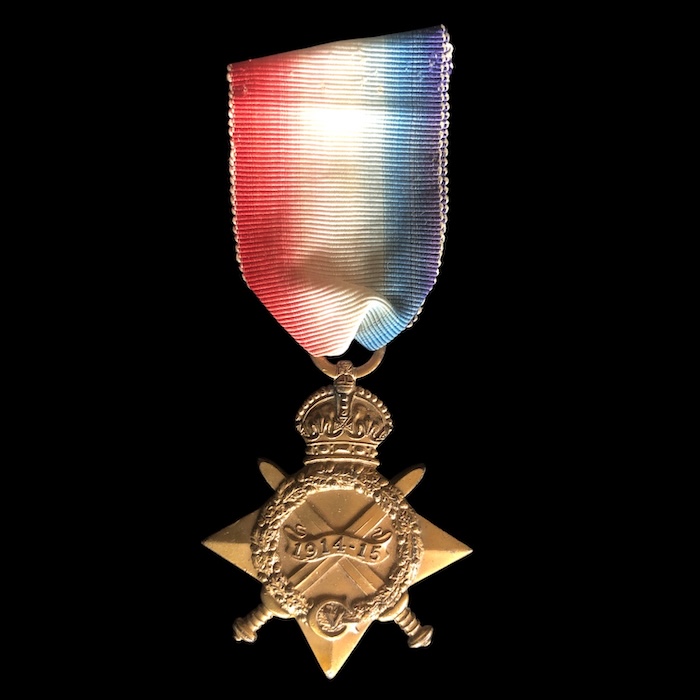
1914-15 star – Royal Navy. (H.M.S. Minotaur during WW1)
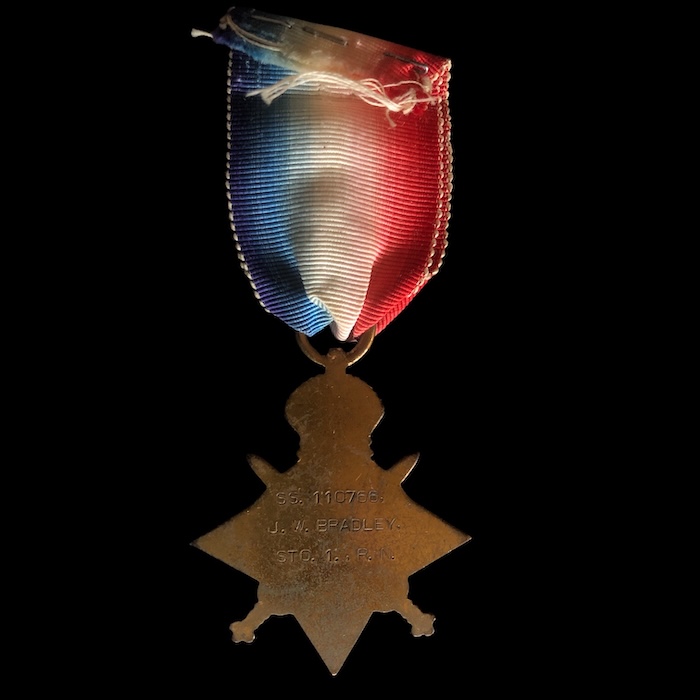
1914-15 Star, SS.110766, J.W. Bradley, Sto.1. R.N.
John Wilfred Bradley was born in Hull, Yorkshire 4th November 1892.
He enlisted on the 27th March 1911, serving on Victory, Renown, Heckla, Spartiate, Minotaur to 15th April 1919
He was on HMS Minotaur from 25th May 1912 to 5th April 1919.
HMS Minotaur, the lead ship of her class of armoured cruisers, played a versatile and wide-ranging role in the Royal Navy throughout World War I.
When war broke out in August 1914, Minotaur was serving as the flagship of the China Station. She was immediately deployed to disrupt German communications and commerce in the Pacific, successfully capturing the German merchant vessel Elsbeth and bombarding a wireless telegraph station on the island of Yap.
By late 1914, she was reassigned to escort crucial ANZAC troop convoys across the Indian Ocean to the Middle East and Europe. Following the threat posed by Admiral von Spee’s German East Asia Squadron, Minotaur was briefly ordered to the Cape of Good Hope Station to act as flagship.
In late December 1914, Minotaur returned to the United Kingdom for a refit. Following the overhaul, she joined the Grand Fleet’s 2nd Cruiser Squadron, eventually serving as its flagship.
Her most notable action came during the Battle of Jutland on 31 May–1 June 1916. Operating on the screen of the Grand Fleet’s main battle line, Minotaur maneuvered through heavy smoke and fog. Although she was present during the major surface engagement, she never opened fire with her main battery, escaping the fleet action without suffering damage or casualties. (In contrast, her sister ship HMS Defence was tragically destroyed during the battle).
For the remainder of the conflict, Minotaur was deployed on the Northern Patrol and convoy protection duties in the North Sea and Atlantic, helping safeguard merchant shipping against German U-boats and raiders.
Following the armistice, she was decommissioned in February 1919, placed in reserve, and ultimately sold for scrap in 1920, marking the end of the Royal Navy’s last generation of armoured cruisers.
Transferred to the Royal Fleet Reserve 6th April 1919.
Condition – VF


