
Description
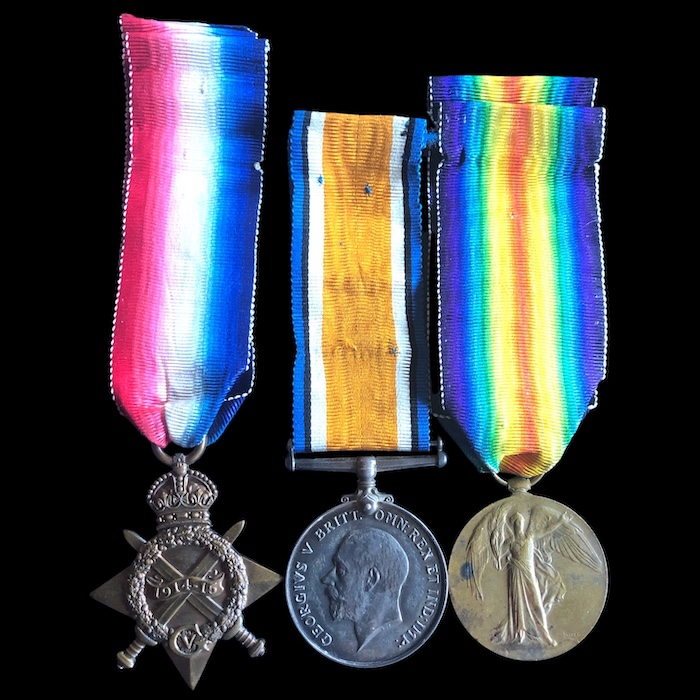
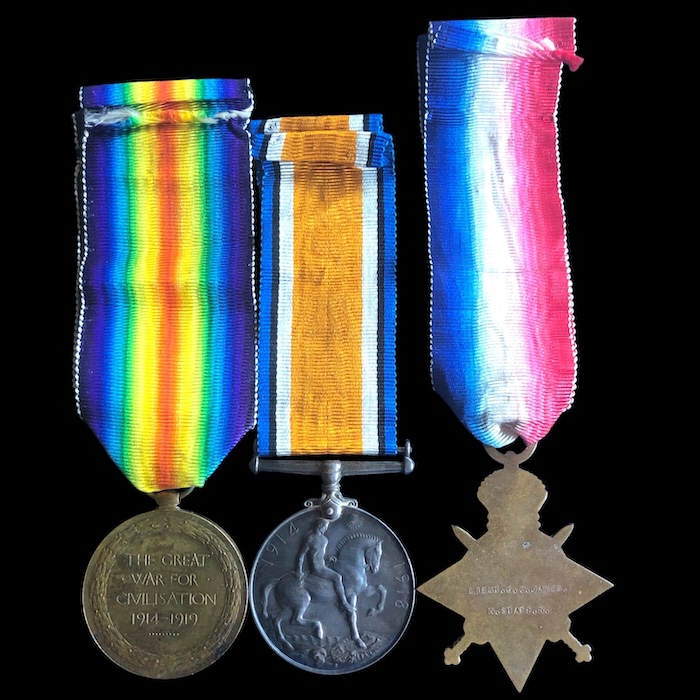
1914-15 trio, Officer 3rd and 8th battalions North Staffordshire Regiment, Twice Wounded and Prisoner of War.
1914-15 Star, Lieut G.C. James. N.Staff.R.; British War and Victory Medals, Capt G.C. James.
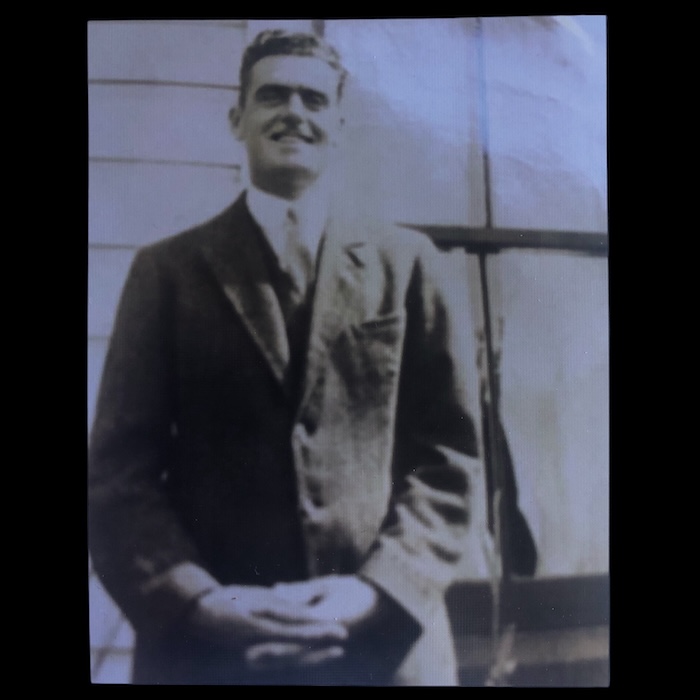
Geofrey Cecil James was born on 26th September 1893 in Barton-Under-Needwood, Burton on Trent.
He applied for a commission on the 8th August 1914 in to the 3rd battalion North Staffordshire regiment (Which was commanded at the time by his father, Lieut Colonel Charles H James), his commission being confirmed in the London Gazette on the 1st September 1914.
He arrived in France on the 15th February 1915, arriving at the front on the 16th March (Now attached to the Bedfordshire Regiment. He was with them for the attack on Hill 60, during which he was affected by gas poisoning and had to return home on “leave: from 18th May to 4th June..
On the 20th November 1915 with three other officers he proceeded to Grantham on secondment to the M.G.C. On the 4th September 1916 he was sent to France , and joined the 8th Battalion North Staffordshire Regiment.
As part of the 57th Brigade within the 19th (Western) Division, the 8th (Service) Battalion, Prince of Wales’s (North Staffordshire Regiment) spent the autumn of 1916 engaged in the attrition of the Somme offensive. Following intense summer fighting around La Boisselle, September 1916 began with the battalion rotating through reserve, training, and trench-holding duties across the sector encompassing Aveluy, Mouquet Farm, and Thiepval.
Throughout September and October, the 8th North Staffords endured harsh autumn weather, continuous enemy artillery bombardment, and treacherous mud while fortifying newly captured positions. In late October, the battalion was committed to frontline operations near Stuff Redoubt and Stuff Trench, critical defensive works commanding the high ground above the Ancre valley. The men endured relentless shellfire while holding vulnerable trenches, constructing assembly saps, and carrying supplies under exhausting conditions.
By early November, the battalion alternated between rest at Aveluy Wood and frontline duty between Thiepval and Mouquet Farm. On 17 November, they assembled at the western end of Regina Trench to prepare for what became the final major British enterprise of the Somme: the Battle of the Ancre.
On 18 November 1916, at 06:10 hours, amidst blinding sleet, driving snow, and deep mud, the 8th North Staffords went over the top toward Grandcourt and the Desire Trench line. Navigating ground churned into a sea of liquid mud and cratered chaos, the battalion encountered severe machine-gun fire and a heavy German artillery barrage. Despite extreme conditions and suffering over 300 casualties, the battalion pressed forward with grim determination before the Somme offensive officially ended.
Wounded and taken Prisoner of War on the 18th November 1916. A Staff officer present at the time stated” He took his company over splendidly and although wounded twice, went on till he fell. The attack took place over very difficult ground and in a snowstorm, and of all the officers that went over only one 2nd Lieutenant returned.”
He was held prisoner at Osnabruck, Germany
On 24th January 1919, Geoffrey was requested to provide a statement as to his capture:
“On the 18th November 1916 the 8th North Staffs attacked Grandcourt. I was in charge of “C” Company. We got to the first line enemy trench, with very few men left by this time. I left a a sentry over the only dug out I could see with Germans in, and went on about thirty or forty yards. I looked round to see if there was anyone with me, and there was nobody in sight. The Germans suddenly came into the trench we had just come over, so, I got down into a shell hole. While lying there a man of the Queens Regt crawled into the shell hole with me. We lay there some time, waiting for darkness to be able to get back to our own lines, but the Germans came along and found un and took us prisoners”
After the War he emigrated to New Zealand, where he married . But by 1935 he had returned to England with his wife, but he at some point returned to New Zealand.
He died on the 29th August 1954 in Auckland, New Zealand.
With a good amount of research, including his officers service papers.
Condition – NEF


