
Description
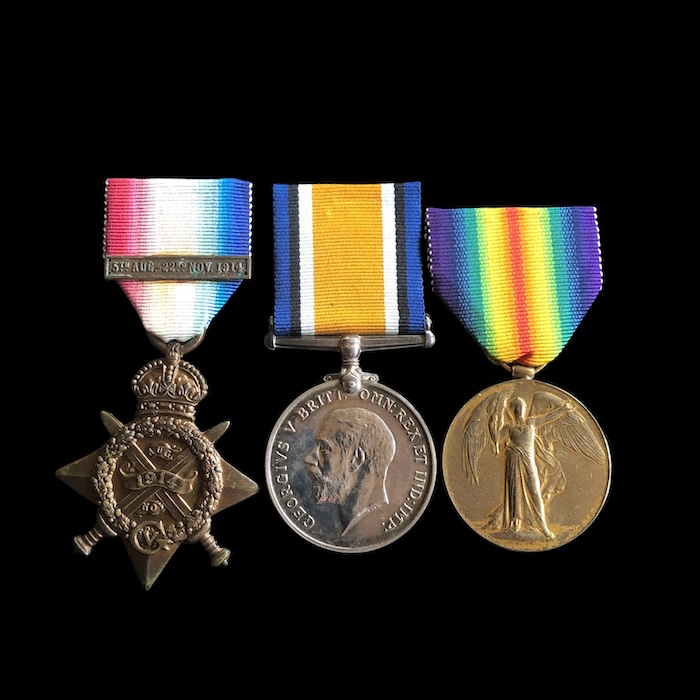
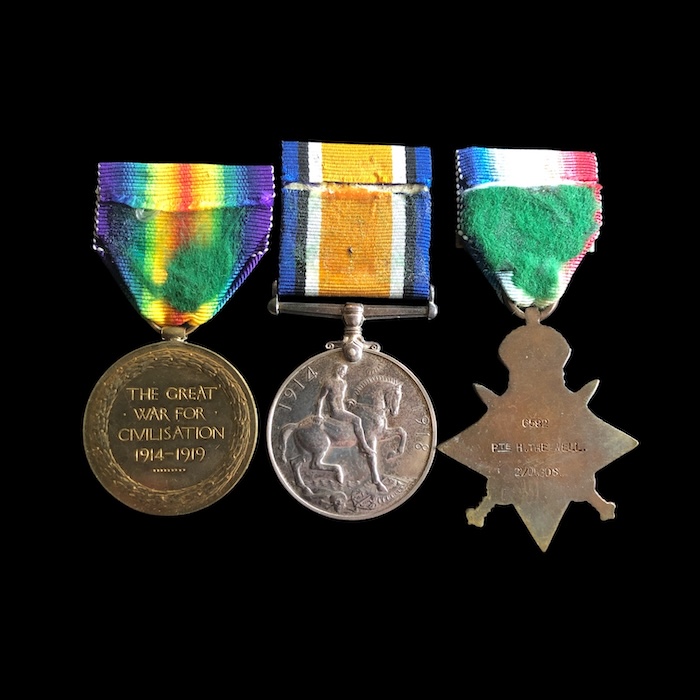
1914 Star and bar trio – 2nd Dragoon Guards.(Queens Bays)
1914 Star (5th Aug-22nd Nov 1914 bar) 6582 Pte H.Thelwell. 2/D.Gds; British War and Victory Medals, D-6582 Pte H. Thelwell 2-D. Gds.
Herbert Thelwell’s MIC confirms his entitlement to the Mons bar, and that he landed in France on the 15th August 1914
Discharged 6th March 1919
The 2nd Dragoon Guards (Queen’s Bays) entered World War I as one of the elite heavy cavalry regiments of the British Army.
The regiment landed in France on August 15, 1914, as part of the 1st Cavalry Brigade in the 1st Cavalry Division. They were almost immediately thrust into the “Great Retreat” following the Battle of Mons.
The Affair at Néry (September 1, 1914) is one of the most celebrated small-unit actions in British military history. It was a chaotic, “backs-to-the-wall” engagement that pitted the 1st Cavalry Brigade against a significantly larger German force during the Great Retreat from Mons.
For the 2nd Dragoon Guards (Queen’s Bays), it was a morning that began with a peaceful breakfast and ended in a desperate, muddy struggle for survival.
The British 1st Cavalry Brigade had halted at the village of Néry to rest. A thick, “pea-soup” fog covered the valley. Because of the poor visibility, the brigade delayed its 4:30 am departure, allowing the men to water their horses and cook breakfast.
A German patrol from the 4th Cavalry Division stumbled upon the British camp. Legend has it they saw a British corporal calmly shaving and realized they had found the enemy.
The Opening Salvo: Around 5:40 am, the fog suddenly lifted. Twelve German field guns and several machine guns, positioned on the ridge overlooking the village, opened fire at a range of only 600–800 yards.
The Queen’s Bays and L Battery, Royal Horse Artillery (RHA) were the primary targets. The initial bombardment was devastating:
The Bays were in the process of “shifting saddles” (re-adjusting gear). The sudden explosion of shells caused a massive stampede. Hundreds of horses, including those of the Bays and the artillery teams, broke loose and charged through the village streets in a blind panic.
With many of their horses gone or killed, the Bays had to fight as infantry. They scrambled into the gardens, orchards, and the local sugar factory, using their Lee-Enfield rifles to return fire against German cavalrymen who were attempting to encircle the village.
While the Bays held the perimeter, L Battery RHA performed a feat of legendary endurance. Caught in the open, they managed to unlimber three of their six guns under a hail of shrapnel. Two guns were quickly knocked out. The remaining gun was served by a dwindling crew of officers and men. The Victoria Crosses: Three men from L Battery were awarded the VC for keeping this single gun firing for over two hours against a full German battery:
The Queen’s Bays didn’t just hide; they provided the suppressive fire that allowed the lone RHA gun to survive.
The Bays’ machine-gun section, led by Lieutenant de Crespigny (who was killed in the action), managed to get their Vickers guns into a position that enfiladed the German artillery.
As British reinforcements (including I Battery RHA and the Middlesex Regiment) began to arrive, the Bays and the 11th Hussars pushed forward. The Germans, believing they were being attacked by a much larger force, began a disorganized retreat.
The Bays suffered roughly 50–60 casualties. L Battery was nearly wiped out, with only 40 men left standing out of 200.
The First Battle of Ypres: As the front lines stabilized, the Bays fought as dismounted troops, helping to hold the thin British line against massive German assaults.
1915–1917: As the Western Front froze into a stalemate of trenches and barbed wire, the role of cavalry became complicated. The Bays spent much of this period in a cycle of:
Dismounted Service: Serving in the trenches just like infantry, often in high-risk sectors.
The Cavalry Reserve: Waiting behind the lines for the “Great Breakthrough.” Generals frequently held them and other cavalry units in readiness to exploit gaps in the enemy line—gaps that rarely materialized during the meat-grinder battles of the Somme (1916) and Passchendaele (1917).
1917: The Tanks at Cambrai
At the Battle of Cambrai, the Bays were positioned to rush through the opening created by the first large-scale tank attack. While the breakthrough wasn’t as decisive as hoped, the regiment was involved in intense fighting around the village of Fontaine-Notre-Dame.
1918: The final year of the war saw the Queen’s Bays return to their traditional role.
The Spring Offensive: When the German Army launched its massive “Kaiserschlacht” in March, the Bays acted as a mobile screen, fighting desperate rearguard actions to slow the German advance and plug holes in the retreating British line.
The Hundred Days Offensive: During the final Allied push, the regiment finally found the “open country” they had waited four years for. They took part in the Battle of Amiens and the pursuit of the retreating German Army, proving that cavalry still had a role in scouting and rapid exploitation right up until the Armistice on November 11, 1918.
Major Honors Mons, Le Cateau, Marne, Aisne, Messines, Ypres, Somme, Cambrai, Amiens
Note on Casualties: Like many regular army units that served from 1914 to 1918, the regiment suffered heavy losses, with many of the original “Old Contemptibles” who landed in 1914 not surviving to see the victory in 1918.
Condition – NEF


