
Description
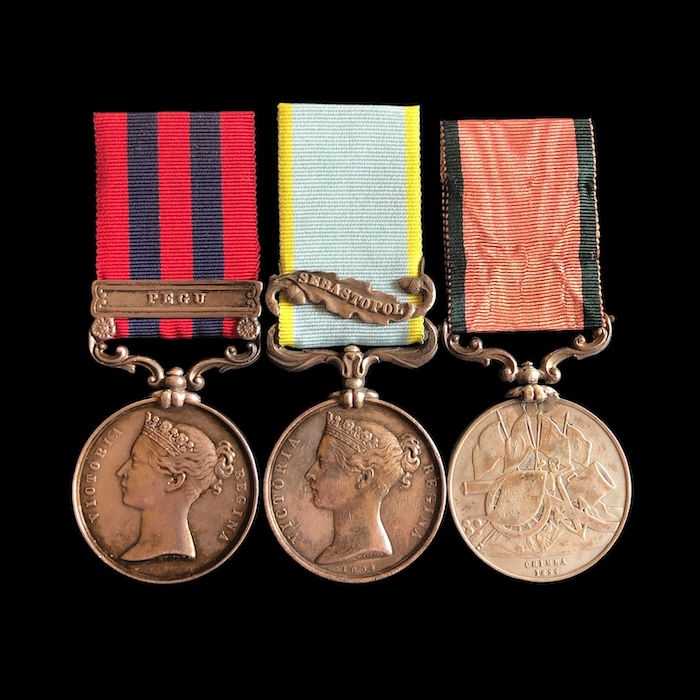
A good Royal Irish Regiment group, to the Paymaster Sergeant of the 1st battalion. (later Quartermaster)
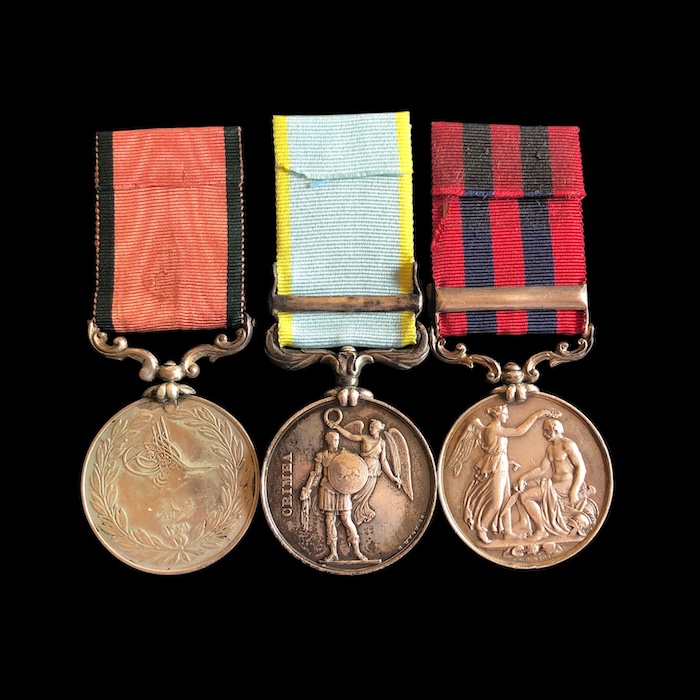
India General Service Medal 1854, clasp ‘Pegu’, Pay Mr. Sepjt Maurice Hackett 18th Rl. Irish Regt Crimea Medal with clasp ‘Sebastopol’ and Turkish Crimea, British issue, with ornate suspension, (the latter pair un-named as issued).
Maurice Hackett was born in 1829 in the parish of Trinity Without, Co. Waterford. He was a currier (leather worker) and shoemaker, aged 18½ when he enlisted for the Royal Marines at Liverpool at 2pm on 7 March 1848 for a bounty of £3-17-6d. He attested before the magistrate at Manchester at 4pm on 10 March 1848; he received 2 shillings and sixpence on attestation. Hackett was described as 5’ 7½”, of fresh complexion, with grey eyes and brown hair.
Assigned to Chatham Division, Hackett only served 73 days with the Royal Marines. On 31 May 1848 he transferred to the 18thRoyal Irish Regiment as a Private; he was given the regimental number 2592. He must have been in poor health because, on joining the Royal Irish from the Marines, he went straight into the regimental hospital, sick.
Hackett was with the Service Companies of the Royal Irish Regiment at Chatham. From September-November he was on duty at Upton Castle. On 9 August 1849 he embarked to join the regiment in India. He landed at Bengal on 16 September 1849, joining the Royal Irish at Meerut on 10 April 1850.
During August/September 1850, Hackett was in hospital. On 14 October the regiment began the march to Allahabad but Hackett was left sick at Meerut; he rejoined the regiment at Calcutta in December. The regiment was stationed at Fort William, Bengal throughout 1851; Hackett was again in hospital for a period in July.
On 23 September 1851, Hackett was appointed Paymaster Sergeant of the 1st Battalion. He must, therefore, have been both literate and numerate. He was to remain in the Regimental Pay Office for the next 9 years and 5 months.
In early 1852 the Royal Irish embarked for active service in Burma. Hackett was in Burma from 26 January 1852; serving at Moulmain and Rangoon. In mid-1852 he did duty on board the Honourable East India Company’s steam frigate Sesostris. He was then at Prome from October 1852 to October 1853, with the exception of a spell of duty at Shoedang during the spring of 1853. On 29 November 1853 the regiment returned to Calcutta, as it was due to return to England for a spell of home service. In December, Hackett embarked on the HEIC steamer Mahanuddy and subsequently on the troop ship Southampton.
Hackett landed in England on 12 May 1854. The Royal Irish were initially stationed at Chatham. During the summer, Hackett did duty at Canterbury. He was granted furlough from 20-30 November 1854. Only a few days later, on 8 December, he embarked with the Royal Irish Regiment on the S.S. Magdalene for active service in the Crimea, landing at Balaklava on 30 December 1854. Hackett is noted as having served in the Crimea from February 1855.
On 20 June 1856 the Royal Irish Regiment, after 18 months service, was among the last to leave the Crimea, embarking on HMS Majestic, an 80-gun ship fitted with an auxiliary screw. The Regiment landed at Portsmouth on 10 July 1856. After a few days at Aldershot, the Royal Irish was posted to Ireland and was first at Dublin before being assigned to the Curragh. The Regiment spent the next year at the Curragh; Hackett obtained furlough from 6-29 November 1856. On 23 October 1857, while serving at the Curragh, Hackett signed on for a further term of 11 years with the Colours.
After all to short a stay at home, the Regiment was once again sent on active service; this time to India, for service during the Mutiny. It embarked at Cork on 12 November 1857 on board the steam transports Princess Charlotte and Italian and landed at Bombay on 8 February 1858. The Royal Irish were sent to Poona. For the next 12 months the Regiment was split into many detachments, which frequently changed stations. Hackett remained mostly at Poona but in late 1858 he was at Islampoor and, in December, at Ahmednagar. In early 1859 he was at Camp Sholapore but spent time detached at Ahmednagar and Mar Poona.
In May 1859 the Royal Irish left Sholapore for Secunderabad, arriving in June. The 1st Battalion, Royal Irish Regiment, as it had now become (following the formation of the 2nd Bn in 1858) was to remain at Secunderabad for the next 7 years (from May 1859 to January 1866). It was a time of stability, following the previous 7 years of rapid moves and active service.
On 20 February 1861, Thomas Carney, the Quartermaster of the 1st Bn 18th (Royal Irish) Regiment, died of fever at Secunderabad. Two days later, the commanding officer wrote to the Military Secretary recommending Paymaster Serjeant Maurice Hackett for the vacant Quartermastership. In his letter, the commanding officer stated:
‘Paymaster Sergeant Hackett has been in the Pay Office for 9 years and 5 months and has always given great satisfaction, he is an excellent accountant, thoroughly versed in official forms of correspondence and accounts and familiar with the Warrants and Regulations relating to Regimental matters.
He is of respectable extraction, well educated, trustworthy and his manners and [….] are good. I consider him well fitted in every respect for the vacant appointment.’
On 22 February the Battalion surgeon confirmed Hackett medically fit. On 23 April 1861, after 13 years in the ranks, Hackett was appointed Quartermaster of the 1st Bn Royal Irish Regiment, with the honorary rank of Lieutenant.
Hackett served as Quartermaster of the 1st Battalion for 8 years, at: Secunderabad (1861-1866), Shorncliffe (June-December 1866), Aldershot (December 1866-August 1867), Chester (August 1867-May 1868) and at Edinburgh (May-September 1868).
Hackett was placed on Sick Leave on 10 September 1868, shortly before the Battalion moved to Ireland. In December 1868 he became an inmate at the Richmond Lunatic Asylum in Dublin. Hackett’s wife was living in Ireland at the time. The Surgeon of the 18th examined Hackett on 25 February 1869 and certified that he had been suffering from ‘dementia’ for the last 5 months; that he was ‘incapable of military duty’ and would continue to be so at the end of his period of sick leave. In March 1869 the Army authorities in Ireland, including the medical staff, arranged for his retirement on medical grounds. By 2 April 1869 a replacement for Hackett as Quartermaster of the 1st Battalion Royal Irish Regiment had been identified (an officer from the 4th West India Regiment).
Quartermaster Hackett was retired on temporary Half Pay on 24 April 1869.
The 1870 Army List shows Hackett’s name under the ‘deaths’ column.
War Services: “Quartermaster Hackett served throughout the Burmese War of 1852-53, including the taking of Martaban, storming of Rangoon and occupation of Prome (Medal). Served also in the Crimea from February 1855 [till June 1856], including the siege and fall of Sebastopol (Medal and clasp and Turkish Medal).”
L/MIL/5/52 ff.105-112 confirms entitlement to the IGS medal with clasp ‘Pegu’ as the Pay Master Serjeant of the 18th Royal Irish; regimental number 2592.
WO 100/27 confirms the Crimea medal with clasp ‘Sebastopol’, still as the Paymaster Serjeant of the Regiment (p.299).
Hackett was not entitled to a Long Service and Good Conduct Medal, presumably due to his having been appointed Quartermaster with honorary officer rank.
Condition – GVF Note ‘p’ instead of ‘r’ of Serjt on the IGS.


