

Description
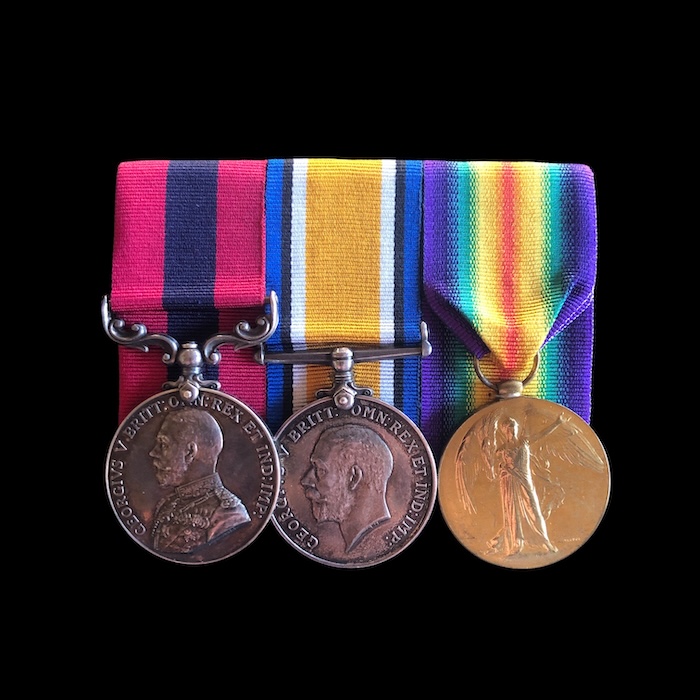
A Good Attack on the village of Thilloy Distinguished Conduct medal group – 7th battalion Royal Fusiliers. (Good citation)
Distinguished Conduct medal (Geo V), L-11886 C.S. Mjr. C.S> Cooper. 7/R. Fus.; British War and Victory medals, L-11886 W.O. Cl 2 C.S. Cooper R. Fus. (Court mounted for display.
Charles Samuel Cooper was born in Portland, Dorset. The son of a bandsman in the Queens Regiment.
He attested for the 7th (Volunteer) battalion Royal Fusiliers on the 27th November 1905. He joined the regulars on the 25th January 1906.
Having served at various stations the regiment returned to England on the 20th October 1914, he was promoted to Company Sergeant Major, but he did not go to France, so was likely employed as an instructor for the thousands of recruits joining the regiment.
He is confirmed as serving in France from the 20th March 1918, initially in the 2nd battalion, transferring to the 7th .
Distinguished Conduct medal – London Gazette 5th December 1918.
“For conspicuous gallantry and devotion to duty (at Thilloy, France on the 27th August 1918) during two attacks on a wood and a village. His company was badly cut up, and all the officers had become casualties. He re-organised the remnants and led them forward to the final objective with great determination. Working under very adverse conditions and in the face of intense fire this warrant officer set a fine example in maintaining the discipline and morale of the company.”
The attack on the strongly defended village of Thilloy was ultimately a failure, the remnants of the assaulting companies were force to withdraw despite the initial success of the assault.
Cooper survived the war and on the 20th February 1919 was re-engaged to complete 21 years service whilst serving in the army of occupation, returning to England on the 11th April 1919. Admitted to the Queen Alexandra Military Hospital, Milbank, London with double Mitral disease of the heart.
He died there on the 9th July 1920. His home address shown as Springfield Road, Tottenham. He is buried in Tottenham Cemetery.
Condition – GVF+


