


Description
A Good Boer War Casualty – 2nd battalion Gloucestershire regiment, with original documents.
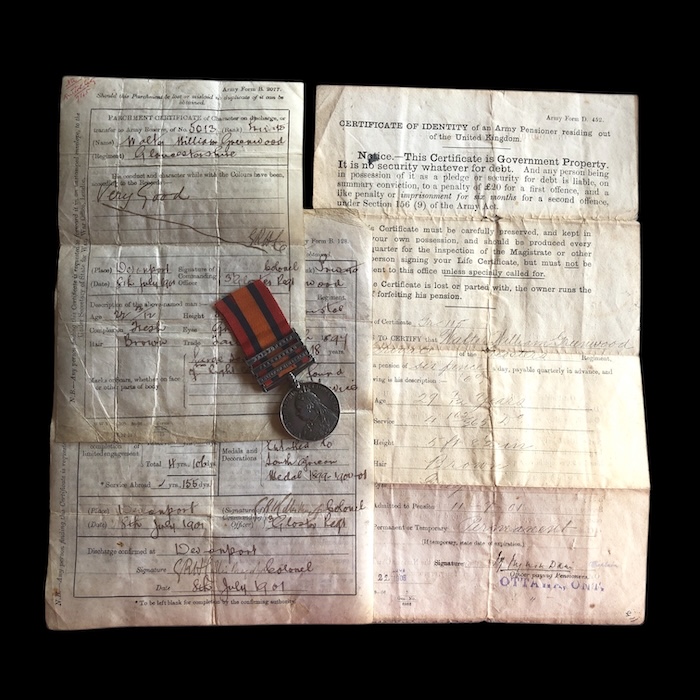
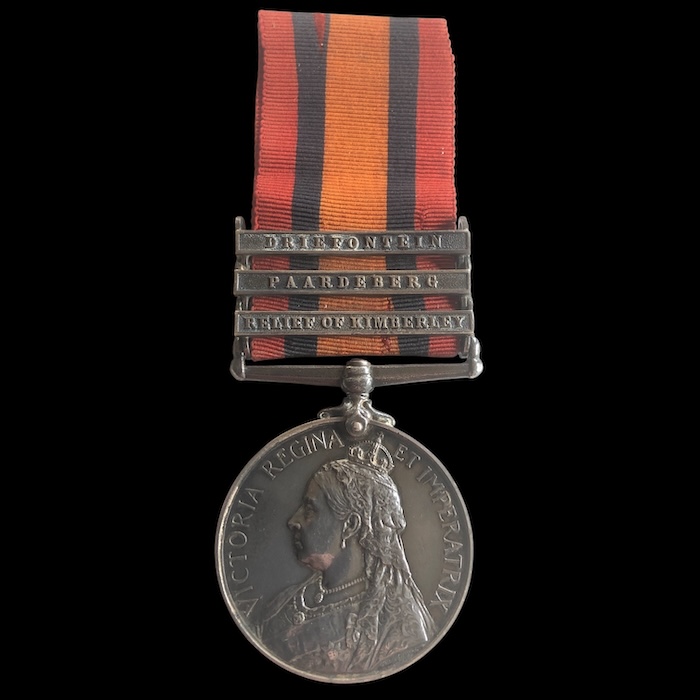
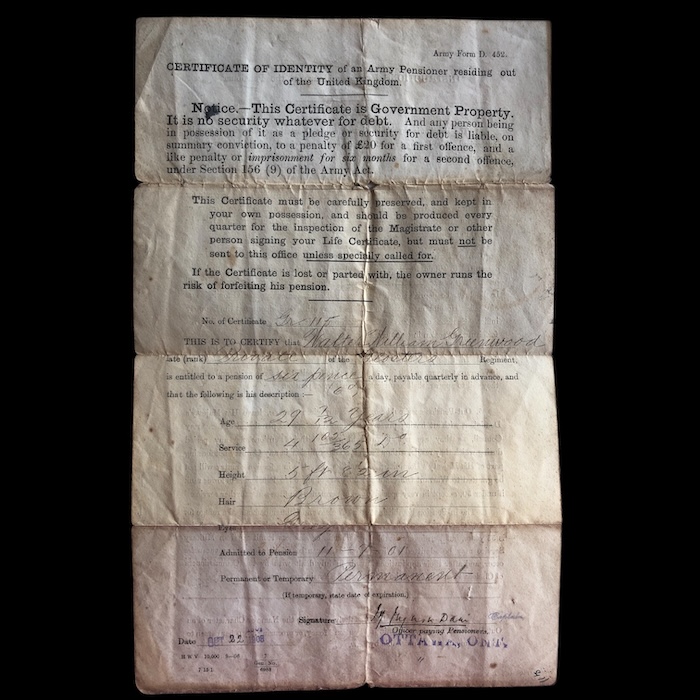
Queen’s South Africa 1899-1902, clasps, Relief of Kimberley, Paardeberg, Driefontein, 5013. Pte. W. W. Greenwood. Glouc. Rgt. (engraved naming); The recipient’s Parchment Certificate of Discharge; Parchment Certificate of Character on Discharge; and Certificate of Identity.
William Walter Greenwood was born in Horfield, Gloucestershire, in 1879 and attested for the Gloucestershire Regiment at Bristol on 26 March 1897.
He served with the 2nd Battalion in South Africa during the Boer War, and was wounded at Driefontein on 10 March 1900.
Returning to England, he was discharged medically unfit for further service on 8 July 1901, after 4 years and 106 days’ service, of which 155 days were served abroad.
Despite the deprivation, the battalion played a vital role in the critical campaign to surround the Boer commander Piet Cronje. This culminated in the Battle of Paardeberg (February 1900), where the 2nd Battalion’s pressure contributed directly to the surrender of Cronje’s army, marking the first major British victory of the war. Weeks later, on March 10, 1900, the battalion proved its mettle again at the Battle of Driefontein.
At the Battle of Driefontein on March 10, 1900, the 2nd Battalion of the Gloucestershire Regiment played a pivotal role in the British advance toward Bloemfontein. Following the surrender of General Piet Cronje at Paardeberg, Lord Roberts’ forces sought to break the Boer defensive line spanning the hills—or kopjes—that blocked the path to the Orange Free State capital.
The 2nd Battalion, serving as part of the 13th Brigade under Lieutenant-General Thomas Kelly-Kenny, faced the brunt of the day’s fighting. As the British infantry advanced across the open veldt under a sweltering sun, they were subjected to intense rifle fire and “pom-pom” shells from Boer positions entrenched on the central ridge.
By early afternoon, the 13th Brigade was ordered to clear the central heights. The Gloucesters, advancing in extended order alongside the Essex Regiment, steadily gained ground despite mounting casualties. Around 2:00 p.m., as the lines neared the enemy positions, the order was given to “Fix Bayonets” and charge. The momentum of the infantry assault proved decisive; the men surged forward, driving the Boer burghers from their trenches and securing the crest of the ridge.
The victory at Driefontein was hard-won, with the 2nd Battalion sustaining 5 killed and approximately 20 wounded. The engagement is immortalized in regimental lore through accounts of individual gallantry displayed during the final rush.
This successful clearing of the Boer center effectively collapsed their defensive line, forcing a retreat and clearing the road to Bloemfontein, which fell just three days later. The action cemented the battalion’s reputation for tenacity in the face of modern, entrenched defensive fire.
Following these victories and the capture of Bloemfontein, the conflict shifted into a counter-guerrilla phase. For the remainder of the war, the 2nd Battalion adapted to mobile, defensive warfare. They were tasked with garrisoning strategic hubs and constructing and occupying the vast networks of defensive blockhouses built across the veldt to restrict the movement of Boer commandos. The battalion remained stationed in Bloemfontein long after the peace treaty in 1902, returning home in 1904.
Condition – GVF, some edge bruising.


