

Description
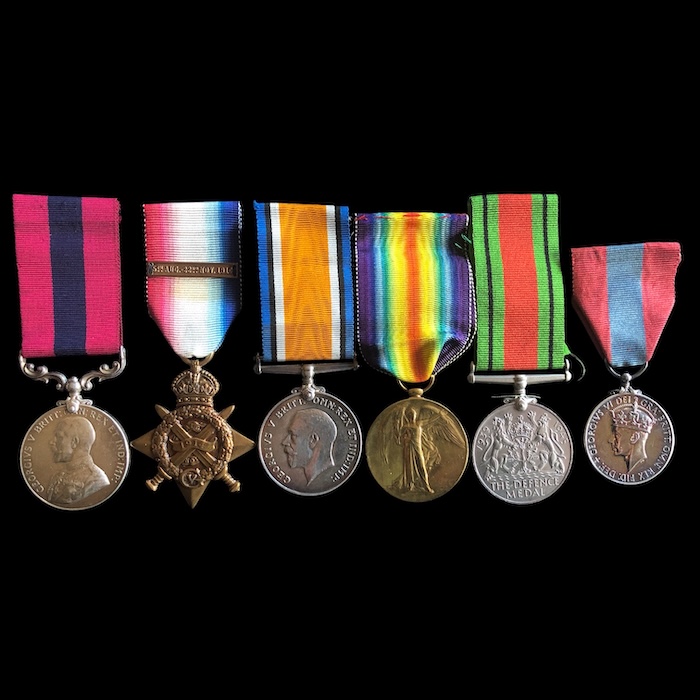
A Good D.C.M. Group, 2nd and 3rd battalions Worcester regiment – Battle of Messines.
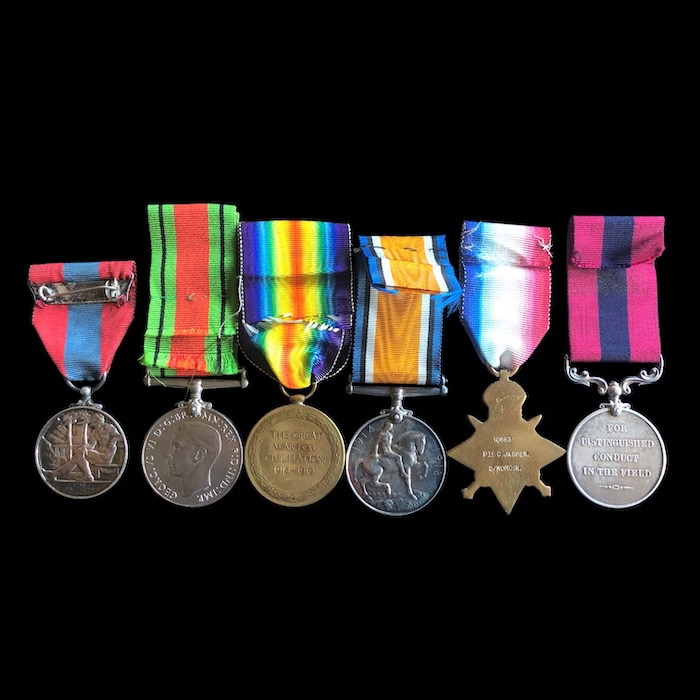
Distinguished Conduct Medal, G.V.R. (10863 Pte. C. Jasper. 3/Worc: R.); 1914 Star with tailor’s copy clasp ‘5th Aug.-22nd. Nov. 1914’ upon ribbon (10863 Pte. C. Jasper. 2/Worc: R.); British War and Victory Medals, 1914-1919 (10863 Pte. C. Jasper. Worc. R.), official correction to first digits of V.M.; Defence Medal, 1939-45, unnamed as issued; Imperial Service Medal, G.VI.R. (Charles Jasper D.C.M.);
D.C.M.: London Gazette: 16 August 1917 – ‘for conspicuous gallantry and devotion to duty. During an attack, when all officers and N.C.O.s in his vicinity had become casualties, he led his platoon and men of another unit with the greatest ability and courage against two enemy strong points, which he rushed, in the absence of the troops to whom this objective had been allotted. He took over 40 prisoners, and his initiative and grasp of the situation were of the greatest value and importance.’
Private Charles Jasper of Ipswich, Suffolk, was born on 15 January 1885, enlisted for service with the Worcestershire Regiment in 1907 and was still serving when hostilities for the Great War broke out. As a member of the 2nd Battalion he served through the retreat from Mons and the early battles of 1914 before returning to England in 1915. Rejoining for further service with the 3rd Battalion in France, he fought at Vimy Ridge, on the Somme — where he was wounded at Ovillers — and at Messines Ridge, where he performed the actions for which he was later awarded the D.C.M. Research shows that on 7 June 1917, during the Battle of Messines, Jasper, despite being a Private, and in the complete absence of any officers or N.C.O.s. (who had all been made casualties), rallied the men of his unit and another nearby, and stormed two important German machine gun blockhouses near Lumms Farm and Bell Farm, successfully taking both and capturing 40 prisoners in the process – as confirmed in the regimental history.
He was wounded a second time at Pilkem Ridge on 31 July 1917, and was later transferred to the Labour Corps for the remainder of the war (almost certainly owing to the severity of his wounds). After the war he lived in Ipswich, working for the G.P.O. (General Post Office) and later received the Imperial Service Medal, presumably for this service.
With a good quantity of detailed research, including copied maps, war diaries, and a professionally printed booklet.
Condition – the first heavily polished and pitted, good fine, the remainder about extremely fine
The 2nd Battalion, Worcestershire Regiment landed in France on 14 August 1914 as part of the 5th Infantry Brigade, 2nd Division of the original British Expeditionary Force (BEF). Deployed to stem the German advance, the battalion fought at the Battle of Mons (23–24 August) and endured the arduous 200-mile retreat toward Paris. Reaching the Marne, the unit counter-attacked in September, driving German forces back to the River Aisne, where early static trench lines began to form.
In October 1914, the battalion redeployed north to Flanders during the First Battle of Ypres. The unit etched its name into military history on 31 October 1914 at the Battle of Gheluvelt. German forces had smashed through the British 1st Division’s front line, capturing Gheluvelt Chateau and opening a path that threatened to sever the Allied lines and capture the Channel ports.
Major Edward Hankey led approximately 370 surviving men of the 2nd Worcesters in a desperate bayonet charge across 1,000 yards of open ground under direct artillery and rifle fire. Against heavy odds, they ejected the enemy from the chateau grounds, restored the defensive line, and saved the entire BEF from a disastrous retreat—an action later praised by Field Marshal Sir John French as having saved the Empire.
By November, weeks of relentless shelling in the Ypres Salient had severely decimated the battalion’s pre-war regulars. In December 1914, the unit transferred to the Givenchy sector, taking up winter trench defense under flooded, freezing conditions. The battalion’s operational record throughout 1914 remains one of the most celebrated of the entire war.
Throughout 1915, the 3rd Battalion, Worcestershire Regiment served on the Western Front as part of the 7th Infantry Brigade in the 3rd Division, enduring relentless trench warfare near Second Ypres, Sanctuary Wood, and Hooge. They participated in grueling defensive engagements and localized counter-attacks across Flemish mud. On 19 October 1915, the battalion transferred to the 25th Division, forging a battle partnership that defined their remaining wartime service.
In 1916, the 3rd Worcesters were committed to the brutal Battle of the Somme. Beginning in July, the battalion engaged in heavy fighting around Ovillers-la-Boisselle, the Leipzig Salient, and Thiepval Ridge. In late August, they mounted a celebrated night assault to capture a heavily defended section of the Hindenburg Trench system near Leipzig Redoubt, maintaining their ground despite ferocious enemy artillery bombardments and counter-attacks.
In early 1917, the battalion participated in operations following up the German strategic retreat to the Hindenburg Line near St. Quentin. Later that summer, following their major assault at Messines, the battalion plunged into the grueling offensive at Third Ypres (Passchendaele), taking part in the assault on Pilckem Ridge, enduring relentless shellfire, gas attacks, and deep mud.
The final year of the war brought immense trial and eventual victory. During the German Spring Offensive of March 1918, the 3rd Worcesters fought desperately on the Somme and along the River Lys near Morbecque. Outnumbered and subjected to severe artillery bombardment, they conducted crucial rearguard actions—at one point holding the line alongside their comrades in the 4th Battalion—though sustaining severe casualties.
Rebuilt with drafts of young reinforcements, the battalion joined the Allied Hundred Days Offensive in August 1918. Advancing continuously through Picardy and French Flanders, the 3rd Worcesters broke through successive enemy defensive positions until the final Armistice on 11 November 1918 ended four years of distinguished service.
The Battle of Messines (June 1917)
During the Battle of Messines (7–14 June 1917), the 3rd Battalion, Worcestershire Regiment served in the 7th Infantry Brigade of the 25th Division. Assigned to attack enemy positions on Messines Ridge near Kruisstraat and Wytschaete, the battalion spent late May conducting extensive raids and preparations.
At 03:10 on 7 June 1917, nineteen massive underground mines were detonated beneath the German lines, shaking the earth violently. As the debris settled, the 3rd Worcesters surged over the parapet into no man’s land behind an intense creeping artillery barrage. Advancing through heavy machine-gun fire and cratered terrain, they captured their initial objective (the Red Line) before pressing forward to secure the Green Line on the crest of the ridge.
When officers and senior non-commissioned officers fell under heavy enemy fire, junior leaders stepped up—such as Sergeant J. W. Forrest, and Pte Jasper. Going into action with 18 officers and 618 other ranks, the 3rd Worcesters suffered 240 casualties on the opening day alone (including 10 officers). Despite severe ongoing shellfire, the battalion consolidated and held their hard-won positions on the ridge until relieved on 11 June, marking a decisive victory.


