Description
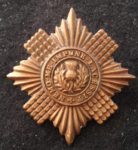
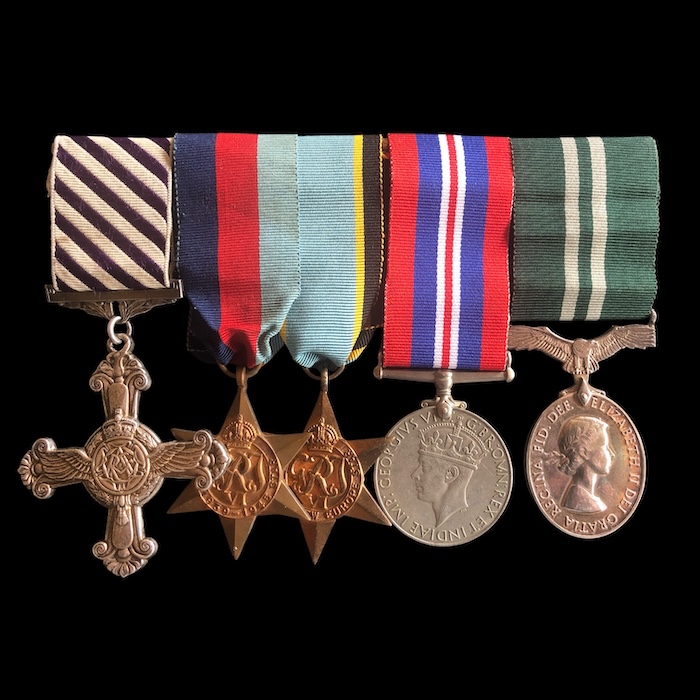
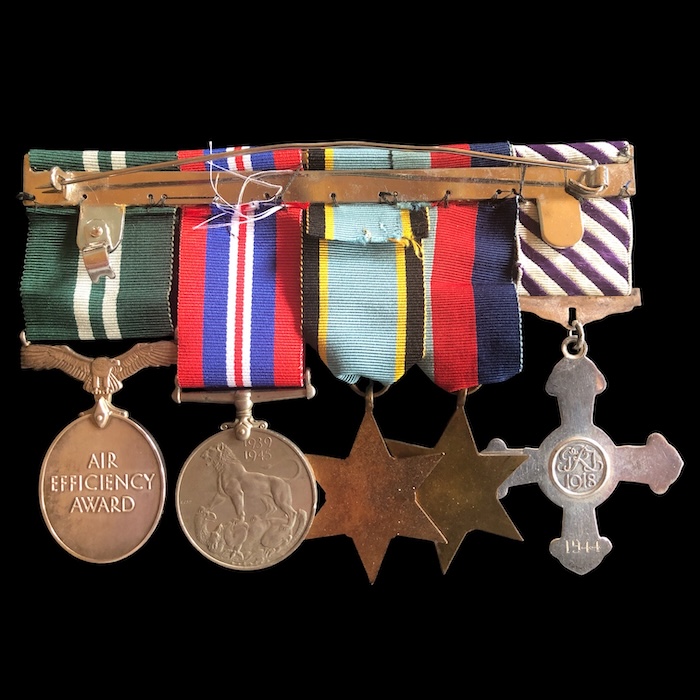
A Good Distinguished Flying Cross group – 158 Squadron Royal Air Force.
Distinguished Flying Cross, dated 1944; 1939-45 Star; Air Crew Europe Star; 1939-45 war Medal; Air Efficiency Award (E.II.R.), Flt. Lt. H. J. S. Harmer. R. Aux. A.F..;D.F.C. Royal Mint box of issue (Group Swing Mounted)
Harold James Stephen Harmer was born in Watford, Hertfordshire, around 1910,
He joined a firm os Stockbrokers in the City, but volunteered for aircrew shortly after war broke out.
He was commissioned as a Pilot Officer into the Royal Air Force Volunteer Reserve on 5 July 1942, He served during the Second World War. Posted to 466 Squadron at R.A.F. Leconfield, he was advanced Flying Officer on 5 January 1943, and injured shortly thereafter on 15 February 1943, whilst flying as Navigator in Wellington HE-153 whilst returning from a raid to Cologne, when it crashed near Warter Priory, Yorkshire, with the loss of one crew member.
Posted to 158 Squadron, at R.A.F. Lissett on 29 January 1944, Harmer was advanced Flight Lieutenant on 5 July 1944, before the award of the D.F.C. the following month.
D.F.C. London Gazette, 4 August 1944.
‘This officer has completed a large number of sorties, many of them against heavily defended targets. He is a Navigator of high merit whose coolness, determination and ability in difficult and dangerous situations have set an inspiring example. His record is worthy of high praise.’
After the War Harmer remained in the R.A.F.V.R. until relinquishing his commission on 24 January 1948 when he was commissioned into the Secretarial Branch of the Royal Auxiliary Air Force as a Flight Lieutenant, with seniority from 2 December 1947.
He served with 601 Auxiliary Squadron before finally relinquishing his commission on 24 January 1963.
He died in Honiton, Devon, on 3 October 1987. He is buried at Ottery, St Mary, East Devon.
With some extracts from squadron records but more available online.
466 Squadron :-
Formed under Article XV of the Empire Air Training Scheme, No. 466 Squadron RAAF operated within No. 4 Group of RAF Bomber Command, establishing its operational foundations between mid-1942 and early 1944. Beginning with administrative preparations in July 1942 prior to its official stand-up, the unit evolved from a Commonwealth medium-bomber outfit into a frontline heavy bomber squadron.
Preliminary organization under the Empire Air Training Scheme began in mid-1942, leading to the official formation of No. 466 Squadron on 15 October 1942 at RAF Driffield, Yorkshire. Manned by a mix of British, Australian, Canadian, and New Zealand personnel, the squad progressively transitioned toward a predominantly Australian crew profile over time. On 27 December 1942, the unit relocated to RAF Leconfield, equipped with twin-engine Vickers Wellington Mk III and Mk X medium bombers bearing the squadron code HD.
Wellington Missions and the Ruhr Campaign (January 1943 – August 1943)
No. 466 Squadron flew its inaugural combat mission on 13 January 1943, conducting high-risk naval mine-laying (“gardening”) along enemy-controlled North Sea coastlines. Soon after, it entered the main strategic bombing campaign over Western Europe:
Battle of the Ruhr: Participated in heavy nocturnal strikes against industrial targets in Essen, Cologne, Duisburg, and Dortmund.
Tactical & Maritime Support: Maintained routine mine-laying sorties to disrupt Axis sea transport while bombing rail infrastructure across occupied France.
Operational Toll: Sustained significant aircrew casualties while navigating concentrated Flak belts and German night-fighter interception zones over Germany and the Low Countries.
Conversion to Heavy Bombers and Berlin (September 1943 – January 1944)
In late August 1943, the squadron temporarily withdrew from active operations to transition from medium Wellingtons to four-engine Handley Page Halifax heavy bombers (initially Mk II, rapidly followed by Hercules-powered Mk III models).
Returning to combat on 1 December 1943, No. 466 Squadron launched deep-penetration night raids into Germany. Through December 1943 and January 1944, the squadron participated heavily in Bomber Command’s relentless “Battle of Berlin”. This operational phase culminated on the night of 28 January 1944, when the squadron dispatched its Halifaxes in a major multi-wave assault on the German capital, cementing its role as a core heavy bomber unit in No. 4 Group.
158 Squadron:-
On the night of 28/29 January 1944, No. 158 Squadron RAF launched from RAF Lissett in East Yorkshire to attack Berlin during the height of Bomber Command’s strategic offensive. This date marked a major operational transition for the unit as it entered the final, intensive phase of World War II
Throughout January 1944, 158 Squadron converted from the Halifax Mk II to the upgraded Handley Page Halifax B. Mk III. Equipped with Bristol Hercules radial engines, the Mk III offered superior reliability, speed, and ceiling performance. During this re-equipment window, the squadron’s ‘C’ Flight was detached to help form No. 640 Squadron at RAF Leconfield. Stationed at RAF Lissett—the easternmost bomber base in Yorkshire—158 Squadron remained a frontline heavy bomber unit within No. 4 Group, Bomber Command.
In March 1944, the squadron took delivery of Halifax Mk III serial number LV907 (coded NP-F), dubbed “Friday the 13th”. Painted with unlucky symbols to defy superstition, this bomber went on to complete 128 operational sorties before VE Day—one of the highest mission counts achieved by any heavy bomber in Bomber Command.
During the spring of 1944, 158 Squadron shifted focus from deep night raids into Germany to tactical interdiction strikes supporting Operation Overlord. Crews targeted French railway marshaling yards, ammunition dumps, coastal defense batteries, and V-1 flying bomb launching sites to isolate the Normandy region before Allied troops landed.
Following the Normandy landings, 158 Squadron resumed strategic operations against German industrial targets and synthetic oil plants, including major daylight and night raids on locations such as Gelsenkirchen.
Final Combat Operation: Flown on 25 April 1945 against fortified coastal artillery batteries on the North Sea island of Wangerooge.
Transfer to Transport Command: On 7 May 1945 (VE Day), 158 Squadron officially transferred out of Bomber Command into RAF Transport Command, re-equipping with Short Stirling Mk V aircraft to transport troops and freight.
During its operational operations at RAF Lissett, 158 Squadron flew 250 combat missions, losing 144 aircraft to enemy action and accidents, with 851 airmen killed in action.
Condition – NEF
NOTE: Sorry we cannot accept payment by PayPal for this item, We can accept payment by Credit / Debit Card, Bank Transfer or Cheque.