
Description
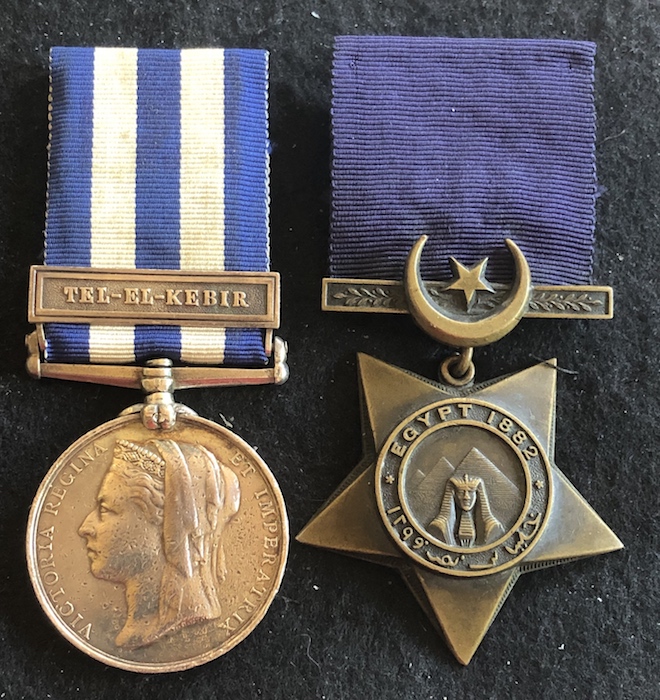
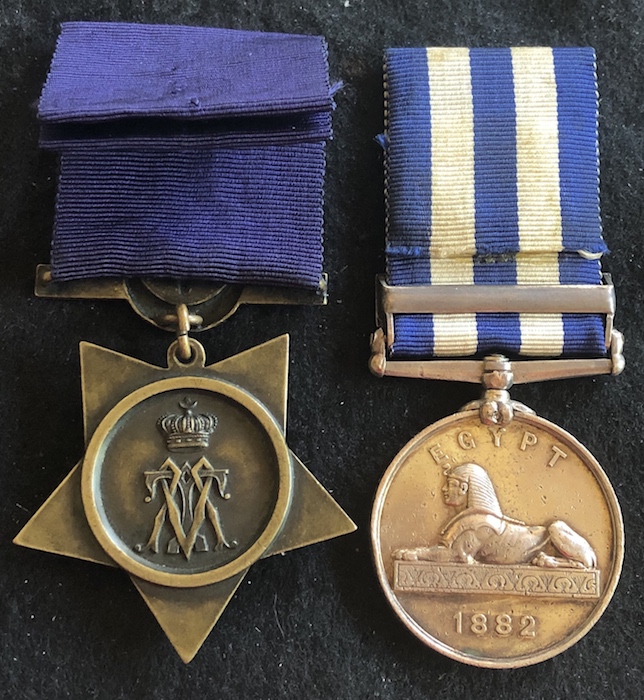
A Good Egypt pair to an Officer in the famous N/2 Royal Artillery (The Broken wheel battery), with WW1 service and C.M.G.
Colonel J. F. Craig, Royal Artillery Egypt and Sudan 1882-89, dated reverse, 1 clasp, Tel-El-Kebir (Lieut: J. F. Craig. N/2. Bde. R.A.); Khedive’s Star, dated 1882,
Provenance: Jack Webb Collection, Dix Noonan Webb, December 2008.
John Francis Craig was born on 28th July 1856, `gentleman Cadet 25th September 1874 and entered the Royal Artillery as a Lieutenant on 2 February 1876.
He was A.D.C. to the Governor of Mauritius from December 1880 to February 1881, and from April 1881 to February 1882.
He served in the Egyptian war of 1882, including the battle of Tel-El-Kebir (Medal and Clasp; Bronze Star).
Promoted to Captain in January 1885, he was Adjutant of the Clare Artillery Militia, from 1887 to 1894.
Major 30th September 1893.
Lieut Colonel 25th November 1902.
Colonel 25th November 1905.
He went on half-pay in the rank of Colonel in November 1907,
Retired Pay 23rd February 1910.
He served in the First World War, as a Colonel in the Royal Field Artillery, landing in France in August 1915, his MIC confirms entitlement to a 1914-15 trio, and a Silver War Badge.
Mentioned in Despatches, London Gazette 14th December 1917
Awarded 3rd class Companion of the Order of Saint Michael and Saint George, London Gazette 3rd June 1918 for Services Rendered in connection with Military Operations in France
By the time his medals were issued he is recorded as living in Weymouth.
Died in 1922.
“N” Battery, 2 Brigade, Royal Artillery, was later awarded the Honour Title “The Broken Wheel” for an incident during the battle of Tel-El-Kebir. It having been decided to attack at dawn after an approach march by night, the latter difficult operation was carried out by the two infantry and one cavalry divisions moving in line, in an echelon from the left with all the seven field batteries, also in line, in an interval between the two infantry divisions. The left-hand infantry division arrived first at the enemy’s entrenchments in the half light and was met by a blaze of fire. Their attack was not at first completely successful, but with the aid of their supports, they and the other division forced their way into the entrenchments where hand-to-hand fighting continued.
Meanwhile, the guns had been halted until there was enough light to see what was going on; but, as dawn broke, they were ordered forward to come into action inside the entrenchments in positions from which they could engage the defences in enfilade. N/2 galloped forward with the rest and, in the words of an officer of the battery, writing just after the battle: ‘All of a sudden the smoke lifted like a curtain and we found ourselves close to a long line of entrenchments… We at once went on and Major Branker found an angle in the line just in front where the ditch was not so deep, so the right gun galloped straight at it. It went with a bump into the ditch, and stuck fast on the face of the parapet, with most of the horses over; but a lot of 42nd [Highlanders] rushed to our help, and we lifted and shoved the gun over; but found one of the wheels smashed to pieces’. Although one of its guns had thus come to grief, N/2 brought its remaining guns into action inside the entrenchments and engaged the rearward parts of the defences with effective shrapnel fire in enfilade at 1,000 yards’ range.
The enemy, facing destructive fire from both their front and flank were soon broken up and with victory secured, N/2 gained their prized Honour Title.
Condition – NVF, pitting from star and normally found.


