Description
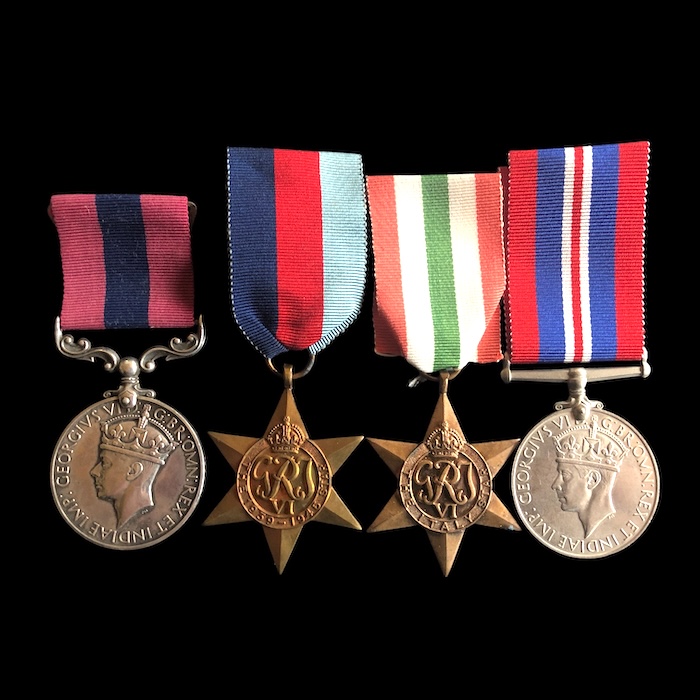
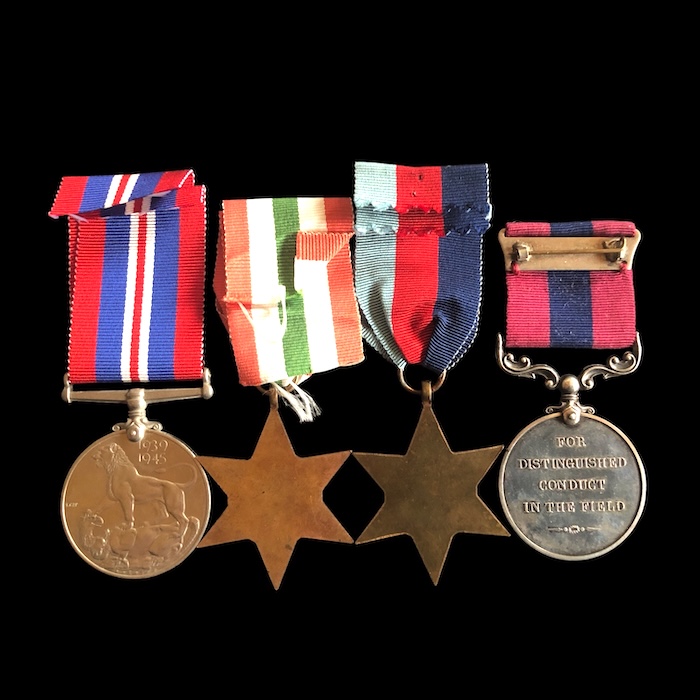
A Good Lake Camacchio Distinguished Conduct Medal group – The Buffs
Distinguished Conduct Medal (Geo VI), 6102411 A.Sjt T.W.D. Whitbread. The Buffs.for Lake Comacchio,
A.SgtT.W.D. Whitbread original enlistment register shows him joining the Royal West Kent Regiment (The Queens Regt)
He is then shown as transferred to the L.A.A. The RWK converted to LAA
The 14th Battalion, Queen’s Royal Regiment was initially raised as a war raised infantry battalion in 1940.
On 1 December 1941, [exact date for Whitbread] it was officially transferred to the Royal Artillery and redesignated as the 99th Light Anti-Aircraft Regiment, Royal Artillery.
WW2 Service: The 99th LAA served in the UK, deployed to Iraq in 1942, and subsequently moved to North Africa. They actively participated in the major Allied amphibious landings of the Italian Campaign, including Operation Husky (Sicily) and Operation Avalanche (Salerno), before being disbanded in late 1944 [hence Whitbread’s re-transfer].
He transfers to the Buffs on 16th December 1944.
Distinguished Conduct Medal, London Gazette 19th July 1945:
“Whitbread, Thomas William Donald, Sergeant (actg.) 6102411, Ist Bn The Buffs (Royal East Kent Reg) (London, NS) (Immediate)
On 13th April 1945, Ist Battalion The Buffs was part of a force landed on the south western beaches of Lake Comacchio, with the object of securing two vital bridges.
Sjt. Whitbread was in command of a platoon of ‘A’ Company which had been ordered to seize and hold the south bridge, which was more than a thousand yards inland.
On the original plan, Sjt. Whitbread’s Platoon was to have been in reserve, but during the approach march the L.V.T. containing one of the assaulting platoons broke down and orders had to be quickly changed before beaching. In spite of this, Sjt. Whitbread quickly organized his Platoon on the beach and lead the attack with such force, initiative and spirited determintion that the bridge was captured before the enemy could demolish it.
On the way to the objective, the Platoon passed through a previously unlocated mine field and suffered casualties, but such was this NCO’s leadership that no delay or unnecessary confusion was caused. He was joined by the second platoon of “A’ Company at the bridge, and over 30 enemy prisoners were taken. Except for wireless communications with Company HQ this bridge party was out off from all assistance until it was relieved during the night 14th/15th April by Coldstream Guards working up from the South East.
The bridge was continually attacked but on every occasion the Platoons repulsed the enemy and inflicted heavy casualties. The Officer in Command of the second platoon at the bridge was killed on the early moring of 14th April; Sjt. Whitbread now assuming command of the entire bridge force.
This NCO showed inspiring leadership and cool determination throughout the operation, and his holding of this bridge was a major factor in the success of future operations.”
In April 1945, during the final Allied offensive in Italy (Operation Grapeshot), the 1st Battalion, The Buffs (Royal East Kent Regiment) performed vital service at Lake Comacchio (often cited as Lake Camacho). Operating as part of the 56th (London) Infantry Division, the 1st Buffs were tasked with breaching the heavily defended, flooded marshlands of the Argenta Gap to help collapse German forces south of the River Po.
Lake Comacchio, a vast and shallow lagoon in northeastern Italy, presented a formidable natural barrier. The German High Command had fortified its surrounding dykes, canals, and flooded fields to block the British Eighth Army’s path. To bypass these static defenses, the Allies planned amphibious thrusts across the flooded mudflats—terrain impassable to conventional armor. Coincidentally, the amphibious tracked vehicles used to transport the battalion across the lagoon were LVT-4s, known as “Water Buffaloes”.
The Amphibious Assault (13 April 1945)
On the morning of April 13, 1945, the 1st Battalion, The Buffs—mustering 34 officers and 785 men—launched a major amphibious assault targeting the Fossa Marina canal. Their primary objective was to capture two crucial bridges: one on the edge of the flooded Lake Comacchio lagoon, six miles northwest of Menate, and a second bridge roughly 1,000 yards inland.
Embarkation: The battalion boarded 38 LVT Water Buffaloes to navigate the deep silt and submerged obstacles.
H-Hour Push: At 04:30 AM, supported by a heavy artillery barrage, the amphibious vehicles churned across the open water under heavy defensive fire.
German garrisons built into raised flood-banks engaged the landing craft with machine guns, mortars, and anti-tank weaponry.
Combats at Fossa Marina
The battle for the bridges was among the most grueling fought by the regiment in the Italian campaign. German forces held deep dugouts along the flood-banks and fiercely resisted the assault.
‘C’ Company’s Stand: Company ‘C’ led a key arm of the assault, taking heavy casualties and losing almost all of its stretcher-bearers and medical supplies. Despite being pinned down and isolated, the company held its ground.
By late afternoon, with medical kit completely exhausted, a German party approached ‘C’ Company under a Red Cross flag. The enemy offered to dress the wounded and evacuate critical casualties—an offer the Buffs accepted due to the total lack of medical supplies.
Air support from dive-bombers and reinforcement from follow-up companies eventually shattered enemy resistance, securing both bridges by evening.
The 1st Buffs’ capture of the Fossa Marina bridgehead unlocked the eastern flank of the Argenta Gap. This allowed British armored formations to pour through the gap, cross the remaining water barriers, and race toward the River Po, trapping major German forces and accelerating the final surrender of Axis troops in Italy.
Condition – NEF
First time on the open market.