



Description
A Good Military British Empire Group – Royal Navy with various Original documents.
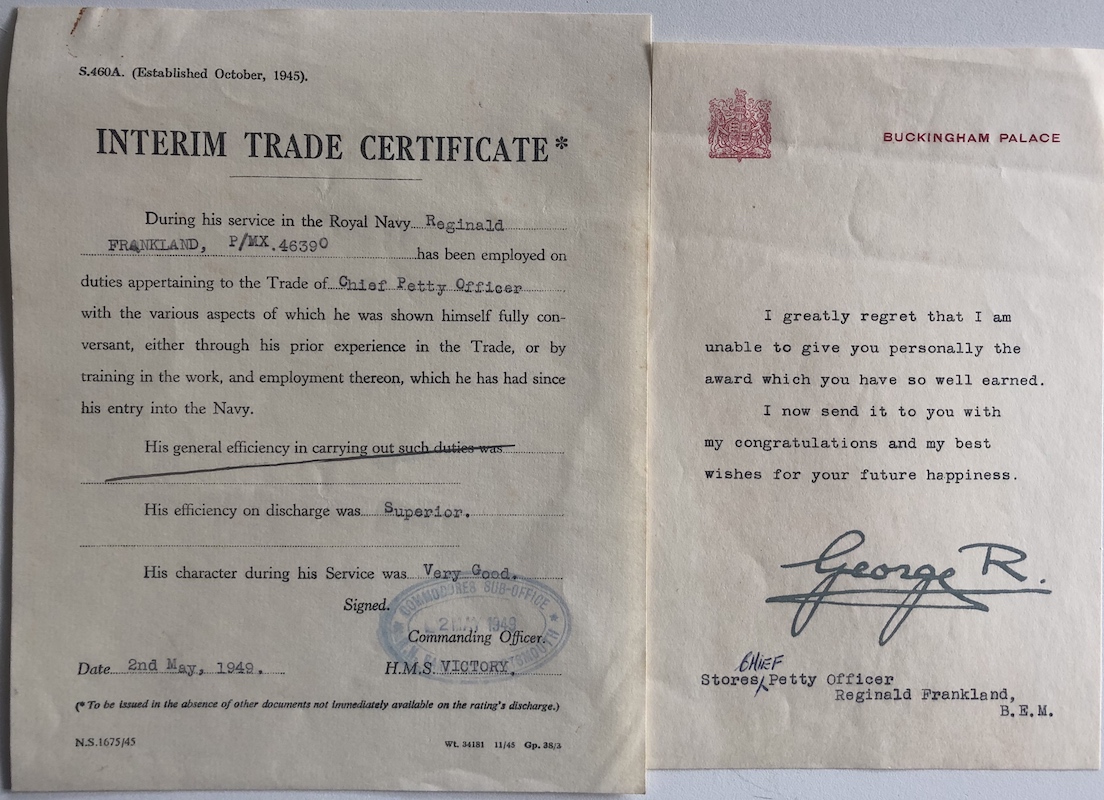
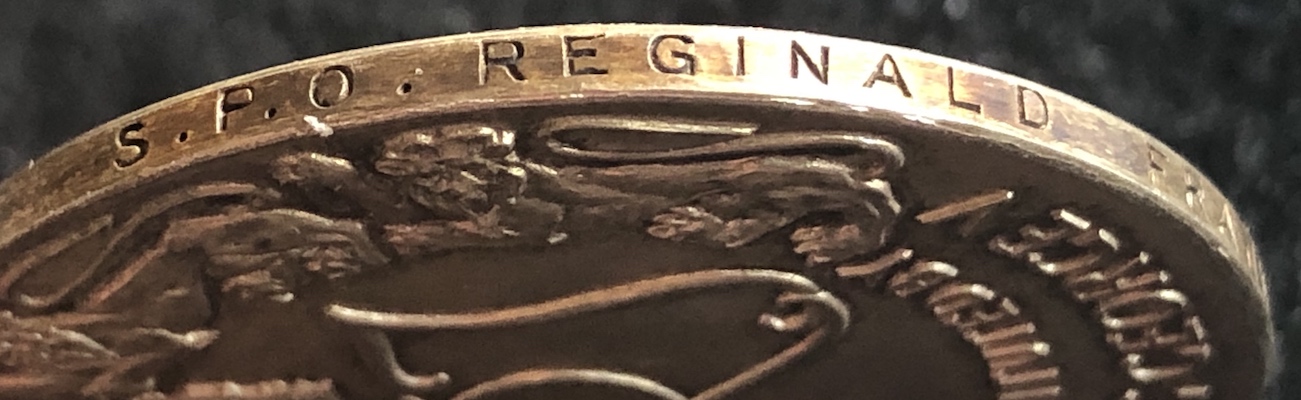
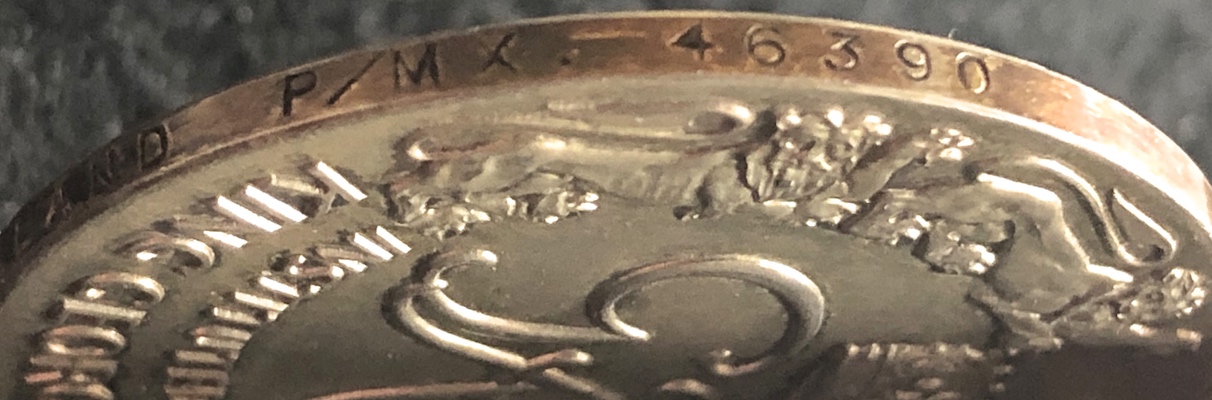
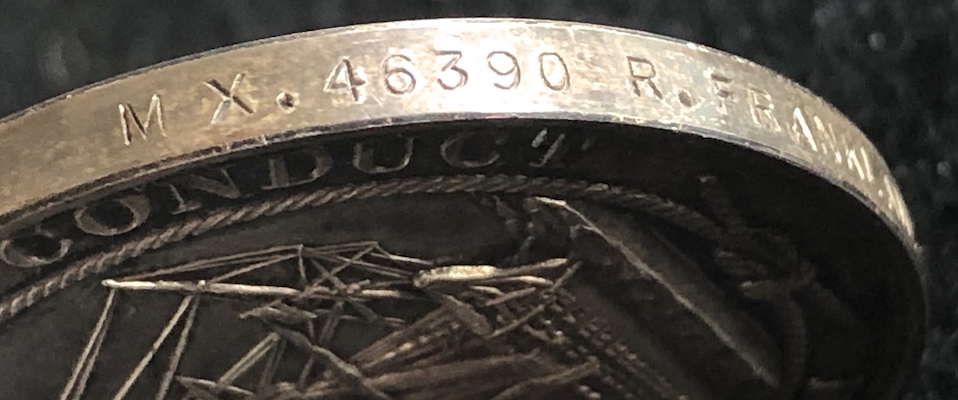
British Empire Medal (G.VI) Military Division (S.P.O. REGINALD FRANKLAND P/MX. 46390); 1939/45 star; Africa Star; 1939/45 Defence Medal; 1939/45 War Medal; Royal Navy Long Service & Good Conduct Medal (G.VI) (MX.46390 R. FRANKLAND S.C.P.O. H.M.S. VICTORY.).
British Empire Medal: London Gazette 13th June, 1946.
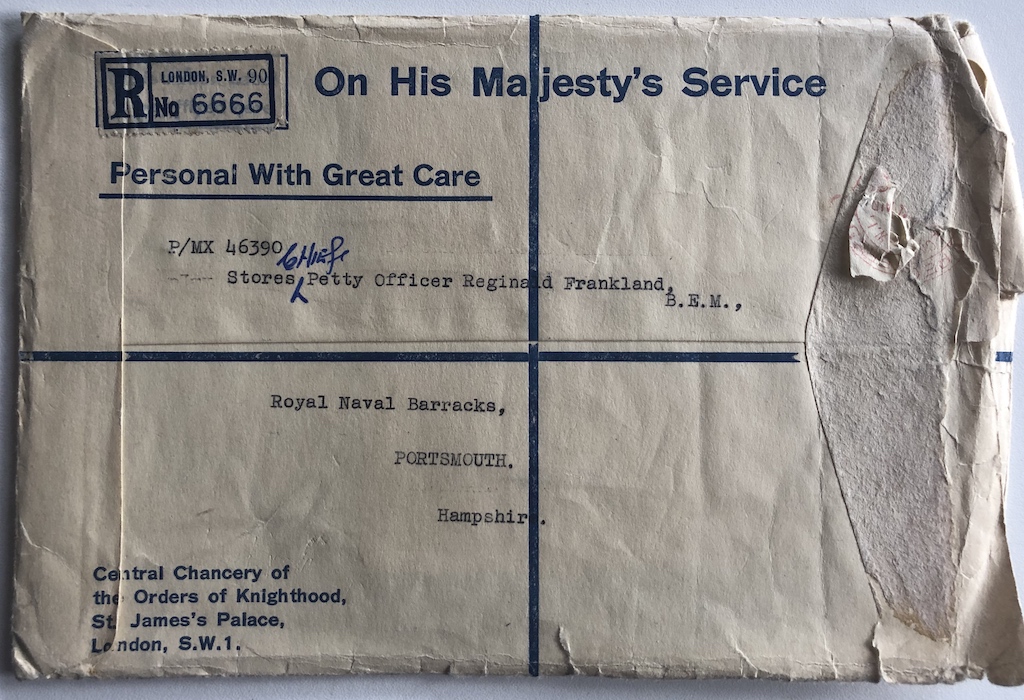
Stores Petty Officer Reginald Frankland, P/MX. 46390.
In London Gazette Supplement No. 37598 of 13th June,1946. The following correction is made:
For Stores Petty Officer Reginald FRANKLAND, P/MX 46390, Page 2798.
Read Chief Stores Petty Officer Reginald FRANKLAND, P/MX 46390.
Long Service & Good Conduct Medal: 22nd May, 1942 (H.M.S. Victory). 46390 R. Frankland S.C.P.O. H.M.S. Victory.
Reginald Frankland was born on the 23rd March, 1908 at Kingston, Portsmouth, Hampshire. The 1911 census shows he was the youngest of 7 children born to Harry and Beatrice Frankland of Portsmouth, Hampshire.
He entered the Royal Navy on the 7th June, 1927 for 12 years service with his stated occupation as Clerk.
Initially posted to H.M.S. Victory II, he joined H.M.S. Cairo on the 27th July, 1928.
HMS Cairo (D87) was a C-class light cruiser of the Royal Navy, named after the Egyptian capital, Cairo. So far she has been the only ship of the Royal Navy to bear the name. She was part of the Carlisle group of the C-class of cruisers.
H.M.S. Cairo was temporarily attachment to the China Station until 1927, when she joined the 8th Cruiser Squadron on the North America and West Indies Station. From 1928 to 1930, Cairo was in the Mediterranean as flagship for the Rear-Admiral. After a refit from 1931–1932, she was with the Home Fleet as Commodore. She was converted to an anti-aircraft cruiser in 1939.
On the 21st March, 1929 Frankland joined H.M.S. Ramillies and on the 29th June 1929 he joined the ‘stone frigate’ H.M.S. Calliope. On the 21st November 1929 he went to H.M.S. Victory II and then a further ‘stone frigate’ H.M.S. Excellent on Christmas Day (25th December 1929).
H.M.S. Revenge.
On the 2nd November, 1931 Frankland once again went to sea when he joined H.M.S. Revenge.
HMS Revenge was the lead ship of five Revenge-class super-dreadnought battleships built for the Royal Navy. The ship’s interwar career was uneventful.
On the 1st January, 1933 Frankland was stationed at Fort St. Angelo II (Delight), Malta until he returned to the UK on the 23rd August, 1934 when he once again joined H.M.S. Victory II (Delight). Further service in ‘stone frigates’ followed with HMS Victory II on the 24th October, 1934 and HMS Vernon (Amazon) on the 8th December, 1934. On the 2nd January, 1936 he was once more at H.M.S. Victory II and remained there until he joined H.M.S. Berwick on the 2nd December, 1938 for service at sea.
H.M.S. Berwick.
Stores Petty Officer A. Frankland joined H.M.S. Berwick on the 2nd December, 1938, and would serve at sea from that date until he returned to H.M.S. Victory II on the 15th March, 1942.
H.M.S. Berwick, pennant number 65, was a County-class heavy cruiser of the British Royal Navy. She underwent reconstruction between 1937 and 1938, where her single 4-inch guns were replaced with double mounts, numerous light machine guns were added, along with a significant addition of note; a cemented 4-inch (100 mm) thick and 6 feet (1.8 m) deep armoured belt was added to both sides of her hull beginning at the armoured deck down past her water line.
After these modifications, she completed her sea trials and then proceeded west, to serve on the North America and West Indies Station with the 8th Cruiser Squadron, arriving on 18 January 1939. Once there, she replaced HMS York as station flagship. When the Second World War started, she served on ocean convoy escort duties, then formed part of Force “F”, with York, when hunting groups were created to find German raiders. She did not make contact with any raider, but did intercept the mercantile blockade runners Wolfsburg and Uruguay in the Denmark Straits during March 1940.
On 9 April 1940 she participated in the Norwegian Campaign and on 10 May 1940 in the Invasion of Iceland. She was then allocated to Force “H” at Gibraltar arriving on 7 November. On 27 November, while taking part of Operation Collar, Berwick was hit by a single 203 mm (8 in) shell from an Italian heavy cruiser, either Pola or Fiume, which knocked out her “Y” turret and killed seven men. A second round that struck her some minutes later and destroyed the aft electric switchboard, leaving the cruiser’s aft section without power. Some sources credit the second hit to an Italian Trento-class cruiser, either lead ship Trento or her sister-ship Trieste, the only Italian Royal Navy heavy cruisers within range at the time of the strikes.
On 25 December 1940, Berwick engaged the German heavy cruiser Admiral Hipper off the Canaries when she formed part of the escort to convoy WS-5A, a troop convoy to the Middle East. Despite being thoroughly ready for combat, Berwick got the worst of the encounter. She scored no hits on Admiral Hipper, and sustained a fair amount of damage, being hit by several 8-inch (which for the most part passed right through the ship) and 4.1-inch shells. The action did however, drive off Admiral Hipper, and saved the convoy from any losses. Four of her complement were killed and she had to return to Britain for repairs, which lasted until June 1941.
When repaired Berwick joined the Home Fleet and for the remainder of her wartime career she was escorting convoys to North Russia and operating in the northern North Sea.
The Battle of Cape Spartivento:
The Battle of Cape Spartivento, known as the Battle of Cape Teulada in Italy, was a naval battle during the Battle of the Mediterranean in the Second World War, fought between naval forces of the Royal Navy and the Italian Regia Marina on 27 November 1940.
The following is an extract from the Malta War Diary:
27 November 1940: Malta Convoy Attacked off Cape Spartivento.
BRITISH AND ITALIAN FLEETS LOCK IN BATTLE.
Malta’s latest convoy was involved in a fierce sea battle in the Mediterranean today. Just before 10 o’clock this morning, the convoy was off Cape Spartivento in Southern Sardinia. Admiral Somerville, commander of Force H sent to protect the convoy from the north, received a report from air reconnaissance that a significant force of the Italian fleet was in the vicinity. Shortly afterwards he heard that additional ships of the Mediterranean Fleet had arrived from Alexandria, meaning that he was well equipped to match the Italian threat.
Somerville immediately ordered his forces into two groups to form a protective shield over the convoy and repel attacks. Swordfish aircraft were prepared for take-off from H.M.S. Ark Royal. At 12.22 hours the two opposing forces came within range and the Italian cruiser Fiume opened fire, which was quickly returned. The British naval ships were initially outgunned; H.M.S. Berwick was hit by two shells which killed seven men and wounded nine others. The British vessels rallied and the Italian destroyer Lanciere was badly damaged by a broadside from H.M.S. Manchester. The Italians again showed superior fire power before withdrawing from the engagement after just 54 minutes of battle. Admiral Somerville’s forces set off in pursuit but as they approached Italian shores they were forced to turn back. The convoy was able to continue its safe passage to Malta.
On the 1st September, 1943, whilst still at H.M.S. Victory II, Frankland was appointed Stores Petty Officer.
For the remainder of the war C.P.O. Reginald Frankland served in various ‘stone frigates,’ Royal Navy Air Stations and Royal Navy Mobile Operating Air Bases in the UK, Australia and Ceylon as follows: –
15th March, 1924 H.M.S. Victory II
29th August, 1942 H.M.S. Cockrane I
18th July, 1944 H.M.S. Victory II
Royal Naval Air Stations and Royal Navy Mobile Operating Naval Air Bases (MONAB).
2nd September, 1944 Stores Petty Officer A. Frankland was appointed to H.M.S. Fly Catcher, Royal Naval Air Station, Norfolk, England.
H.M.S. Fly Catcher was the H.Q. Mobile Naval Airfields Organisation, M.O.N.A.B. Assembly Station and accommodation for 2 M.O.N.A.B.s.
By mid-November the unit was ready for despatch overseas; all of the mobile units planned had been allocated to the support of the new British Pacific Fleet which was to begin operations in the South Western Pacific in early 1945. Australia was to be the rear echelon area for the fleet and a number of the MONABs were to be installed there.
The stores, equipment and vehicles of MONAB I were transported by road to Victoria dock, Birkenhead for sea passage to Sydney, Australia on board the S.S. SUFFOLK, sailing on or around November 20th. The personnel and last-minute additions sailed from Gladstone dock, Liverpool onboard the S.S. EMPRESS OF SCOTLAND on November 20th. The passage, via the Panama Canal and across the Pacific, took a month, the personnel arrived in Sydney onboard the S.S. EMPRESS OF SCOTLAND on December 20th 1944, the main body disembarking to Warwick Farm, a part of HMS Golden Hind, the RN barracks in Sydney, whilst an advance party went directly to the unit’s operational base at Royal Australian Air Force Station Nowra, New South Wales, arriving there on the 22nd. The S.S. SUFFOLK arrived at Sydney on Christmas Eve 1944. Work began immediately on unloading the stores and equipment for transport to Nowra, this being done by No. l Transportation & Movements Office, of the Royal Australian Air Force (RAAF).
On the 20th November, 1944 Stores Petty Officer A. Frankland sailed as part of the MONAB I contingent to New South Wales, Australia. He formed part of the the advance party and went directly to the unit’s operational base at Royal Australian Air Force Station Nowra, New South Wales, arriving there on the 22nd December. 1944.
His service record shows he was posted for duty with Royal Navy Mobile Operating Naval Air Base H.M.S. Nabbington, Nowra, New South Wales, Australia. (MONAB I) from the the 28th October, 1944.
On the 7th November, 1945 he was posted for duty with Royal Navy Mobile Operating Naval Air Base H.M.S. Nabswick, Jervis Bay, Australia. (MONAB V).
MONAB V was commissioned RNAS Nowra as HMS NABSWICK on November 15th 1945. HMS NABBINGTON paid off on the same day.
H.M.S. Nabbington, (MONAB I) and H.M.S. Nabswick (MONAB V), were both Royal Navy Mobile Operating Naval Air Bases.
18th March 1946 he was appointed to H.M.S. Golden Hind (Australia).
H.M.S. Golden Hind was commissioned on the 20th November, 1944 as an Royal Navy Accounting Base and headquarters at the former American army camp at Hargrave Park, Liverpool, Sydney, New South Wales. The Headquarters camp comprised of wooden huts, with additional accommodation being completed in the early part of 1945. A Barracks & Drafting Pool was established on the opposite side of the railway line, at the nearby Warwick Farm racecourse; this was a huge tented camp which occupied the centre of the racecourse. Here the naval personnel arriving from the UK were accommodated while awaiting passage to join the BPF at Manus or elsewhere.
H.M.S. Golden Hind was also the headquarters of the Flag Officer Naval Air Stations (Australia) (F.O.N.A.S. Australia), Rear-Admiral R. H. Portal, DSC, who had responsibility for all Fillet Arm related matters including the drafting of large numbers of Fleet Air Arm personnel that were to pass through the Barracks on route to Air Stations in Australia and for the fleet carriers and support vessels.
His service with the Royal Navy’s Mobile Operating Naval Air Bases was clearly appreciated and considered to be “meritorious” as he was recommended for, and awarded, the British Empire Medal for his services with them.
British Empire Medal.
London Gazette, dated 13th June, 1946.
Chief Stores Petty Officer Reginald Franklin, P/MX. 46390.
On the 19th June, 1946 Stores Chief Petty Officer Reginald Frankland B.E.M. was appointed to H.M.S. Gould, Ceylon commanded by Commodore B.L. Moore who hoisted his broad pendant in H.M.S. Gould at Colombo as COMBRAX, British Pacific Fleet.
His record of service states: – H.M.S. Gould “Patent Account”.
Note: COMBRAX meaning Commodore Naval Barracks, the senior officer of a ports main naval barracks which has a large number of men.
The move to Colombo, Ceylon was a component part of the exercise to reduce the size of the Royal Navy’s Pacific Fleet, necessary with the ending of hostilities.
ADMIRALTY WAR DIARIES of WORLD WAR 2 (from Naval History web site).
BRITISH PACIFIC FLEET – December 1945 to June 1946
Move of Drafting Pool to Ceylon.
10. Towards the end of 1945 the Admiralty had indicated that it desired that the British Pacific Fleet Drafting Pool should be moved from Sydney to Ceylon.
15. Early May, Commodore B.L. Moore hoisted his broad pendant in H.M.S. GOULD at Colombo as COMBRAX, British Pacific Fleet. Drafting has again been resumed and although it is early to comment, there does not appear to have been any dislocation in the Age and Service Group reliefs during the period of the move.
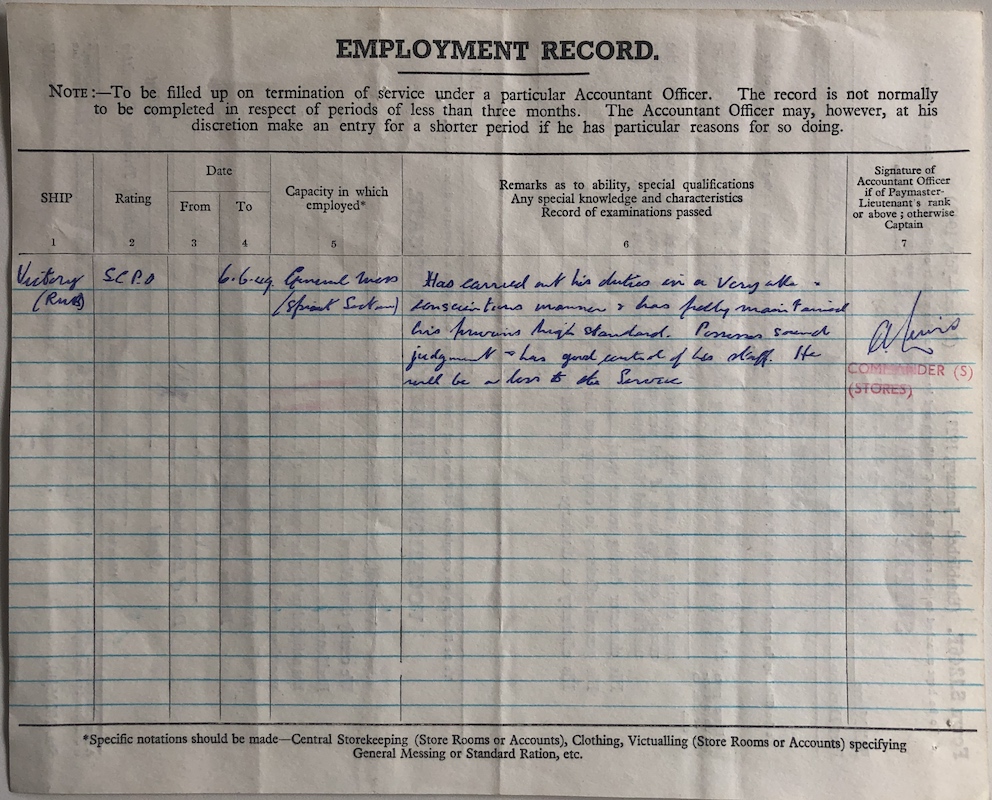
On the 4th July, 1946 he was back in the UK at H.M.S. Cockrane, H.M.S. Victory 1st October, 1947 and retiring from the Royal Navy on the 6th June, 1949 from H.M.S. Victory.
H.M.S. Berwick’s movements & operations for Stores Petty Officer Arthur Frankland.
KENT-Class cruiser ordered on 26th June 1924 from Fairfield at Govan. The ship was laid down on 15th September 1924 and was first of Class. Launched on 30th March 1926 she commissioned for trials on 15th July 1927. Build was completed on 15th February 1928 and she had commissioned for service on 5th of that month. Her first five years of service were on the China Station and at a refit between these two commissions a catapult and crane for launch of one aircraft was fitted. In 1937 this cruiser underwent an extensive reconstruction during which twin 4in AA mountings replaced the four single mountings and a hangar was provided with two cranes for handing two aircraft. On completion in 1939 she re-commissioned for service in the West Indies. HMS BERWICK had an association with the civil community of Berwick-on-Tweed which has continued with the ROTHESAY Class frigate which entered service in 1961.
Stores Petty Officer Arthur Frankland joined H.M.S. Berwick on the 2nd December, 1938, and would serve with her at from that date until he returned to H.M.S. Victory II on the 15th March, 1942.
During his service with H.M.S. Berwick she gained the Battle Honours ATLANTIC 1939 – NORWAY 1940 – SPARTIVENTO 1940.
1939 September.
Flagship of 8th Cruiser Squadron based at Bermuda with HM Cruisers YORK, ORION
and PERTH (RAN).
3rd – Deployed for interception of blockade runners and defence of Atlantic convoys. Took passage to Halifax.
15th – Sailed from Halifax with HM Cruiser YORK to join Convoys HX1 and HXF1 as Ocean Escort.
Convoy HX1 (with H.M.S. Berwick – from 16/09/39 to 18/09/39).
Left Halifax on Sept. 16 – 1939 and arrived Liverpool on the 30th.
Arnold Hague’s “The Allied Convoy System” gives 15 ships in this convoy.
Convoy HXF1 (with H.M.S. Berwick – from Sept. 19 to Sept. 20).
Departed Halifax on Sept. 19 – 1939 and arrived Liverpool on the 29th.
Arnold Hague’s “The Allied Convoy System” agrees w/8 ships in this convoy.
17th – Joined convoys to replace Local Escort by HM Canadian Destroyers SAGUENAY and ST LAURENT.
20th – Detached from Ocean Escort and resumed patrol.
22nd – Took passage from Halifax for patrol.
1939 October.
3rd – Arrived at Halifax for repair.
4th – Sailed with HMS PERTH as escort for Convoy KJ3 during passage to Bermuda. Relieved by HM Cruiser EFFINGHAM and resumed patrol.
Convoy KJ3. – Sailed Oct. 3 & 4 -1939, arrived at rendezvous on Oct. 25
5th – Nominated for service in Hunting Group F with HMS YORK.
(Note: This Group was intended for interception of commerce raiders but did not form
because of requirement to cover Atlantic convoys against attack by German battleship DEUTSCHLAND.)
7th – Based at Bermuda and deployed for patrol and search for commerce raiders.
26th – Taken in hand for docking and repair at Bermuda.
1939 November.
Transferred to 1st Cruiser Squadron, Horns Fleet.
7th – Took passage from Bermuda to Portsmouth.
14th – Taken in hand for repair on arrival at Portsmouth.
1939 December.
9th – Took passage from Portsmouth to join Squadron at Scapa Flow.
12th – Deployed in North Western Approaches for trade defence.
25th – Returned to Clyde.
30th – Resumed patrol duties in North Western Approaches.
1940 January.
Atlantic deployment in continuation.
10th-Arrived at Rosyth.
19th – Returned to Scapa Flow to resume patrol duties.
21st – Passage from Scapa Flow for Northern Patrol duty.
1940 February.
29th – Returned to Greenock.
1940 March.
Resumed Northern Patrol duties.
2nd – Intercepted and boarded German freighter WOLFSBURG which was on fire. Sank mercantile by gunfire.
5th – Intercepted and boarded German freighter URUGUAY which also had been set afire by crew and had to be sunk by gunfire.
1940 April.
Recalled for support of planned landings in Norway (Operation R4).
(Note: This operation to land troops in Norwegian ports if Germany carried out an invasion after a minelaying off Norway to prevent passage of iron ore shipping (Operation WILFRED). Passage to Rosyth.
3rd – Embarked 1/4 Royal Lincolnshire Regiment at Rosyth for passage to Norway.
(Note: Troops were also embarked in HM Cruisers DEVONSHIRE, GLASGOW and YORK.)
8th – Disembarked troops after German invasion of Norway confirmed. Sailed from Rosyth with other cruisers. Joined off Kinnaird Head by French Cruiser Emil Bertin, destroyers TARTU and MAILLE BREZ as screen. Carried out sweep to North East as ordered by Admiralty with same ships.
(Note: Operation R4 was cancelled and replaced by the Operation RUPERT. For details see NARVIK by D. Macintyre, THE DOOMED EXPEDITION by J Adams, ENGAGE THE ENEMY MORE CLOSELY by C. Bamett and Naval Staff History (HMSO -2001).
Sailed to join Home Fleet ships on passage to Norwegian waters to cover allied landings.
9th – After joining HM Battleships RODNEY, VALIANT and WARSPITE, HM Aircraft Carrier
FURIOUS screened by Home Fleet destroyers, came under heavy and sustained German
air attacks during which HM Destroyer GURKHA was sunk.
11th
Deployed as escort for HMS FURIOUS during air attacks on Trondheim. On completion joined HM Cruisers DEVONSHIRE screened by HM Destroyers INGLEFIELD, ILEX, IMOGEN and ISIS to carry cut search of Trondheim Leads for German troopships.
14th – Carried cut search in Aandsfjord and Vaagsfjord with HMS INGLEFIELD.
15th – Rejoined Home Fleet ships off North Cape.
16th – Near missed during air attacks without significant damage.
18th – Detached with HMS DEVONSHIRE and HMS INGLEFIELD and took passage to Scapa Flow.
(Note: See above references for details of operations off Norway.)
23rd – Deployed as escort for HM Aircraft Carriers ARK ROYAL and FURIOUS with HM AA Cruiser CURLEW and HM Destroyers FEARLESS, FURY, HASTY, HEREWARD, HYPERION and JUNO during passage to the Norwegian coast for air operations (Operation DX).
(Note: This was the first RN joint aircraft carrier operation. See CARRIER GLORIOUS by J Winton.)
28th – Deployed as escort for HMS ARK ROYAL during rest period off Faeroes.
1940 May.
1st – Under air attacks off Norway with HMS ARK ROYAL, HMS GLORIOUS and HMS VALIANT.
3rd – Provided cover for HMS GLORIOUS during continuations of DX air operations’ in place of HMS ARK ROYAL.
4th – Took return passage to UK as escort for HMS ARK ROYAL.
8th – Joined HMS GLASGOW, HM Destroyers FEARLESS and FORTUNE in Clyde. Embarked advance party of Royal Marines for passage to Iceland (Operation FORK).
(Note: British occupation of Iceland was carried cut to prevent German landings following the fall of Denmark.)
10th – Landed Royal Marines at Reykjavik and searched fjords for enemy activity. Embarked German nationals for passage to UK for detention.
11th – Passage to Liverpool.
17th – Under repair at Cammell Laird shipyard, Birkenhead.
1940 June.
Under repair.
1940 July.
22nd – Repair work completion date.
1940 August
4th – Sustained damage in collision with mercantile and returned for docking.
1940 September.
Undocked and took passage to rejoin Squadron.
22nd – Arrived at Scapa Flow for Hone Fleet duties.
1940 October.
8th – Deployed for interception patrol in Atlantic. During patrol selected for service in Mediterranean and took passage to prepare for foreign service in Clyde.
30th – Took passage from Clyde with HM Battleship BARHAM, HMS GLASGOW, HM Destroyers GALLANT, GRIFFIN, GREYHOUND and ENCOUNTER to join Fleet in the Mediterranean. (Operation COAT)
(Note: Designated as Force F. HMS ARK ROYAL also took passage to rejoin Force H at Gibraltar.)
1940 November.
6th – Arrived at Gibraltar.
7th – Sailed with Force F to join ships of Force H for escort during passage to land stores and personnel in Malta.)
(Note: For details of naval operations in Mediterranean during 1940 to 1942 see THE BATTLE FOR THE MEDITERRANEAN by D Macintyre and Naval Staff History) (HMSO-2001)
9th – Convoy under air attack and submarine threat which failed to make contact.
10th – Disembarked troops and stores in Malta. Took passage to join Mediterranean Fleet ships.
11th – Deployed with HM Cruisers GLASGOW, GLOUCESTER and YORK. HM Destroyers HAVOCK, HERO, HEREWARD, JERVIS and JUNO to provide cover during air attacks from HM Aircraft Carrier ILLUSTRIOUS on Italian fleet at Taranto (Operation JUDGEMENT).
14th – On arrival at Alexandria with Mediterranean Fleet joined 3rd Cruiser Squadron.
15th – Embarked troops for passage to Piraeus with HM Cruisers YORK, GLASGOW and SYDNEY (RAN).
25th – Passage to Malta with HM Battleship RAMILLIES and HM Cruiser NEWCASTLE (Operation COLLAR – Joint operation with Force H and included the transfer of ships to Gibraltar covered by HM Battleships BARHAM, MALAYA, HM Aircraft Carrier EAGLE.
HM Cruisers MANCHESTER and SOUTHAMPTON were also on passage to reinforce the
Mediterranean Fleet and a mercantile convoy was on passage to Egypt).
27th – Met HM Battlecruiser RENOWN, HM Cruiser SHEFFIELD and HMS ARK ROYAL. Took part in surface action against Italian Fleet units (Battle of Spartivento). Hit by two 8in shells in return of fire and sustained damage to after turret.
Casualties: 7 Killed & 9 Wounded.
(Note: The only RN ship to be hit in this action. See above references and THE NAVAL WAR IN THE MEDITERRANEAN by J Greene and A. Massignani.) When Italian Fleet withdrew, joined ships of Force H with HMS RAMILLIES and HMS NEWCASTLE for passage to Gibraltar.
29th – Under repair at Gibraltar.
1940 December.
Nominated for service with Hunting Group K for interception of German commerce raiders.
(Note: This was subsequently cancelled.)
18th – On completion prepared for operational service.
21st – Took passage to join military convoy WS5A as relief for HM Cruiser NAIAD.
24th – Joined HM Cruisers DUNEDIN and BONAVENTURE in Ocean Escort for WS5A.
(Note: HMS FURIOUS and HMS ARGUS were with the convoy and were taking aircraft to
Takoradi for flight to join RAF in Middle East.)
25th – Convoy came under attack by German cruiser HIPPER at dawn and was scattered.
Engaged HIPPER and hit by 4 shells in return fire causing casualties.
“On 25 December 1940, Berwick engaged the German heavy cruiser Admiral Hipper off the Canaries when she formed part of the escort to convoy WS-5A, a troop convoy to the Middle East. Despite being thoroughly ready for combat, Berwick got the worst of the encounter. She scored no hits on Admiral Hipper, and sustained a fair amount of damage, being hit by several 8-inch (which for the most part passed right through the ship) and 4.1-inch shells. The action did however, drive off Admiral Hipper, and saved the convoy from any losses. Four of her complement were killed and she had to return to Britain for repairs, which lasted until June 1941.”
Casualties: 4 Killed.
(Note: After structure and gun mountings damaged with some flooding. Troopship SS EMPIRE TROOPER was also seriously damaged and was escorted to Ponta Delgado, Azores. Ships of convoy were later re-assembled by Force H from Gibraltar. Considerable confusion was caused and attempts by carriers to carry out air attacks were cancelled on Admiralty orders. See Naval Staff History.)
31st – Landed wounded at Gibraltar and taken in hand for temporary repair.
1941 January.
Under temporary repair.
5th – On completion took passage to Portsmouth for permanent repair.
11th – Casualty List for December engagement published.
1941 February to April.
Under repair by HM Dockyard, Portsmouth (Note: Type 286M modified RAF radar fitted to provide limited warning facility. Type 284 main armament fire-control radar fitted. Fit of aircraft warning radar is recorded but to be confirmed. New masts to allow later fitting of this equipment may have been provided. (For details of development and use of radar in RN see RADAR AT SEA by D Howse.) 20mm Oerlikon guns fitted to improve Close Range defence.
Nominated for service in 1st Cruiser Squadron, Home Fleet.
1941 May
Arrangements made for completion of refit work at Rosyth. Took passage to Rosyth.
1941 June
Completion of refit in continuation by HM Dockyard.
17th – Carried out post refit trials.
21st – Arrived at Scapa Flow for work-up.
1941 July to August.
On completion of work-up deployed with Squadron based at Rosyth.
(Note: Home Fleet units carried cut interception and convoy defence duties).
1941 September.
Under repair at Rosyth.
1941 October.
Repair in continuation.
15th – Rejoined Squadron at Scapa Flow for Home Fleet duties.
1941 November.
1st – Deployed as escort for HM Battleship DUKE OF YORK with HM Destroyers ESCAPADE,
TARTAR and PUNJABI for passage from Clyde to Scapa Flow on completion of build.
3rd – Deployed with HM Battleship KING GEORGE V, HM Aircraft Carrier VICTORIOUS, HM Cruisers KENT and SUFFOLK, screened by five Home Fleet destroyers.
(Note: These ships took passage to Iceland after report of possible break-cut into Atlantic by German battleships SCHEER and TIRPITZ.)
5th – Arrived in Iceland.
17th – Deployed with escort for Russian Convoy PQ4 with HM Destroyers OFFA and ONSLOW.
Convoy PQ 4 was the fifth of the Arctic Convoys of World War II by which the Western Allies supplied material aid to the Soviet Union in its fight with Nazi Germany. The Convoy sailed from Hvalfjord, Iceland on 17 November 1941 and arrived at Archangelsk on 28 November 1941.
(with H.M.S. Berwick from 25 Nov. – 27 Nov.).
(For details of an Russian Convoy operations see CONVOYS TO RUSSIA by R A Ruegg,
CONVOY! by P Kemp, THE RUSSIAN CONVOYS by B Schoefield and ARCTIC CONVOYS by R. Woodman.)
27th – At Murmansk after arrival of PQ4.
1941 December.
Independent return passage to UK with RAF personnel. Rejoined Squadron at Scapa Flow for Hone Fleet duties.
1942 January.
Passage to Iceland for patrol and interception duties with Home Fleet units.
17th – Sailed from Iceland with Home Fleet units to Tromso area after TIRPITZ break-cut reported and for air operations against coastal shipping. Search unsuccessful and returned to Iceland.
1942 February.
Deployed in Iceland for interception duties and took part in search for German cruiser PRINZ EUGEN and ADMIRAL SHEER reported en passage in North Sea to join TIRPITZ.
20th – Detached from Fleet units to join HM Aircraft Carrier VICTORIOUS. Joined HM Destroyers ASHANTI, BEDOUIN, ESKIMO, PUNJABI and ICARUS as escort for HMS VICTORIOUS during air strikes.
22nd – Operation cancelled after enemy ships reported anchored in Aasfjord.
23rd – Rejoined Home Fleet units.
1942 March.
Deployed with Squadron at Scapa Flow.
4th – Sailed with HMS KING GEORGE V, HMS VICTORIOUS, HM Destroyers ONSLOW ASHANTI, INTREPID, ICARUS, LOOKOUT and BEDOUIN to join HMS DUKE OF YORK,
HMS RENOWN, HM Cruiser KENYA, HM Destroyers FAULKNOR, ESKIMO, PUNJABI
ECHO and ECLIPSE to provide cover for passage of Russian convoy PQ12 and return Convoy QP8.
(with H.M.S. Berwick from 6 March – 10 March).
Convoy PQ12 sailed 4th March 1942, reaching Murmansk despite a sortie against it by the German battleship Tirpitz. All ships arrived safely.
Convoy QP8 departed Murmansk March 1-1942, split up March 9 – 5 ships arriving Hvalfjord March on 11.
6th – Detached to carry cut patrol south of PQ12 whilst TIRPITZ was at sea.
9th – Rejoined Home Fleet units during air operations against TIRPITZ near Lofotens.
(Note: See ENGAGE THE ENEMY MORE CLOSELY. These attacks failed and this was the only occasion when naval attacks were made whilst enemy ship was at sea.)
11th – Returned to Scapa Flow with Fleet units.
Left Ship for home service
April to May
Home Fleet deployment with Squadron for interception and patrol duties. Machinery problems required attention. Refit arranged at Devonport.


