


Description
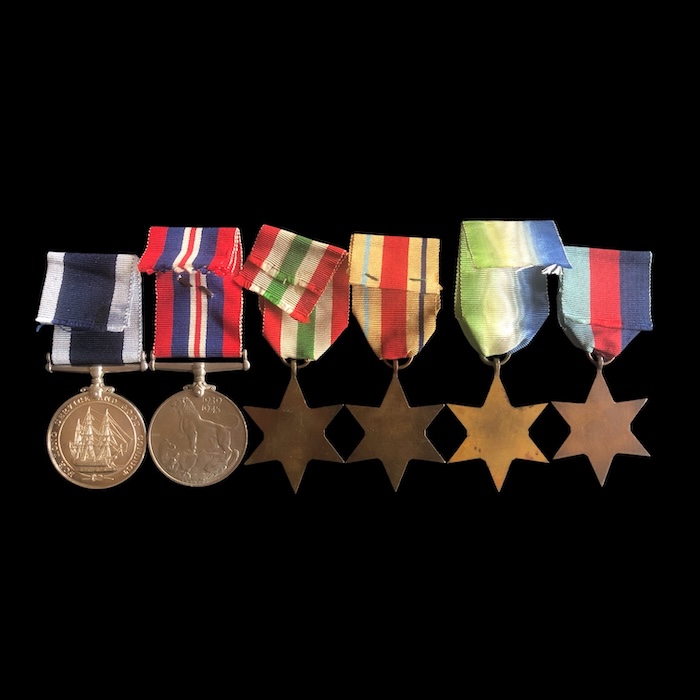
A Good Royal Navy group, Mentioned in Despatches for the amphibious landings at Termoli in October 1943.
1939-45 Star; Atlantic Star, clasp, France and Germany; Africa Star, 1 clasp, North Africa 1942-43; Italy Star; War Medal 1939-45, with M.I.D. oak leaf; Royal Navy L.S. & G.C., G.VI.R., 1st issue, J. 32559 R. G. Bettles. A.B., H.M.S. Ilex.
M.I.D. London Gazette 25 January 1944.
Reginald George Bettles was born at Walmer, Kent on 12 February 1899, the son of a Royal Marine, and entered the Royal Hospital School, Greenwich in August 1911. He subsequently joined the Royal Navy as a Boy 2nd Class in September 1914, when he used the alias ‘Hall’, but his service record was amended to his correct surname a few weeks later.
His subsequent seagoing appointments in the Great War comprised the battleships Illustrious (June-November 1915) and Vengeance (December 1915-March 1917), and the destroyer Zubian (June 1917-April 1919). Vengeance was present in operations off East Africa and at the capture of Dar-es-Salaam in 1916. And Zubian, as part of the famous Dover Patrol, sank the UC-50 in February 1918 and acted as an escort to the bombardment force for the first Ostend Raid.
Awarded his Long Service and Good Conduct Medal in January 1938, Bettles was serving in the Hunt-class minesweeper Fermoy on the renewal of hostilities, and he was likewise employed at the time of her loss in Malta. Damaged beyond repair by air attack on 30 April 1941, she was written off and scrapped.
Bettles subsequently attended an amphibious landing course at Inverary, Scotland, and served as a Leading Seaman in the 59th Landing Craft Assault Flotilla and was Mentioned in Despatches for his part in the capture of Termoli in October 1943. The original recommendation – which also records the fact that he had been put forward for similar approbation in the North Africa landings – cites his ‘calmness and devotion to duty while under fire from the enemy shore batteries and during bombing attacks while employed on Operation Devon.’
Condition – Generally VF, but some contact marks and edge bruising.


