



Description
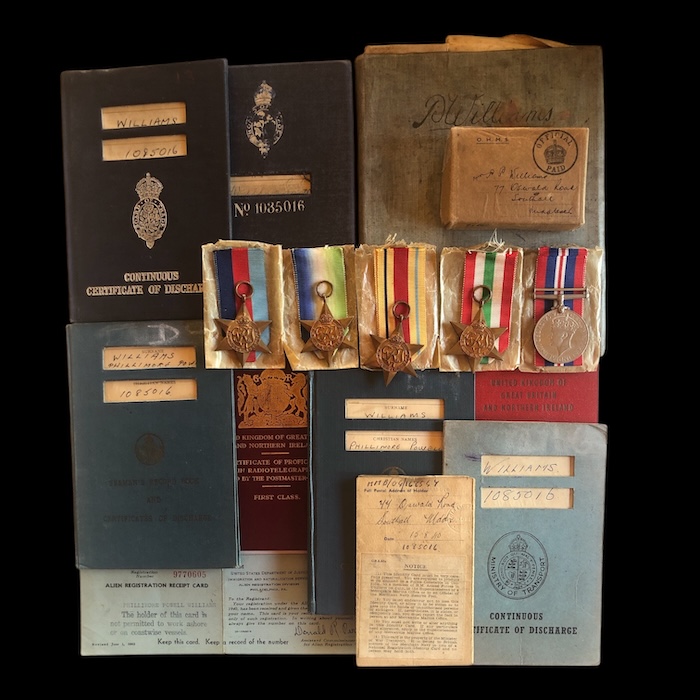
A Good WW2 Merchant Navy group. (Operation Torch 1942)
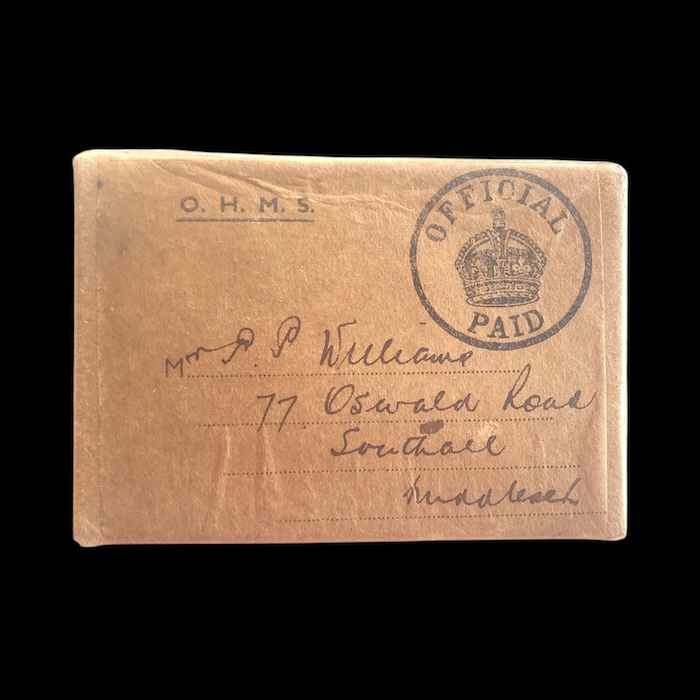
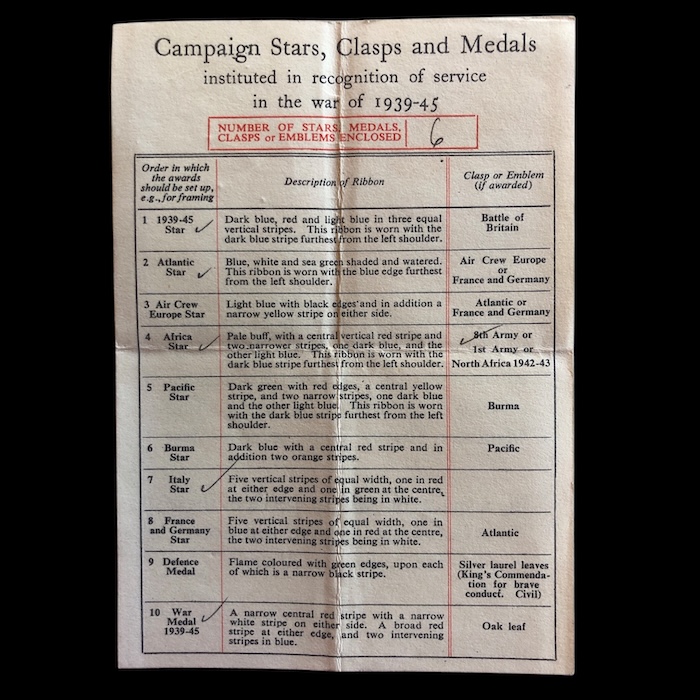
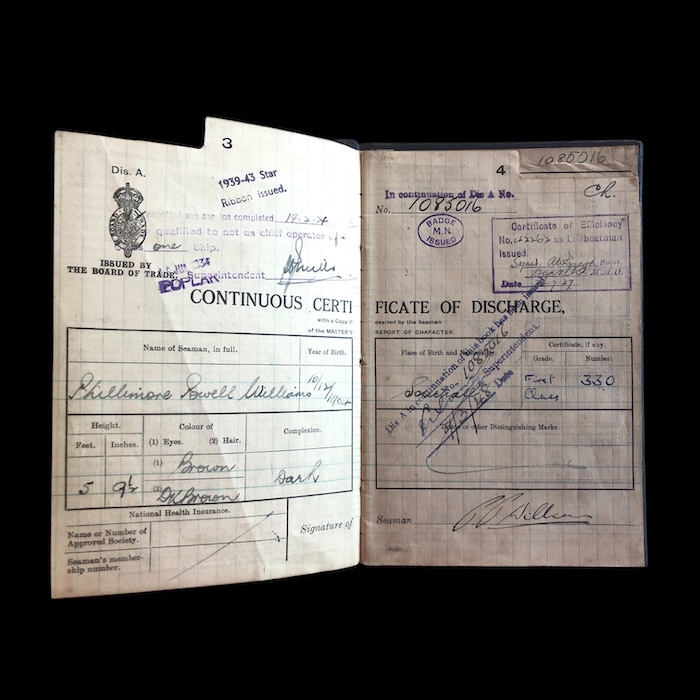
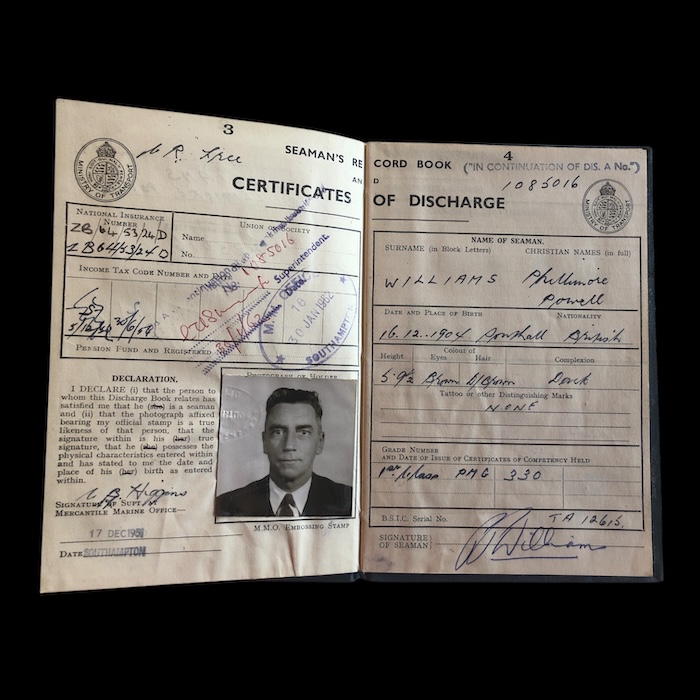
1939-45 Star; Atlantic Star; Africa Star; 1939-45 War Medal; Issue certificate and box of issue and the following original documents.
Phillimore Powell Williamswas born on the 16th December 1904 in Southall Middlesex.
Certificate of Radiotelegraphy 1st class 4th February 1930
Served on :-
Herefordshire January 1923 to August 1923
Kenilworth Castle August 1923 to April 1924.
Balmoral Castle May 1924 to December 1925.
Banbury Castle from December 1925 to July 1927.
SS Gaika from August 1927 to November 1927.
SS Garth Castle from November 1927 to September 1928.
Arundel Castle October 1928 to November 1928.
Saxon from November 1928 to January 1929.
Edinburgh Castle from January 1929 to October 1930
Llanstephan Castle from October 1930 to May 1931.
Grantully Castle from May 1931 to August 1931.
Gloucester Castle from September 1931 to December 1932.
Dunbar Castle from January 1933 to November 1938.
Balmoral Castle from December 1938 to January 1939.
Gloucester Castle from February 1939 to May 1939.
War Time service:
Arundel Castle May 1939 to June 1943
The RMS Arundel Castle entered May 1939 fresh from a major 1937 modernization that had completely reshaped her silhouette from four funnels to two. As the clouds of World War II gathered, the 19,023 GRT vessel was technically requisitioned by the British Admiralty at the outbreak of hostilities in September 1939. However, unlike many of her contemporaries that were instantly pulled for military conversion, Arundel Castle spent her first wartime phase maintaining her traditional commercial Liner and Mail Service between Southampton and Cape Town. Until December 1940, she served as a vital lifeline, safely transporting passengers, mail, and strategic cargo across increasingly hazardous Atlantic waters.
Her role shifted dramatically in January 1941 when she was fully taken up for Sea Transport Personnel services. Transformed into a heavily armed troopship, her civilian luxury was stripped to accommodate four-tier tubular bunks capable of carrying over 4,000 soldiers. For defense against Axis threats, she was outfitted with a 6-inch gun, Bofors, and Oerlikon anti-aircraft cannons.
From 1941 onward, Arundel Castle became an indispensable workhorse of the global Allied logistics network. She served as a pivotal transport in a massive Union-Castle convoy that carried South African troops up to Suez to reinforce the crucial Western Desert campaign. Her grueling itinerary saw her constantly shuttling between the Clyde, Freetown, Cape Town, and the Mediterranean.
Her most perilous deployment occurred in November 1942, when she participated in Operation Torch—the Allied invasion of North Africa. While supporting the landing fleets off Algiers, she narrowly survived a ferocious glider bomb attack, during which her defensive gun crews successfully shot down an attacking German Ju 88 bomber. Following this action, through June 1943, she ran intense, high-stakes trooping voyages between New York, Glasgow, and Algiers, successfully building up the massive troop concentrations necessary for the imminent liberation of Southern Europe.
Llandovery Castle from September 1943 to January 1944.
During World War II, the Union-Castle liner Llandovery Castle served as a dedicated Allied hospital ship, designated HMHS No. 39. Equipped with 450 beds and a complement of 89 medical staff, the vessel was the only Union-Castle ship to serve in this specialized medical capacity. From September 1943 to January 1944, its operational service bridged the high-intensity actions of the Italian campaign and a subsequent return to British home waters.
Following its deployment supporting the invasion of Sicily (Operation Husky) earlier that summer, the Llandovery Castle shifted its focus to the Allied invasion of mainland Italy, beginning with the Salerno landings (Operation Avalanche) in September 1943. Amidst heavy combat, the ship operated as a frontline floating hospital, braving the contested waters of the Mediterranean to evacuate wounded soldiers directly from the beachheads. It maintained a demanding shuttle routine, transporting casualties from the Italian front back to established base hospitals along the North African coast, including Tripoli and Alexandria. During these hazardous runs, the ship served as a critical node in the Allied medical logistics network, routinely stocking fresh blood supplies from Alexandria to sustain advanced surgical procedures while in transit.
By late autumn, after months of continuous evacuation duties in the Mediterranean, the Llandovery Castle sailed back to the United Kingdom for essential maintenance, refitting, and crew rotations. In December 1943, the ship arrived in British ports near Avonmouth and the Solent, where a planned turnaround took place, allowing long-serving crew members to sign off and new personnel to integrate. Throughout January 1944, the vessel remained in home waters to finalize repairs and provision for its next deployment. By the end of the month, the ship was prepared for its February orders to return to the Mediterranean via Gibraltar.
Carnarvon Castle from January 1944 to April 1946.
Following her decommissioning as an Armed Merchant Cruiser in December 1943, the 20,122 GRT Carnarvon Castle spent the period from January 1944 to April 1946 operating as a critical Allied troopship. Stripped of her heavy naval guns but remaining vital to global logistics, the Union-Castle motor liner spent these twenty-eight months navigating grueling, high-stakes transoceanic trooping runs under the command of civilian masters, Captain R. Wren and later Captain M. H. Williams.
The ship hit the ground running in January 1944, embarking from Liverpool on a massive voyage through the Mediterranean and the Suez Canal, arriving in Bombay by the end of the month to reinforce the Far East theater. By March, she was back in the Mediterranean, supporting Allied operations by shuttling troops and casualties between Algiers, Gibraltar, and the United Kingdom. Throughout the remainder of 1944, Carnarvon Castle became a frequent fixture on the strategic route linking Glasgow and Southampton to Italy (Taranto and Naples), Egypt (Port Said), East Africa (Kilindini), and South Africa (Durban and Cape Town).
As World War II entered its final phases in 1945 and shifted into the immediate postwar period, the vessel’s primary mission evolved from combat reinforcement to massive repatriation efforts. She became a lifeline for thousands of liberated prisoners of war, displaced persons, and demobilizing servicemen, constantly crossing the Atlantic and Indian Oceans.
By early 1946, her intensive wartime pace showed no signs of slowing. In January 1946, she arrived back in Southampton from Cape Town for urgent engine repairs before immediately turning around to run subsequent voyages to Freetown and South Africa. By April 1946, Carnarvon Castle arrived back in Southampton for extensive voyage and generator repairs. She remained bound
Arundel Castle from June 1946 to February 1948.
Arumdel Castle Feb 1948 to August 1948
Stirling Castle May 1948 to October 1951.
Capetown Castle from January 1952 to December 1954
Pretoria Castle from December 1954 to April 1957.
Capetown Castle from May 1957 to July 1957
Pretoria Castle from August 1957 to August 1958.
Pendennis Castle from November 1958 to November 1961.
Pendennis Castle December 1961 to November 1967.
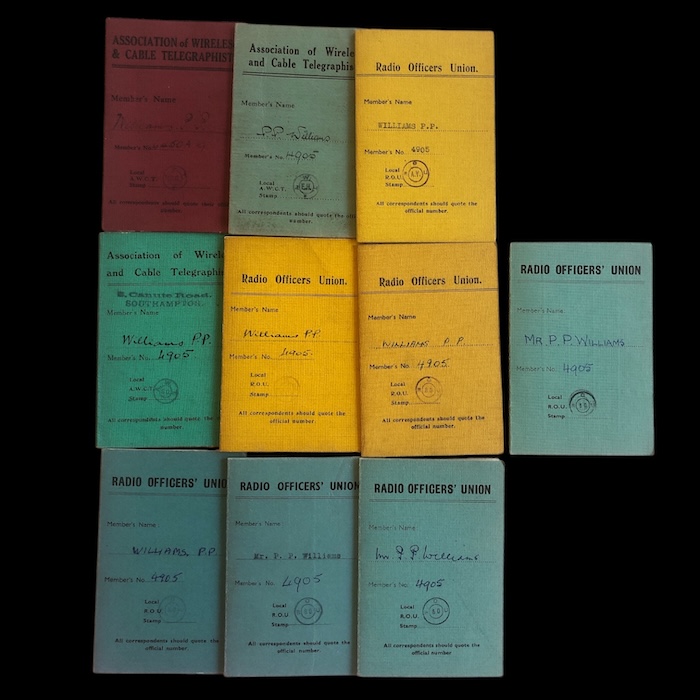
British Seaman’s Identity card; British Seaman card; Continuous Certificate of Discharge (5no); Radio Officers UnionCards (10 no); Hand written notes taken at London Radio college Brentford; US Department of justice Immigration card; Other related ephemera.
Condition – NEF
Note to avoid postage costs we are happy to bring a book to a Medal fair, we regularly attend Mark Carters fairs, Britannia and the OMRS


