
Description
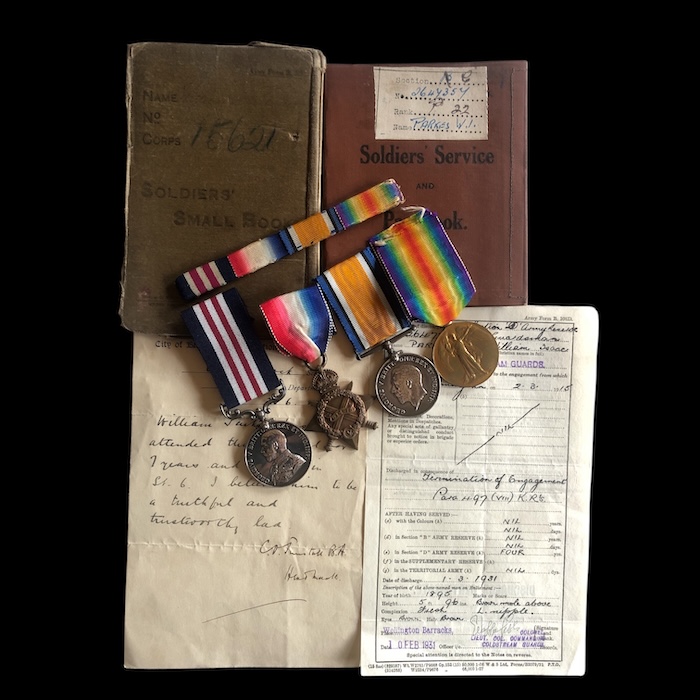
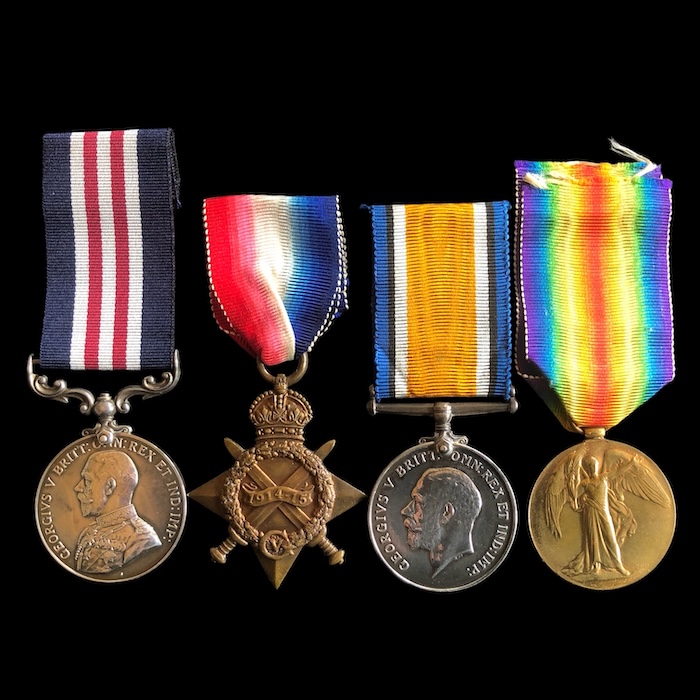
A Good Ypres Military Medal group – Coldstream Guards, with a good amount of original documents, and some details on circumstances of award.
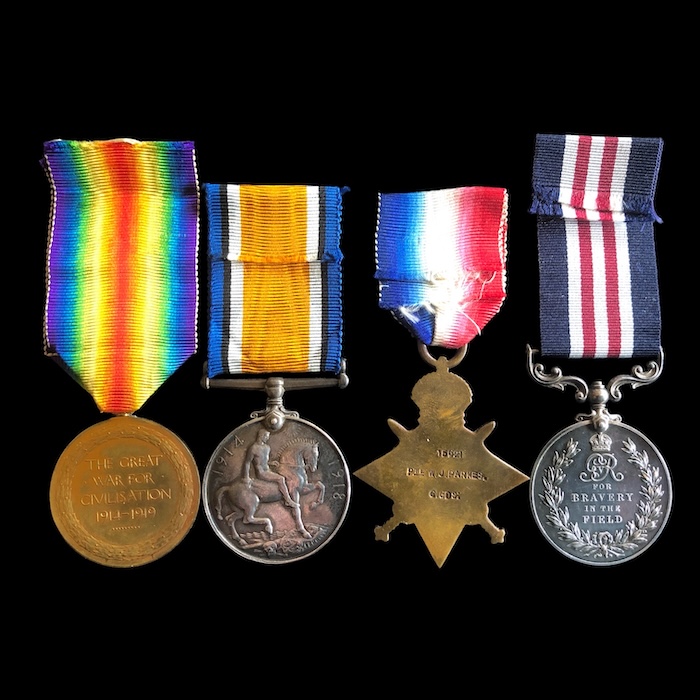
Military Medal (Geo V) 15621 Pte W.I. Parkes 4/C.Gds.; 1914-15 Star, 15621 Pte W.J. Parkes, C. Gds[sic]; British War and Victory Medals, 15621 Pte W.I.. Parkes. C. Gds.; ribbon bar.
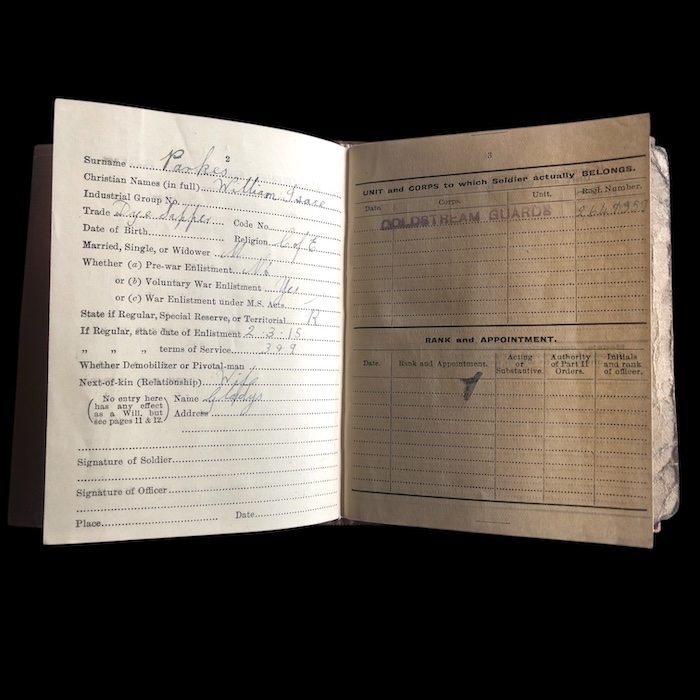
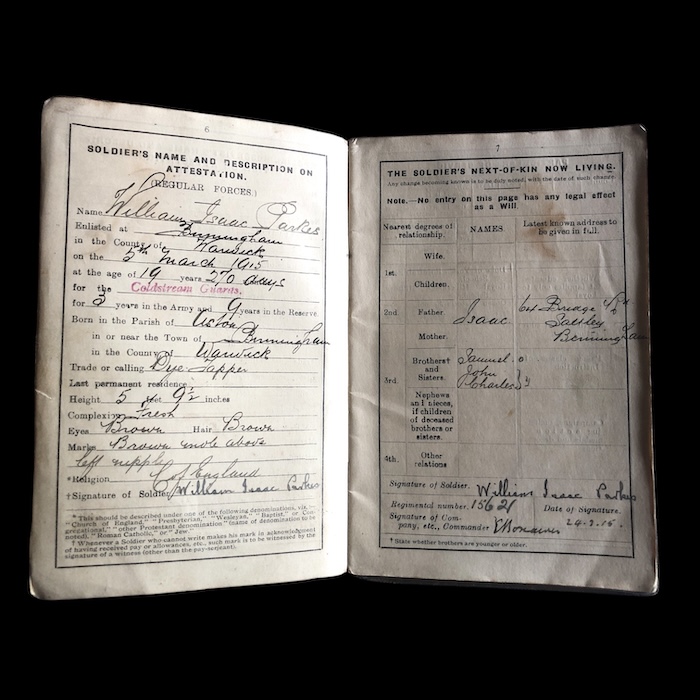
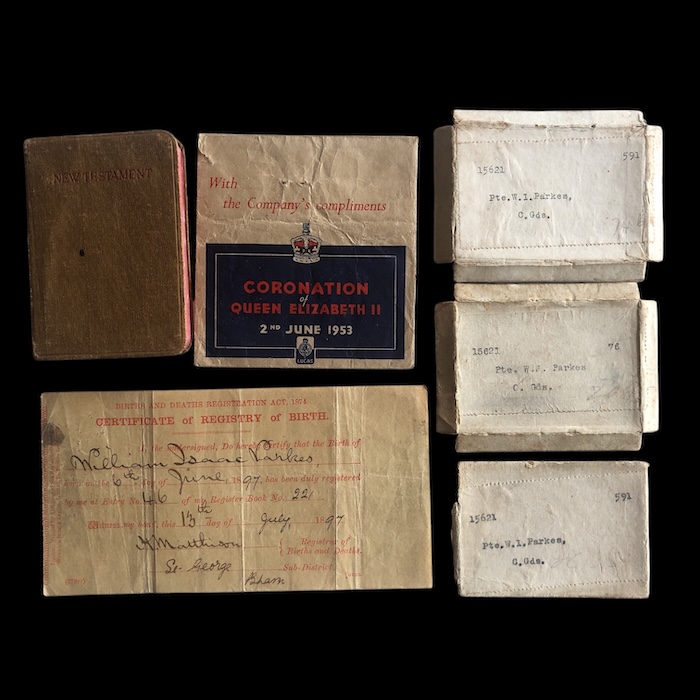
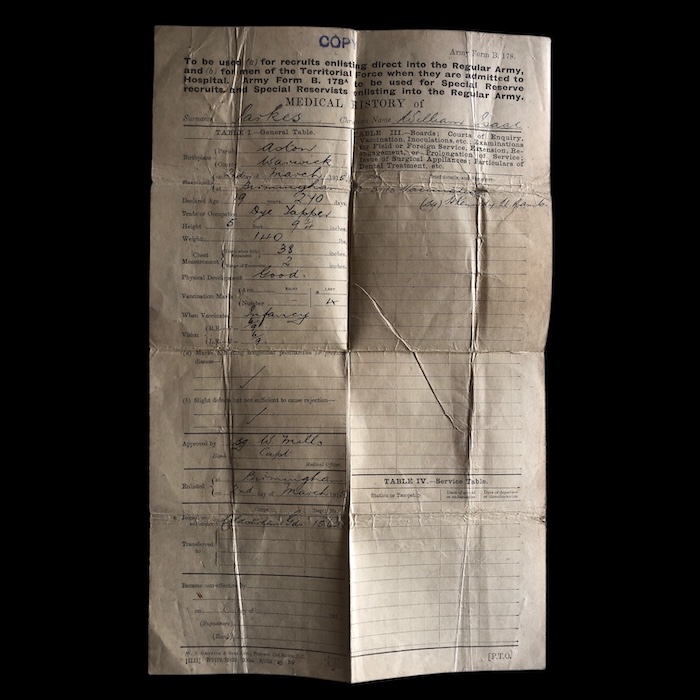
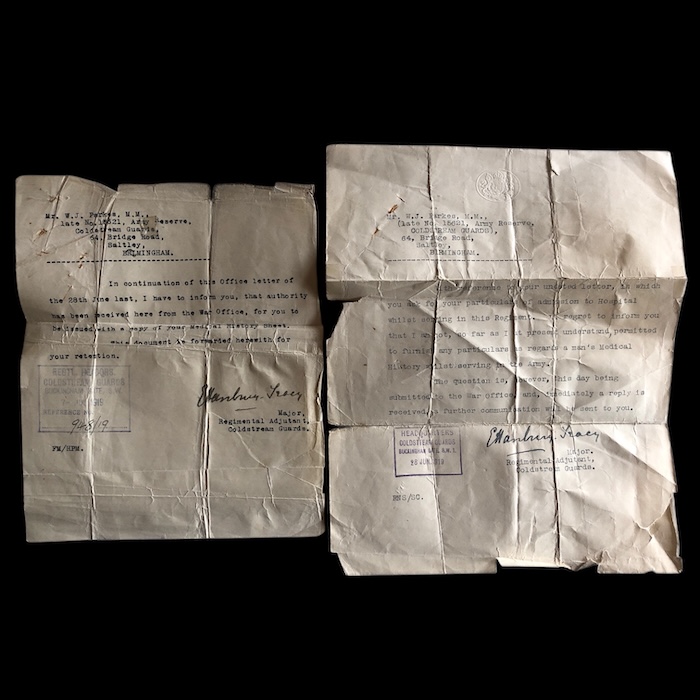
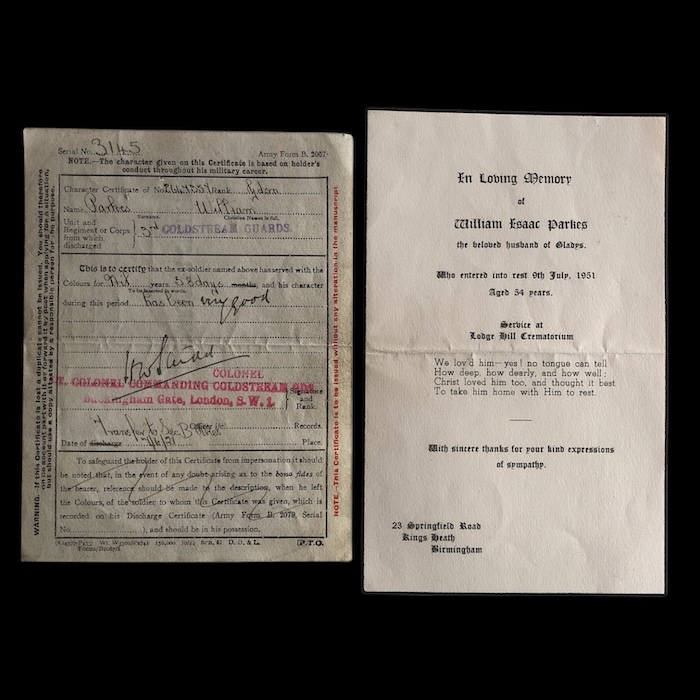
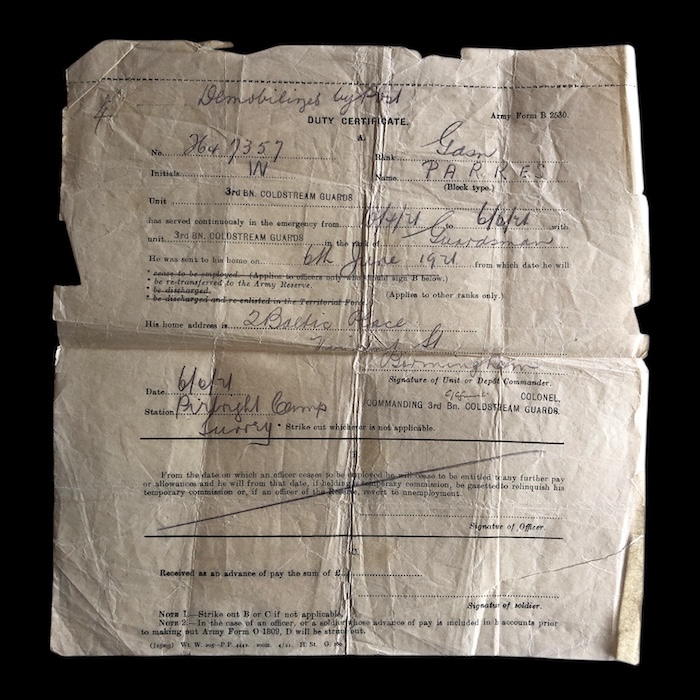
With a quantity of original documentation including Soldier’s Small Book, Soldier’s Service and Pay Book, Discharge Certificates (2), correspondence regarding his medical records.
William Isaac Parkes was born in Aston, Birmingham 6th June 1897, a Dye Tapper, he attested for the Coldstream Guards at Birmingham 5th March 1915 age 19 years 270 days. Serving in France from 15th December 1915 with the 4th Battalion, he was admitted to No 18 General Hospital, France 19th September 1917 with a severe contusion of his left great toe. His admission book entry records he is 22 years old with 22 months active service and serving in number 3 Company 4th Battalion, discharged to Number 6 Convalescent Unit 27th September 1917.
Military Medal London Gazette 19th November 1917 page 11970. (A Ypres award between 16th August to 20th September 1917)
The Birmingham Daily Post 28th November 1917 page 3 records –
Private JW Parkes (sic) of the Coldstream Guards who has been awarded the Military Medal is a Saltley man, his home being at 64 Bridge Road (same address as recorded in his Soldier’s Small Book). He secured the distinction for carrying a wounded Artilleryman over No Man’s Land into safety. Private Parke’s father also served in the Coldstream Guards and was in the Camel Corps in Egypt with Colonel Burnaby in 1884-85. He has two other sons serving”
William transferred to the Army Reserve 7th June 1921, the 1921 census records he is unemployed residing with his wife Gladys and son at 304 Balsall Heath Road, Smethwick, Worcestershire, the 1939 Register records William is a Corporation Ash Man residing with his wife, son and daughter at 91 Vincent Street, Birmingham.
He died at his home 23 Springfield Road, King’s Heath, Birmingham on 9th July 1951 aged 54 years.
Condition – GVF
NOTE: Sorry we cannot accept payment by PayPal for this item, We can accept payment by Credit / Debit Card, Bank Transfer or Cheque.
The 4th Battalion (Pioneers) Coldstream Guards was officially formed at Windsor on 17 July 1915 and deployed to France in August of that same year to serve as the dedicated pioneer battalion for the newly established Guards Division.As pioneers, the battalion occupied a critical hybrid role that combined heavy military engineering with front-line combat responsibilities. Rather than operating exclusively as a conventional infantry unit, the men of the 4th Coldstreamers were tasked with the backbreaking labor essential for the survival, mobility, and operational success of the entire division on the Western Front.
Throughout late 1915 and 1916, the battalion built, fortified, and repaired vital supply routes, constructed secure deep dugouts, laid intricate communication lines, and dug extensive trench systems under constant hazard. During the grueling Battle of the Somme in 1916, they labored tirelessly under relentless enemy artillery barrages, clearing paths through shattered terrain and maintaining critical logistical arteries amidst treacherous mud. Their efforts directly enabled the smooth movement of troops and heavy artillery to the front lines.
As the war evolved, the battalion supported successive major offensives, including operations in the Arras sector and the fierce fighting around Cambrai. Whenever tactical emergencies arose or defensive lines were compromised, the pioneers routinely laid down their shovels to fight as infantry, demonstrating exceptional tactical versatility and courage.
A major organizational transition occurred on 2 February 1918, when the 4th Battalion relinquished its pioneer duties to become a standard infantry unit, joining the 4th Guards Brigade within the 31st Division. In this capacity, they faced the catastrophic German Spring Offensive of March 1918, fighting desperate rearguard actions and holding vital ground against overwhelming numerical superiority. Later that year, they participated in the triumphant Hundred Days Offensive, pushing steadily through enemy defenses and advancing toward the Sambre. By the Armistice on 11 November 1918, the battalion was located near Maubeuge, leaving behind a proud legacy of unmatched sacrifice, resilience, and operational excellence.
Between 16 August and 20 September 1917, the 4th Battalion Coldstream Guards was deeply immersed in the harrowing conditions of the Third Battle of Ypres (Passchendaele). Operating within the swampy, crater-pocked Ypres Salient, the battalion faced some of the most punishing environments of the entire war. Torrential rains had turned the Flanders battlefield into an impassable quagmire, compounding the constant threat of lethal artillery and gas bombardments.
During this timeframe—which spanned the aftermath of the Battle of Langemarck and the lead-up to the Battle of the Menin Road Ridge—the 4th Coldstreamers worked relentlessly as pioneers to support the Guards Division’s offensives.Their primary mission was the construction and maintenance of corduroy roads, light railway tracks, and crucial duckboard walkways across liquid mud. Without these engineering feats, ammunition, rations, and wounded soldiers could not have been moved. Working predominantly at night and under heavy enemy fire, the pioneers suffered continuous casualties from shrapnel and shell bursts while attempting to drain flooded trenches and build forward assembly positions. Their unwavering grit during these weeks under horrendous weather and relentless bombardment kept communications open and underpinned the operational success of the British Second Army.


