
Description
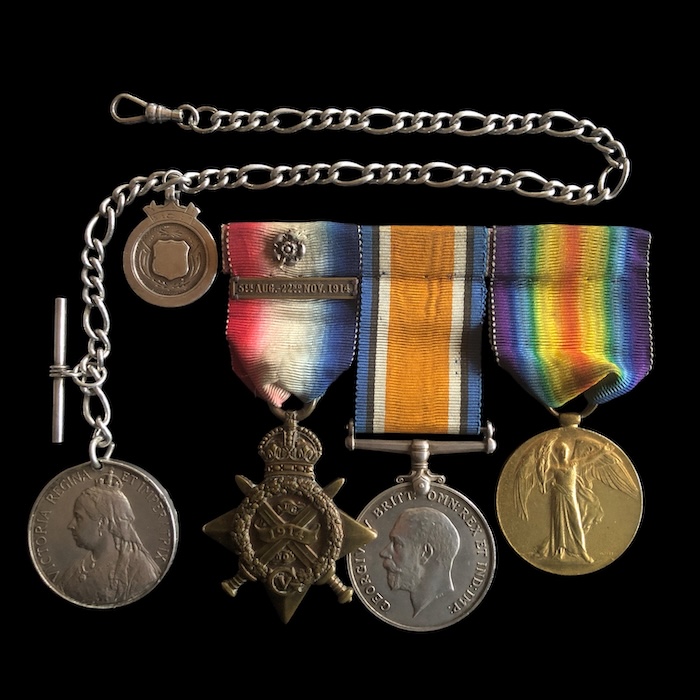
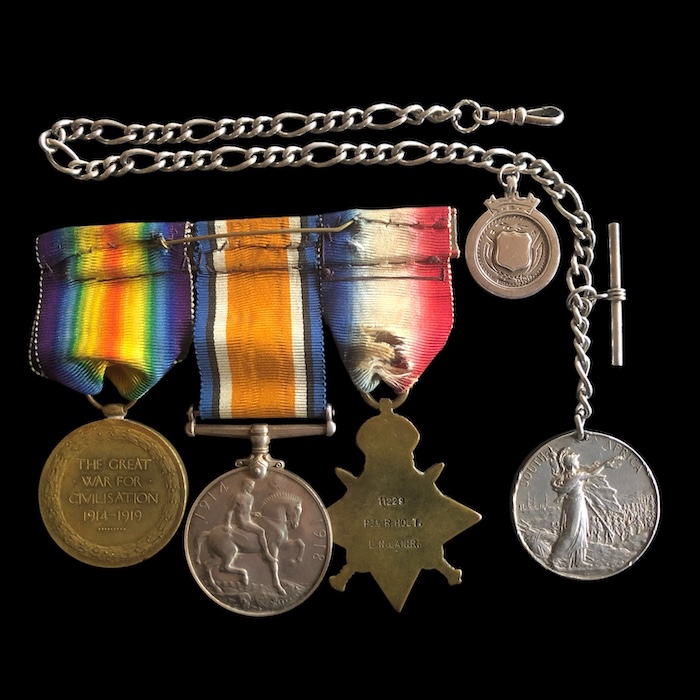
A Interesting Boer war and 1914 trio to the Loyla North Lancs regiment, enlisting under an alias for the Boer War, wounded during WW1 serving in his old regiment.
Queens South Africa (Lacking its suspension, but on a watch chain, HM Silver in places) 5575 Pte J. Green1. L.N.Lanc Regt.; 1914 Star, bar 5th Aug- 22nd Nov 1914 and rose, 11223Pte R. Holt. L.N. Lan. R; British War and Victory Medals, 11229 Pte R. Holt L.N.Lan.R (Swing mounted as worn
Ralph Holt was born in Stalybridge, Lancashire in April 1876. He was the eldest child of Sampson Holt (1853 – 1920), a labourer, and his wife Elizabeth Ann Holt (nee Buckley, 1854 – 1927). He was, eventually, to be one of 7 children.
While the date isn’t known, at some point prior to July 1897, joined the 3rd Battalion of the East Lancashire Regiment. The 3rd Battalion was the Militia Battalion of the East Lancashire Regiment and had, prior to the Childers reforms of 1881 from the 5th Royal Lancashire Militia. The east Lancashires had, until 1898 been based in Burnley but had then moved to Fullwood Barracks in Preston which it shared with the Loyal North Lancashire Regiment.
Joining the Militia was often done as a preparatory step to joining the regular army and on the 19th July 1897 Ralph enlisted into the Loyal North Lancashire Regiment being given service number 5575. However, for reasons that can only be speculated about, Ralph chose to enlist under assumed name, James Green, giving his trade or calling as Groom.
The service papers give us a physical description for Ralph/James: he stood 5 feet 10 inches tall, weighed 146 lbs and had a fresh complexion, grey eyes and brown hair. His religion was given as Church of England.
On the 22nd August, just over a month after enlisting, Ralph was posted to the 2nd Battalion from the Depot, serving in England with that Battalion until the 25th February 1899 when he was ordered to South Africa to join the 1st Battalion which had been serving there since 1898. On the 19th April 1900, after a little over a year’s service in the Boer War, Ralph was invalided back to Britain. Ralph’s service earned him a single clasped Queen’s South Africa medal, the clasp being that for Cape Colony.
There is no indication as to what the reason was for Ralph being invalided home but it was clearly insufficient to lead to his discharge as he was to serve over 9 more years with the colours, not being discharged until the 18th September 1909.
On his return home Ralph would have been stationed at the barracks at Fulwood in Preston.
On the 11th May 1901, just over a year since his return from South Africa, Ralph married Jessie Helena Spencer, the daughter of Henry Spencer, a Cotton Spinner and his wife Mary, from Oldham.
Following Ralph’s discharge from the Army in September 1909, Ralph and his family stayed in Preston and at the time of the Census in 1911 they were living at 16 Spring Gardens. Ralph was working as a general labourer and Jessie as a Cotton Weaver.
Ralph’s who, though having served more than 12 years as a Regular, was still on the Reserve, enlisted at Preston on the 17th August 1914 into his old regiment the Loyal North Lancashire Regiment. This time Ralph used his real name, not an alias, though he did give details of his previous service.
The 1st Battalion had crossed to France on the 12th August so Ralph was initially taken on the strength of the 3rd battalion before, on the 22nd September being posted to the 1st Battalion in France. By the time that he arrived in France the Battalion had suffered significant casualties, not least in the attack on Tryon during the Battle of the Aisne which cost them 9 officers killed or mortally wounded with a further 5 wounded and over 500 other ranks killed, wounded or missing. Many of these had come from “B” Company which had lost 3 out of 5 officers and 175 out of 200 other ranks. Ralph would have been a very welcome reinforcement and although the War Diary does not record the event Ralph, perhaps with other reinforcements, is likely to have joined the Battalion within 2 or 3 days of arriving in France,
The end of September and the first couple of weeks of October saw the Battalion doing trench duty on the Aisne until, on the 15th it was relieved by French troops. Over the next few days it moved to the Ypres sector arriving at Pilckem on the 22nd. The Battalion took part in an attack the following day, charging forward with the 2nd King’s Royal Rifle Corps and with fixed bayonets cleared the enemy from their trenches taking some 600 prisoners and holding their gains until relieved by the French on the 24th. An account of the action appeared in the Daily Telegraph on the 18th November.
The Battalion had lost 2 officers killed, 4 officers wounded and 175 other ranks killed, wounded or missing.
Despite its losses there was no alternative other than for the Battalion to remain in the firing line with only brief periods of rest. The 30th and 31st October were to see them engaged in the heavy fighting around Gheluvelt including a bayonet attack on the German positions which was successful but again cost the Battalion dear the estimates being 8 officers and 400 other ranks killed, wounded and missing.
On the 7th November the Battalion was in the line. The Battalion War Diary records the following for that day.
7.11.14 Loyal North Lancashire Regt
Remained in trenches all day A & B in the trenches, C & D in support. Were rather heavily shelled during the day but only had three men wounded.
10 P.M. Rather sharp & sudden attack but was repulsed. C & D Coys relieved A & B in the trenches.
Trenches VELDHOEK
Ralph was one of those wounded in the attack, receiving a bullet wound in his left thigh, close to his groin. Ralph was transferred from Number 13, General Hospital in Boulogne to a hospital in England, arriving back on home soil on the 11th November. Part of his hospitalisation, from the 23rd November to the 15th December, was at Wanstead House, Cliftonville, Margate. Wanstead House was a former convalescent home for the Infant Orphan Asylum at Wanstead on London’s north-eastern outskirts but had been taken over and converted to a hospital by the VAD (Volunteer Aid Detachment).
On the 9th August 1915, following his recuperation, Ralph did not return to his battalion in France but, perhaps because of his age (he was now nearly 40) and his wound, he was transferred to the 1st Garrison Battalion of the Cheshire Regiment in Gibraltar.
Garrison Battalions tended to be the older and less physically fit members of the regiment who, while not being considered fit for front line duty, were regarded as ideal for the guarding of bases and other tasks in non-combat zones thereby freeing up troops needed at the front.
Ralph returned to England on the 26th February 1919 and was discharged a month later on the 27th March having served, on this occasion, 4 years and 223 days with the colours.
On the 18th July 1919 Ralph went before the Examination Board in relation to his entitlement to a pension for what was described as “Defective vision left eye and wound right groin aggravated by heat of sun at Gibraltar.” And while he was acknowledged as being 20% disabled it was ruled to be “not due &/or aggravated by service”.
Ralph died in Preston in June 1931. Jessie survived him by seventeen years, dying in 1948.
With a superb set of research.
Condition – Trio, GVF. QSA F


