

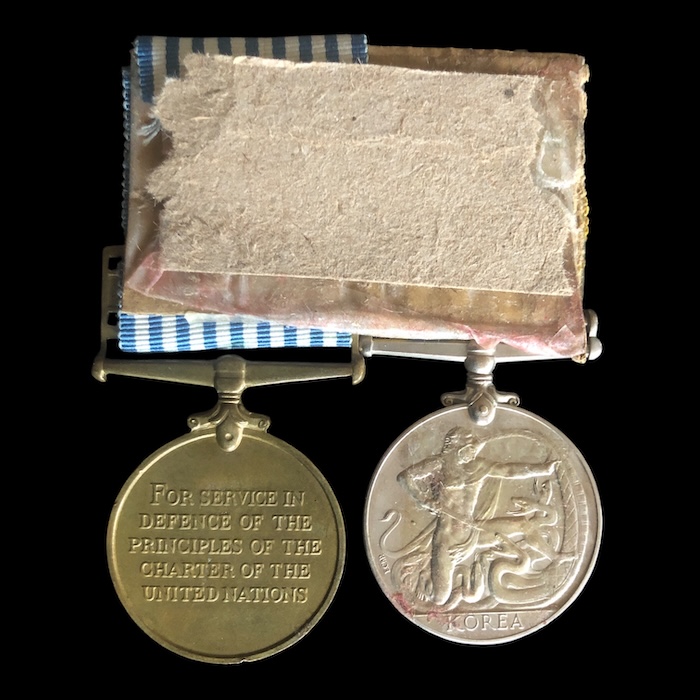
Description
A Korean War Casualty to the Kings Shropshire Light Infantry. Killed in Action 10th July 1952.
Queens Korea, 22468181 Pte R. Luckhurst. K.S.L.I..; UN Korea medal.
Ronald Luckhurst was born on the 3rd November 1932 in Hackney, London.
He was Killed in Action on the 10th July 1952, whilst serving in the 1st battalion Kings Shropshire Light Infantry.
Reburial records record that his cause of death was “Wound missile head”
In July 1952, the 1st Battalion, The King’s Shropshire Light Infantry (1st KSLI) was actively engaged in the Korean War, serving as part of the 28th Commonwealth Infantry Brigade within the 1st Commonwealth Division.
July 1952 marked a period of major operational transition and high-profile security duty for the battalion:
Security Operations at Koje-do POW Camp
At the start of July 1952, ‘B’ Company of the 1st KSLI was deployed on Koje Island (Koje-do) off the southern coast of South Korea.
Following violent riots and political mutinies by North Korean and Chinese prisoners in May 1952, British troops—including detachments from the 1st KSLI—were rushed to the island to restore order.
Under United Nations command, the riflemen guarded high-risk prisoner compounds, enforced strict security protocols, and assisted in breaking up communist prisoner networks.
‘B’ Company rejoined the main battalion on the frontline on July 10, 1952, after completing their security assignment on Koje-do.
Frontline Patrols & Static Warfare (The Demilitarized Zone)
For the remainder of the battalion stationed along the frontline (near the Imjin River sector and the 38th Parallel), July 1952 was defined by intense static trench warfare.
Night Patrolling & Ambushes: War in mid-1952 was largely a nocturnal affair. The 1st KSLI conducted aggressive combat and reconnaissance patrols into “No Man’s Land” to gather intelligence, capture prisoners, and counter Chinese probing attacks.
Extreme Weather: July brought the start of the summer monsoon season in Korea. Torrential rains collapsed trenches, flooded underground bunkers, destroyed supply tracks, and turned the terrain into deep mud, making defensive maintenance an exhausting daily struggle.
Artillery Duels: The battalion faced heavy sporadic bombardments from Chinese Communist Forces (CCF) artillery and mortars positioned across the valley.
Preparation for Relief and Rotation
Having been continuously deployed in Korea since May 1951, July 1952 marked the final full month of active combat operations for the 1st KSLI in Korea.
During July, the battalion began preparations to hand over its frontline defensive sector to their incoming replacement unit, the 1st Battalion, The Durham Light Infantry (1st DLI).
Shortly after completing their duties in July and August, the 1st KSLI embarked for their return journey to the United Kingdom in September 1952.
Condition – NEF
NOTE: Sorry we cannot accept payment by PayPal for this item, We can accept payment by Credit / Debit Card, Bank Transfer or Cheque.


