

Description
The superb Great War Western Front Company Sergeant Major’s Opening Day of the Battle of Arras 9th April 1917 storming of the Point du Jour house Distinguished Conduct Medal and Battle of the Somme probable High Wood attack on Nose and Trail Trench 20th October 1916 Military Medal group awarded to 2nd Lieutenant A. Whatmough, King’s Own Scottish Borderers, who as a pre-war regular with the 2nd Battalion, was then present out on the Western Front from 15th August 1914, and was wounded in action whilst a Lance Corporal with ‘B’ Company on 18th October 1914, and received a presentation cigarette case by the “Teachers & Class’ of his old school ‘as a Token of Esteem’ on 10th November 1914. Back at the front, he was wounded in action for a second time, he being slightly wounded in the right hand whilst in action at Ypres on 10th July 1915. Then as a Company Sergeant Major with ‘A’ Company of the 6th Service Battalion he was twice decorated. The first occasion was during the Battle of the Somme when he was awarded the Military Medal, this being earned most probably when in action at High Wood in the attack on Nose and Trail Trench on 20th October 1918 when ‘A’ Company succeeded in capturing Nose Trench, despite the failure of the other company attacks. It was however on 9th April 1917 that Whatmough greatly distinguished himself and was awarded the Distinguished Conduct Medal in the attack that marked the opening of the Second Battle of Arras and the Arras Offensive. His battalion took the first of the three objectives, namely Obermeyer Trench after having suffered at the hands of a friendly artillery bombardment. Then during he taking of the third objective, his battalion was held back however until ‘A’ Company was sent forward to fill the gap between the 11th and 15th Royal Scots during the assault, and as a result stormed the Point du Jour house during which Whatmough ‘led the advance, and succeeded in capturing a machine gun and five prisoners in a house. His party dispersed the garrison.’ Commissioned from Acting Warrant Officer 1st Class to 2nd Lieutenant in June 1917, he was then severely wounded in action and having been placed on the half pay list ‘on account of ill-health caused by wounds’ in December 1919, he appears to have never recovered from his wounds, and died in 1922.
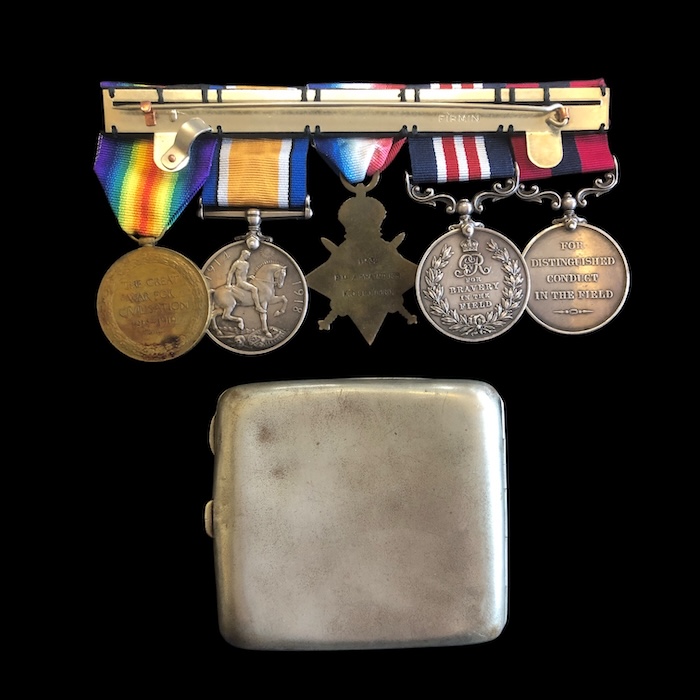
Distinguished Conduct Medal, GVR bust; 11532 C.S.MJR: A. WHATMOUGH. 6/K.O.S.B.; Military Medal, GVR bust; 11532 SJT: A. WHATMOUGH. 6/K.O.S.B.; 1914 Star; 11532 PTE. A. WHATMOUGH. K.O.SCO: BORD.; British War Medal and Victory Medal; 2.LIEUT. A. WHATMOUGH.
Condition: some contact wear and a slight edge bruise to the first, overall about Good Very Fine.
NOTE: Sorry we cannot accept payment by PayPal for this item, We can accept payment by Credit / Debit Card, Bank Transfer or Cheque.
Together with an EPNS marked presentation cigarette case, this engraved on the lid: •Presented to Lance Corps. A. Whatmough. by his Teachers & Class As a Token of Esteem. Nov. 10. 1914.?
Provenance: the medals and presentation cigarette case were originally acquired directly from the family by the London Medal Company.
Arthur Whatmough was born in early 1895 in Rochdale, Lancashire, the son of Jams Whatmough, a cotton operative. A pre-war regular soldier, by the outbreak of the Great War he was serving as a Private (No. 11532) with the King’s Own Scottish Borders, and as such then saw service with the 2nd Battalion out on the Western Front with the British Expeditionary Force from 15th August 1914, being wounded in action whilst serving as a Lance Corporal with ‘B’ Company on 18th October 1914. Whatmough was gifted a presentation cigarette case by the “Teachers & Class’ of his old school ‘as a Token of Esteem’ on 10th November 1914.
Whatmough was subsequently serving as a Corporal with the 2nd Battalion when he was wounded in action for a second time, he being slightly wounded in the right hand whilst in action at Ypres on 10th July 1915. Whatmough was on home leave when he married Olive Mary Temperley, a domestic servant and the daughter of a miner, the couple being married in the parish church of Saint Mary in Rochdale on 11th November 1916, he having just returned from active service in the Battle of the Somme.
Since the time of his second wounding Whatmough had been promoted to Sergeant and transferred to the 6th Service Battalion of his regiment with whom he was serving as an Acting Company Sergeant Major. The 6th Battalion had originally arrived at the front in May 1915, when part of the 28th Brigade in the 9th (Scottish) Division, but had then transferred to the 27th Brigade in the same division in May 1916.
It was whilst Whatmough was serving as an Acting Company Sergeant Major during the Battle of the Somme that he was awarded the Military Medal for bravery in the field in the London Gazette for 22nd January 1917. This gazette dates covers tidying up awards earned between19th August and 14th November 1916, and covers the actions on the Ancre and Transloy Ridges.
On 1st July 1916 his battalion was held in reserve in Trigger Wood Valley, and it was not till the evening of 3rd July that it made an attack into Bernafay Wood. This was a successful attack with small casualties, and despite a heavy enemy bombardment, it managed to consolidate the position during the night. The next five days and nights through to the 9th July when it was relived saw the battalion endure intense enemy shelling, and despite having only suffered five casualties in the attack on the 3rd July, but the date of its relief, mostly due to enemy bombardment, it had suffered some casualties of six officers and 300 others ranks.
On 13th July it received orders to return to the front line for the forthcoming attack on the German second line from Bazentin-le-Grande to Longueval. It supported the attack from Caterpillar Valley, and after the line was taken by troops of the 26th and 27th Brigades was then tasked with carrying up stores, water, ammunition and grenades, all under an intense enemy bombardment. It remained in this role till 17th July when orders were received for the battalion to move up to Longueval in order to at the northern end of the village and also and enemy strong point on the north west corner of Delville Wood. In company with the 11th Royal Scots and two companies of South Africans itv cleared the village and then cleared the houses in Delville Wood., however the attack failed due to the enemy strong points being too strongly held, and then remnants of the battalion assembled back at Caterpillar Valley. The following day it was ordered to hold a part of the line in Caterpillar Valley at Longueval, and during the night heavy enemy shelling meant that casualties were starting to become serious.
On the 19th July it was still holding the trenches at Longueval under a continuous and intense enemy fire of heavy shells, whiz-bangs, trench mortars, and machine gun fire, and by that evening could only muster 100 N.C.O.’s and men, and 3 company officers, with 6 officers and 120 other ranks having been killed or wounded. As a result, the intention to attack the strong point in Delville Wood had to be abandoned, and urgent messages resulted in the battalion being relieved. On relief the battalion’s state can be judged by the company strengths – “A’ Company under the command of a Lieutenant mustered one officer, 1 N.C.O., and 20 unwounded men. ‘B’ Coy under a 2nd Lieutenant muster 50 men; ‘C’ Coy under a 2nd Lieutenant who though slightly wounded remained in the firing line, mustered only 6 men!; ‘D’ Coy who had lost all its officers, mustered just 30 N.C.O.’s and men. It was relieved that night.
It was not till the 14th August that the battalion went into the support line in the Carency Section. After a period of carrying up duties, it moved into the frontline in the Carency No.1 Section of Trenches in and around the area of the Kennedy Crater on 19th August, and due to enemy mining activity having been heard, were then involved in supporting the tunnellers on mining fatigue duty clearing spoil etc from the 20th August. A number of patrols were conducted during this period of the various mine craters in the area, specifically Kennett, New and Gunner craters. Engagements occurred with enemy working parties during this period, and also trench mortar and small arms fire was exchanged. The 6th Battalion moved out of the front line and back into the support trenches between Basolle and Carency on 31st August. The battalion remained in the support line on carrying duties till take out of the lines on 7th September.
On 19th September the battalion returned to the front line and relieved the 8th Black Watch in the Berthonval Sector, entering the tenches in bad conditions with wet weather, fortunately the enemy was quiet. On 22nd September a patrol went out with the intention of capturing one German but was unsuccessful and the enemy remained quiet. It was only on the 24th September with the 9th Scottish Rifles put in a raid on the enemy trenches that they were discovered to be empty, the Germans having retired to their second line. The battalion was relieved on the 25th September and went into billets. From the 10th October the battalion was tasked with cleaning up Mametz Wood, which had been fought over, and was tasked with tidying up the trenches, burying bodies etc.
Then on the 19th October it moved up to High Wood, and took over the front line from the 1st South African Infantry Battalion. The South African’s had taken part of a German trench but had failed to capture the Nose of the Switch Trench. This relief was accomplished with the greatest difficulty owing to a deluge of rain as the trenches were knee deep in mud and men had to be dug out, some being finally got out from where they had floundered at about 7 a.m on the morning of the 20th October. The chaos caused was heightened by the guides not knowing the best way into the trenches and one officer was killed whilst going into the trenches, whilst some 50 men became casualties. Having taken over the line, arrangements were then made to attack the Nose and Trail Trench. ‘D’ Company were ordered to make a bombing attack along Snag Trench, the Nose attack to start at 4 p.m. With an artillery barrage to lift by 50 yards commencing at 4 p.m., the men were to get close to the barrage, with one green light to be shown when the infantry wanted the barrage to be lifted still further. In event of the ‘D’ Company attack failing, ‘B’ Company were to make a supplementary attack on the Tail across the open timed to commence at 5 p.m. The Companies were to form up and advance by platoons, with A Company on the left to take advantage of any success of either attack and work across from the Pimple to the Nose and join up. Both attacks however failed owing to machine gun fire from slopes but a platoon of ‘A’ Company succeeded in getting into the Nose. The casualties were deemed fairly heavy for the attacking companies, whilst “A’ Companies were slight.
The ‘A’ Company men in the Nose were then ordered to evacuate their gain by their company commander owing to the lack of success of ‘D’ Company, however the CO then requested them to retake it which they did with a mixture of ‘A’, ‘B’ and ‘D’ Companies, and once reinforcements arrived from ‘A’ Company of the 11th Royal Scots, the troops worked up Tail Trench. One officer was killed, two were wounded, and about 60 other ranks became casualties. They then spent the night digging in and consolidating. The enemy bombardment that morning then caused heavy casualties, which were estimated at about 200 men, and later that same day they returned to the support line and switched over with the men of the 11th Royal Scots, and then manned the Flers Line. On 23rd October orders were received to evacuated the frontline all together, and the battalion moved back to Bazentin-Le-Grand. The battalion then remained in various billets right through November 1916, during which period Whatmough had been sent home on leave and had got married.
On 2nd December the battalion took over the Brigade Reserve Line, and then on the 10th December moved into the front line again in the area of Roclincourt. Having been snowed on, thy spent a quiet period until pulled out of the line and sent back to Arras with the Divisional Reserve on 19th December. It returned to the front line from 24th December till relieved on the 31st December, but their relief was difficult owing to the collapse of several parts of the trenches. Back in the front line on 5th January 1917, ‘C’ Company carried out a raid on the 11th January in which three prisoners were taken. They went back into reserve the next day, and again manned the line from 19th to 25th January.
It was during this period that news of Whatmough’s award of the Military Medal was published in the London Gazette for 22nd January 1917, and despite his award not being recorded in the battalion War Diary, it seems most probable that his award was for the attacks on Nose and Trail Trench on 20th October 1918 when in the area of High Wood.
A similar pattern of alternating in and out of the lines followed through February and March 1917 in the run up to the Arras Offensive. The opening day of the offensive began on 9th April, with the 6th Battalion beginning its attack from the area of the Claude and Clarence Craters. In the prelude to Zero Hour the battalion deployed into No Man’s Land and suffered severely from the British barrage which fell very short. The attack began at 05.30 hours and by 6.40 am the Obermeyer Trench had been captured. The 11th Royal Scots then passed through to attack the Railway, but the 16th Royal Scots on the left were held up by machine gun fire, and it was only when ‘C’ Company of the 6th K.O.S.B.’s went forward to support them and then gained the objective, that the attack progressed. The battalion then re-organised in the sunken road and ‘B’ Company then moved forward to act as mopper’s up for the 11th Royal Scots in the attack on the third objective. The remainder of the battalion then followed about 400 yards behind, with ‘A’ Company being then sent forward to fill the gap between the 11th and 15th Royal Scots, and as it pressed forward it stormed the Point du Jour house. The battalion then occupied the third German defensive system, and consolidated, before being withdrawn to the Railway later that evening, and spent the next day clearing the battlefield. The battalion was withdrawn from the line on 13th April, having suffered relatively light casualties.
On the 29th April the battalion relieved the 13th King’s Royal Rifles in the trenches south west of Gavrelle, and the following day moved in Obermeyer Trench, this being then the third line, and a reserve position. It moved up into the front line on 2nd May. Then on the 3rd May it took part in the attack during the opening of the Battle of Bullecourt, the final stage of the Arras Offensive. The battalion formed the left of the divisional attack. However owing to the battalion’s on the left and right failing to push forward owing to resistance, the 6th Battalion’s attack also failed, it having been “left in the air” ‘ Small pushes forward were then made but owing to heavy enemy machine gun fire it was impossible to ascertain what progress was made by the attacking companies, though a signal message from Wit Trench was sent back by ‘C” Company. As a result of being “left in the air” with enemy on both flanks, the 6th Battalion had to eventually retire but found it difficult to do so, as the intervening ground was swept by machine gun fire. Casualties were natural heavy, with 15 officers including the Commanding Officer, and 400 other ranks becoming casualties. Of the 13 officers who went “over the top” only two returned, and there were both wounded. The battalion was relieve that evening and went back to Helford Trench in the Brigade Reserve.
On 9th May it went back one further line to Obermeyer Trench, and on 14th May was sent back to Arras. It was not till the 1st June that it moved up again. It come back out of the line two days later, but then acted in support during the successful Brigade attack on 5th June, and was sent back to camp the following day, bit then relieved the 12th Royal Scots in the front line, manning the newly captured Cupid Trench from 8th June. It came out of the line on the 11th June having spent the period there consolidating the trench and making in defensible.
In the London Gazette of 26th July 1917 it was announced that Company Sergeant Major Whatmough had been awarded the Distinguished Conduct Medal, the citation readings as follows:
“For conspicuous gallantry and devotion to duty. He led the advance, and succeeded in capturing a machine gun and five prisoners in a house. His party dispersed the garrison.”
The only action for which the battalion had participated in that matches the description in the citation is the attack made on 9th April 1917, the opening day of the Battle of Arras, when his battalion, having suffered severely from the British barrage which fell short in No Man’s Land, had then taken the first line of the enemy defences, namely the Obermeyer Trench. It was after this when ‘A’ Company had been sent forward to fill the gap between the 11th and 15th Royal Scots during the assault on the third objective, and had stormed the Point du Jour house that he undoubtedly won the Distinguished Conduct Medal, his citation clearly detailing that he ‘led the advance, and succeeded in capturing a machine gun and five prisoners in a house. His party dispersed the garrison.’
Whatmough was subsequently promoted to Acting Warrant Officer 1st Class and was then commissioned into the King’s Own Scottish Borderers as a 2nd Lieutenant on 18th June 1917. Whatmough was wounded again, this time severely, and as a result of these wounds, was placed on the half pay list ‘on account of ill-health caused by wounds’ on 13th December 1919. Whatmough never recovered from his wounds, and having gone on to live in Blackpool, died in early 1922.


