
Description
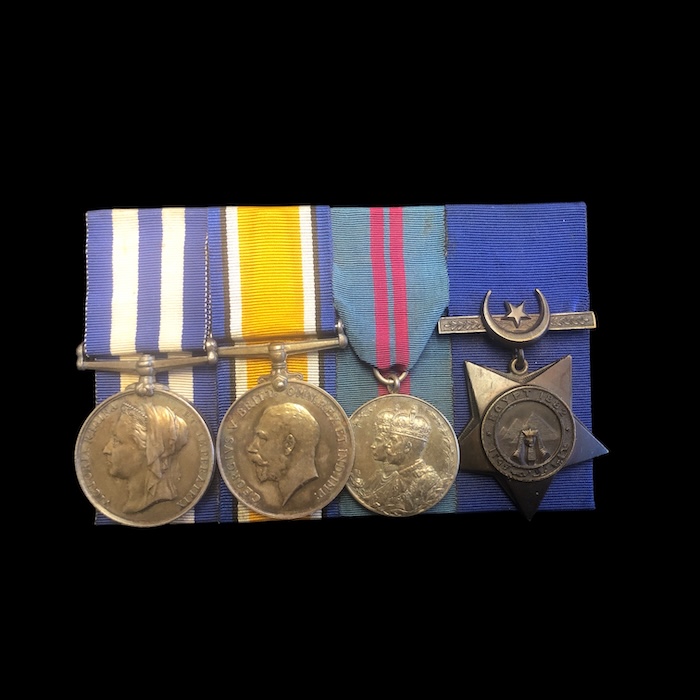
Egypt, WW1 Naval group – H.M.S. Northumberland on Egypt. Retires as an Officer.
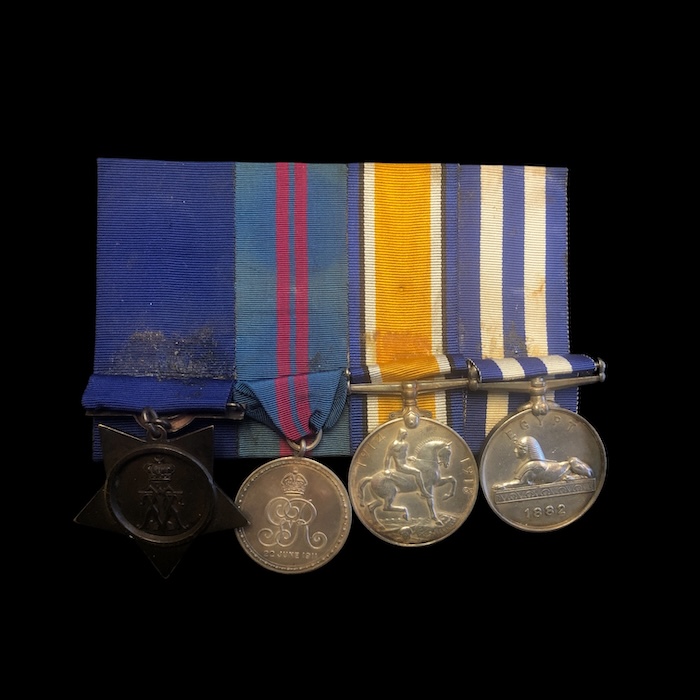
Egypt and Sudan 1882-89, 1882 dated reverse, no clasp, P. Hanvey. A.B. H.M.S. “Northumberland.”; British War Medal 1914-20, Lieut. P. Hanvey. R.N.; Coronation 1911, unnamed as issued; Khedive’s Star, dated 1882, unnamed as issued, mounted court-style for display.
Patrick Hanvey was born in Bangor, County Down, Ireland, on 8 December 1857.
He joined the Royal Navy as a Boy Second Class on 8 September 1873. Advanced Able Seaman on 1 September 1877, he served in H.M.S. Northumberland from 1 July 1881 to 3 August 1884.
Promoted Acting Boatswain on 29 September 1892.
He retired as Chief Boatswain on 1 April 1912, and was granted a pension for wounds. Recalled for War service, he served during the Great War in Portsmouth Dockyard, and was promoted Lieutenant (Retired) on 18 November 1916.
Awarded a Greenwich Hospital Pension of £30 per annum, he died at Brighton on 6 June 1952.
Condition – Normal light pitting to first, generally VF+
HMS Northumberland, a Minotaur-class armoured frigate, played a vital support and power projection role during the Anglo-Egyptian War of 1882. While the initial bombardment of Alexandria on July 11 was conducted primarily by the Mediterranean Fleet’s shallow-draft ironclads, Northumberland, as part of the Channel Squadron under Rear-Admiral Sir John Dowell, arrived to reinforce the British presence and secure the strategic waterways essential for the subsequent land invasion.
The Suez Canal Operation The ship’s most significant contribution came during the seizure of the Suez Canal in August 1882. Following the bombardment of Alexandria, the British objective shifted to securing the canal to ensure the safe passage of General Sir Garnet Wolseley’s expeditionary force. Northumberland, commanded by Captain George Stanley Bosanquet, was ordered to the canal zone to support Rear-Admiral Sir Anthony Hoskins.
On August 20, the ship provided a substantial landing party comprising Royal Marines and seamen. These men were pivotal in the occupation of Ismailia, a key strategic point midway along the canal. The Northumberland contingent, operating alongside men from HMS Orion, helped secure the town and the freshwater canal locks, preventing the Egyptian forces under Arabi Pasha from cutting off the water supply to the advancing British army.


