
Description
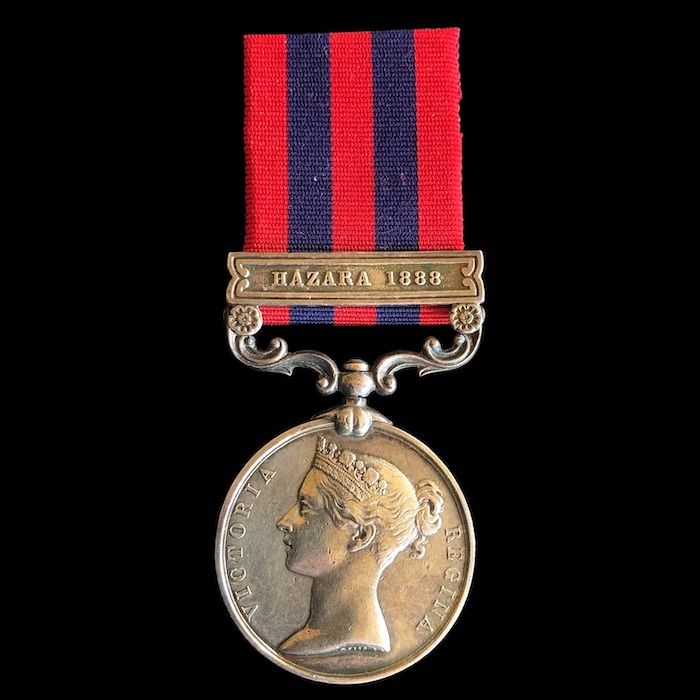
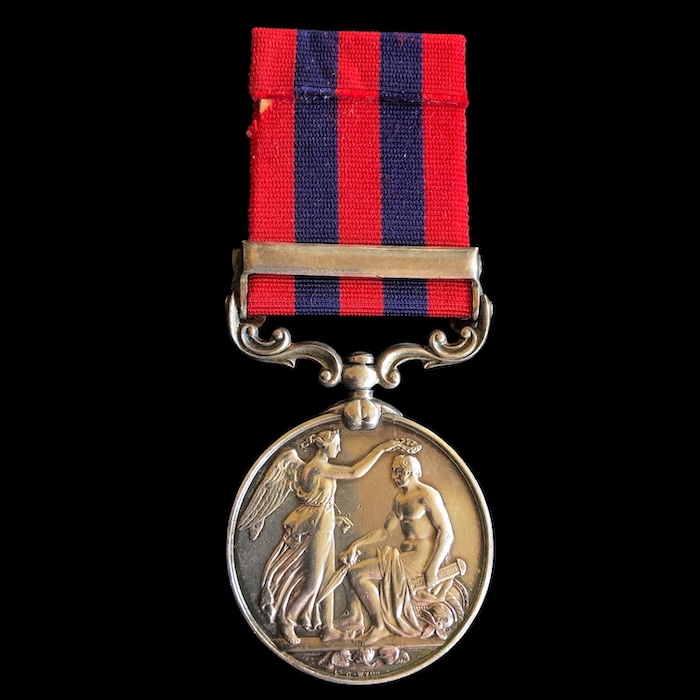
India General Service 1854, Hazara 1888 – 2nd battalion Royal Irish Regiment.
India General Service Medal 1854 clasp ‘Hazara 1888’ (**** Pte W. Campbell 2d Bn R. Ir. R)
William John Campbell was a 21 year old clerk from Stradford, Co. Wicklow when he attested for the 69th Brigade before the Justices at Dublin at 3pm on 21 January 1880. He signed up for 6 years with the Colours and 6 on the Reserve. When medically examined the same day, he was described as 5’ 7” tall, weighed 133 lbs, had a 34½” chest and was of ‘good’ physical development. He had a fresh complexion, hazel eyes, dark brown hair and it was noted that he had a white mark on his right hip. He was a member of the Church of England. His next of kin was given as his father Samuel. His mother was named Eliza and he had a brother Samuel and sisters Eliza, Bella, Mary, Jane, Harriet and Kate.
Campbell joined the 2nd Bn Royal Irish Regiment at Aldershot on 28 January 1880. He received rapid promotion, probably on account of the fact that he could write (he had been a clerk in civilian life). He was probably employed in the Battalion in a clerical capacity, either in the Orderly Room or in the stores. Campbell was appointed Lance Corporal on 19 April 1880 and obtained his 2ndClass Certificate of Education on 20 October 1880. He was promoted Corporal on 30 October 1880. The 2nd Battalion moved from Aldershot to Chatham in October 1881. Campbell was promoted Sergeant on 1 November 1881.
Within 2 years of enlisting he was in the Sergeant’s Mess with a 2nd class Certificate of Education. It was a glittering start to Army life but sadly this promising trend was not to last. On 14 April 1882 he was tried for some offence; it must have been serious as he was given 4 months imprisonment, reduced to the ranks and forfeited 1d per day Good Conduct Pay.
Campbell soldiered on as a Private and it was in that rank that he went on active service with the 2nd Bn in Egypt. According to his papers, Campbell appears to have returned home in October 1882, a few months ahead of the 2nd Bn. His Egypt medal roll entry states ‘with Depot’. It is, therefore, possible that he was posted to the Depot at Clonmel for a year, from October 1882 to September 1883. On 13 August 1883 he extended his service to complete 12 years with the Colours.
On 11 September 1883 Campbell transferred to the 1st Bn Royal Irish Regiment, which was then serving in India. He landed in India on 2 November 1883 and served at Rawal Pindi and Meerut. In August 1884 the 1st Bn moved to Bombay, and embarked for active service in Egypt on the Nile Expedition. After a year in Egypt the 1st Bn Royal Irish sailed home, arriving at Plymouth in September 1885. Campbell’s 1d per day Good conduct Pay having previously been restored (on 14 April 1883) was forfeited once again, for some misdemeanour, on 6 November 1885.
After just 6 weeks on home service at Plymouth, Campbell transferred to the 2nd Bn Royal Irish on 21 November 1885. The 2nd Bn was serving in India. Campbell landed in India on 19 December 1885 and he joined the Battalion at Subathu. Things began to look up for him. On 6 November 1886 his 1d per day good Conduct Pay was restored. In November 1887 the Battalion moved from Subathu to Nowshera. It left to take part in the Black Mountain or ‘Hazara’ Expedition from 21 September to 15 November 1888. Thereafter, it returned to Nowshera. On 1 September 1888 Campbell was appointed Lance Corporal. On 6 November 1888 he was granted 2d per day Good conduct Pay. In October 1889 the 2nd Battalion Royal Irish moved to Peshawar to be reviewed by the Viceroy of India. It returned to Nowshera but in December it moved back to Peshawar. Campbell was appointed paid Lance Corporal on 1 March 1890 and was promoted to Corporal on 2 April 1890. Later that month the Battalion moved to Cherat. In early October the Battalion left Cherat for Peshawar. In December 1890 the Battalion began the 3 month long march to Lucknow, arriving in March 1891.
Campbell was appointed Lance Sergeant on 2 July 1891. He was obviously enjoying Army life, as on 20 October 1891 he re-engaged to complete 21 years service with the Colours. The next day he was appointed paid Lance Sergeant and on 20 November 1891 he was promoted Sergeant (just under 10 years since he had lost that rank). Things were looking up for Campbell but the following year they took a turn for the worse. On 1 May 1892 he was tried, received 21 days imprisonment, was reduced to the ranks and forfeited 2d per day Good Conduct Pay. Once again he soldiered on as a Private. On 20 May 1893 his Good Conduct Pay was restored. He was appointed Lance Corporal on 28 September 1894. On 13 November 1894, after 3½ years with the 2ndBattalion at Lucknow, Campbell was sent to Deolali, to the military hospital there. On 9 December 1894 he sailed for home on the hired transport ‘Victoria’ to be posted to the 1st Battalion Royal Irish Regiment.
On 8 December 1894 Campbell joined the 1st Bn Royal Irish at Limerick. He was appointed paid Lance Corporal on 1 March 1895 but he reverted to Private on 4 June 1895. At this point Campbell must have decided that he had had enough of the Army (or perhaps the Army had had enough of him); he was discharged at Limerick on 20 June 1895, ‘free after 15 years service.’
Campbell’s medical records make fascinating reading. In his 15 years service he was in hospital for a total of 547 days. He received a wound to the scalp at Lucknow on 14 April 1893, exposing his bone. As a result he was hospitalised for 3 weeks and a court of Inquiry was held on 29 April 1893. Other less serious ailments included; bronchitis, catarrh, palpitations, contusion, febricula, ague, conjunctivitis, rheumatism, dyspepsia, 3 doses of gonorrhoea, one of primary syphilis and one of secondary syphilis. In his last 6 months in the Army at Limerick (January to June 1895) Campbell spent 65 days in hospital. Indeed, his last 11 days in the Army saw him hospitalised for ‘alcoholism’. He was released from hospital on 19 June 1895 and was discharged from the Army the following day. He was 36.
Verified on WO 100/74. Number given as ‘2499.’
Also entitled to Egypt 1882 Medal with 2 clasps: The ‘Tel El Kebir’ clasp is verified on WO 100/57; Roll states ‘with Depot’ and to clasp ‘The Nile 1884-85’, WO 100/65 confirms. Khedive’s Star verified. Roll states ‘With Depot.’
Condition – VF/GVF Contact wear affecting the regimental number


