

Description
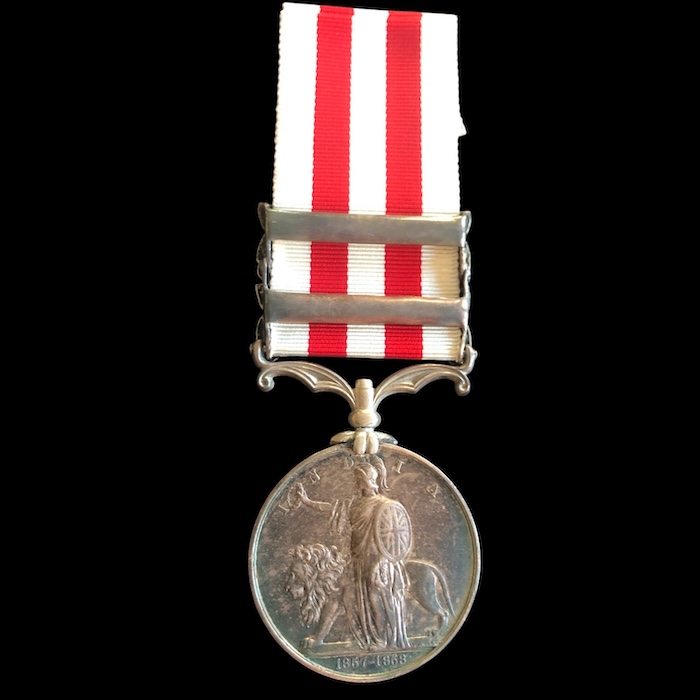
Indian Mutiny, clasps, Relief of Lucknow, Delhi – 1st battalion 8th regiment.
Indian Mutiny, clasps, Relief of Lucknow, Delhi, Corpl Hy Whitlow, 1st Bn 8th Regt.
Henry Whitlow was born in Derby, Lancashire in 1822.
He enlisted in 13th February 1838
A Chelsea Pension from 12th March 1861
He died on the 4th March 1876
Between February 1838 and March 1861, the 1st Battalion, 8th (The King’s) Regiment of Foot navigated an intense chapter of garrison deployments, culminating with combat during the Indian Mutiny.
Pre-Mutiny Deployments (1838–1856)
At the start of this era, the battalion fulfilled routine colonial duties, which included a garrison posting to Nova Scotia from 1839 to 1841. Following home establishment rotations, the regiment received orders for overseas expansion, and in August 1846, it embarked for India, beginning a long, demanding tenure on the subcontinent. Over the subsequent decade, the 8th Foot rotated through multiple military stations, managing internal security across regions like Scinde and Agra, before taking up garrison quarters at Jullundur in the Punjab shortly before the explosion of the sepoy rebellion in 1857.
Frontline Service During the Indian Mutiny (1857–1858)
When the crisis broke out, the battalion found itself stationed right within a critical flashpoint region. The 8th Foot provided exceptional service across several major military milestones:
Securing the Punjab: In the chaotic opening weeks, elements of the regiment successfully neutralized and disarmed volatile native units, helping prevent total administrative collapse in northern India.
The Siege and Assault of Delhi (June–September 1857): Arriving at the Delhi Ridge under Lieutenant-Colonel Edward Greathed, the 8th Foot spent months in heavy combat repulsing relentless rebel sorties, capturing Ludlow Castle, and securing siege batteries. During the decisive 14 September assault on Delhi, the 8th Foot spearheaded Column No. 2 against the Water Bastion and Kashmiri Gate. The battalion endured severely heavy casualties while breaching the city walls and clearing enemy positions through days of fierce house-to-house combat.
Relief of Lucknow and Cawnpore: Following Delhi’s fall, Greathed led a column featuring the 8th Foot down the Doab. The battalion joined Sir Colin Campbell’s forces for the Second Relief of Lucknow in November 1857, before playing a key role in routing the Gwalior Contingent at Cawnpore in December 1857.
The Oude Campaign (1858–1859): Throughout 1858, the depleted battalion conducted arduous counter-insurgency sweeps across Oude and northern India, clearing fortified rebel positions.
Following the suppression of the rebellion and the transition of governance to the Crown, active campaign duties drew to a close. In 1860, the battle-hardened 1st Battalion departed India, returning home to Britain to refit, rest, and reorganize its ranks heading into March 1861.
Condition – GVf, contact marked.


