
Description
Queens South Africa – 2nd battalion Royal Inniskilling Fusiliers – WOUNDED
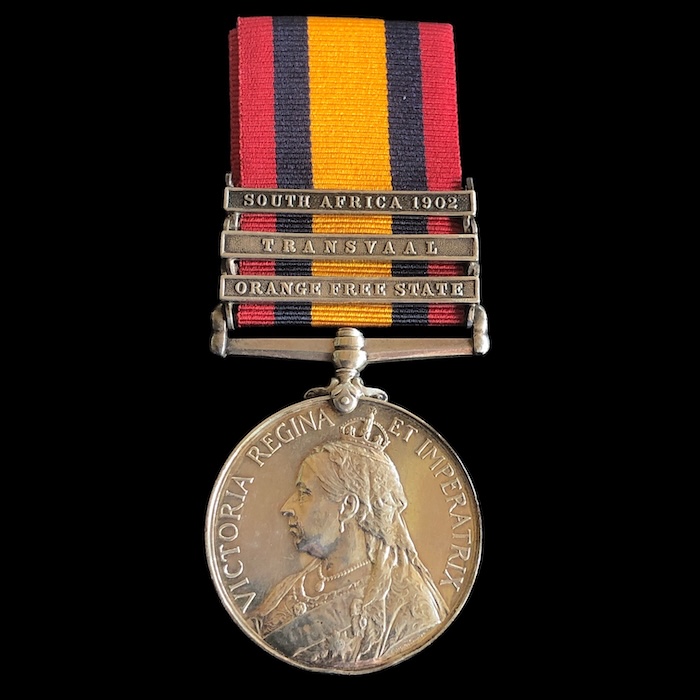
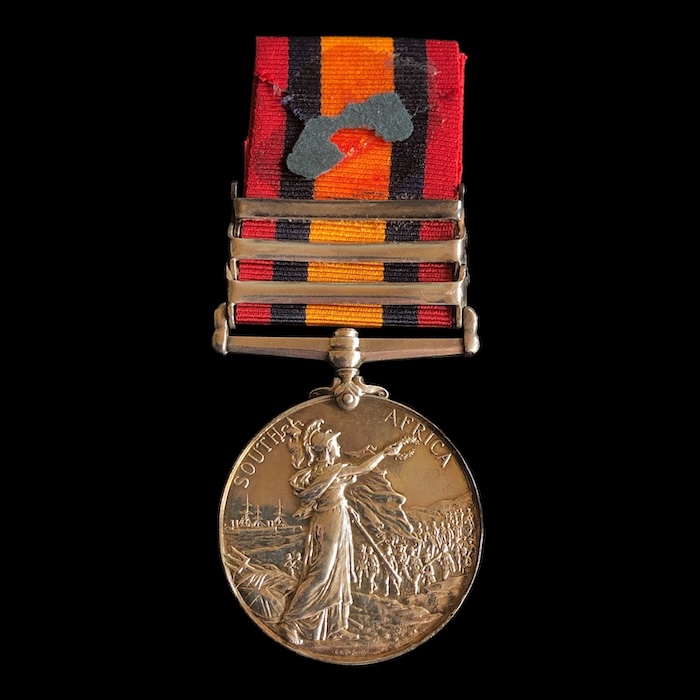
Queens South Africa, clasps, Orange Free State, Transvaal, South Africa 1902, 6029 Pte J. McCaffrey. Rl Innis. Fus.
James McCaffrey was born in Anaugheloy, Tyrone in 1880.
He enlisted on the 7th September 1898, serving at home to the 11th December 1900, East Indies to 23rd January 1902, South Africa to 24th August 1902, home to 31st December 1903.
His service papers record being wounded on the 9th April 1902, “Gunshot wound to abdomen and penis. This occurred at Malipspoort.
Medal rolls confirm the three clasps and invalided home.
In the closing months of the Second Boer War, the British military shifted from major set-piece battles to intensive guerrilla sweeps and blockhouse containment. The northern Transvaal became a bitter final battleground, and it was here that the 2nd Battalion, Royal Irish Fusiliers etched their final major contribution to the campaign at Malipspoort (Malips Poort) in April 1902.
By March 1902, Boer commandos under leaders like General Beyers were heavily pressuring British outposts southeast of Pietersburg, eventually investing Fort Edward. To clear the region and corner the elusive commandos, a coordinated response was launched under Lieutenant-Colonel J.W. Colenbrander.
The 2nd Royal Irish Fusiliers, operating alongside components of the New Zealand Mounted Rifles and Australian Bushmen, were tasked with sealing the rugged mountain passes—or poorts—to prevent the Boers from slipping away into the dense bushveld.
The operational climax arrived in early April. On April 6, 1902, Colenbrander initiated a enveloping maneuver, dispatching flanking columns to block the escape routes to the southeast and southwest.
On April 8, three companies of the 2nd Royal Irish Fusiliers, accompanied by 60 men of the New Zealand Mounted Rifles and two pom-pom artillery pieces, bore the brunt of the heavy fighting as they moved to clear the heavily defended pass at Malipspoort. The Boers utilized the rocky, vertical terrain to maximize their defensive fire.
The Fusiliers advanced methodically up the ridges, using aggressive infantry tactics to dislodge the entrenched commandos. By 3:00 PM, the British pressure broke the Boer line, and by dusk, the remaining enemy forces were in full retreat eastward, leaving behind vital supplies and prisoners.
The action at Malipspoort succeeded in breaking the localized Boer stranglehold on the district. Just weeks later, the Treaty of Vereeniging was signed.
Condition – GVF, some edge bruising.


