
Description
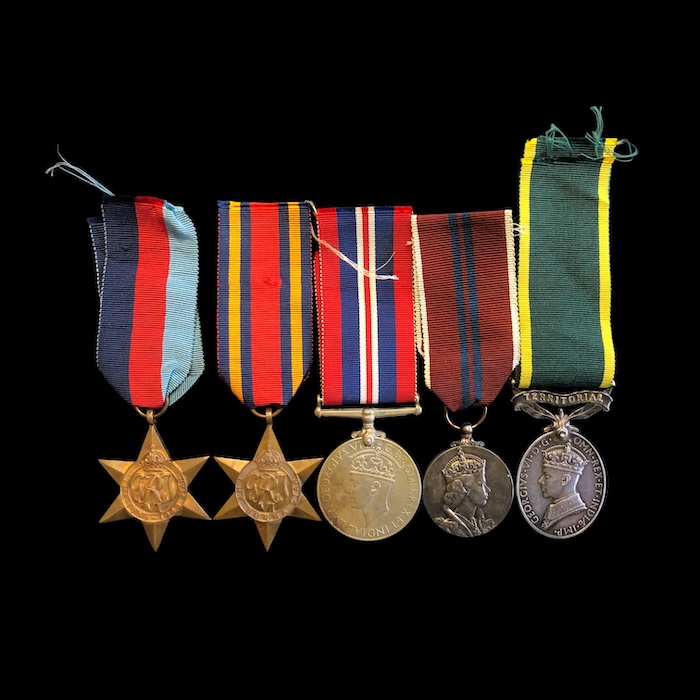
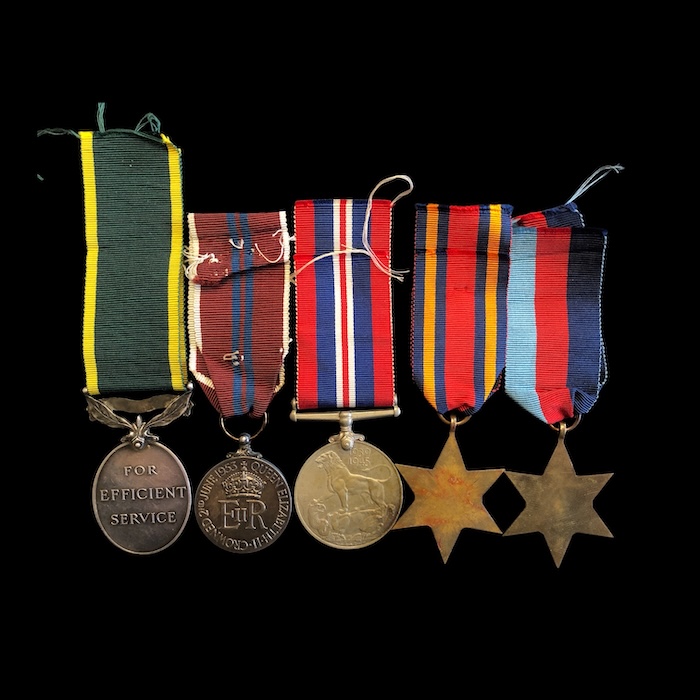
Second World War Burma Efficiency Medal group – 1st battalion Somerset Light Infantry and Royal Artillery.
1939-45 Star; Burma Star; 1939-45 War Medal; 1953 Coronation Medal; Efficiency Medal (Territorial) 4973201 S. Sjt C. Starbuck. R.A.
George Starbuck is confirmed as serving in the 1st battalion Somerset light infantry during WW2.
He later served in the Coast Artillery and Searchlight.
He is confirmed as receiving the 1953 Coronation medal.
Condition – NEF
The 1st Battalion Somerset Light Infantry spent the early years of the war on the North-West Frontier and in central India. Their role was initially defensive, providing internal security and guarding the “Jewel in the Crown” during a period of significant political upheaval and the looming threat of Japanese expansion.
The Burma Campaign: The Arakan
The battalion’s primary combat contribution came during the grueling Burma Campaign. In 1943 and 1944, the 1st Somersets were deployed to the Arakan, a coastal region of Burma characterized by steep, jungle-covered ridges and malaria-ridden swamps.
They saw intense action during the Second Arakan Offensive. Key highlights of their service included:
The Ngakyedauk Pass: The battalion fought to keep this vital supply route open during the Japanese “Ha-Go” offensive. This pass was the only link between British forces on either side of the Mayu Range.
North Arakan & Buthidaung: They participated in the heavy fighting around the “Golden Fortress”—a series of formidable Japanese bunkers. The fighting was often hand-to-hand, conducted in extreme humidity and dense vegetation where visibility was limited to a few yards.
The “Admin Box”: While not the primary unit trapped in the famous “Admin Box” siege, the battalion was heavily involved in the operations to relieve the besieged troops and break the Japanese encirclement.
After the Japanese surrender in 1945, the 1st Battalion returned to India. Their final historical distinction is perhaps their most famous: they were selected as the last British battalion to depart from India. On February 28, 1948, in a ceremony full of military pageantry, the 1st Battalion marched through the Gateway of India in Bombay (Mumbai). As the band played “Auld Lang Syne,” they boarded the HMT Empress of Australia. This event marked the symbolic end of nearly 300 years of British military presence in the subcontinent


