

Description
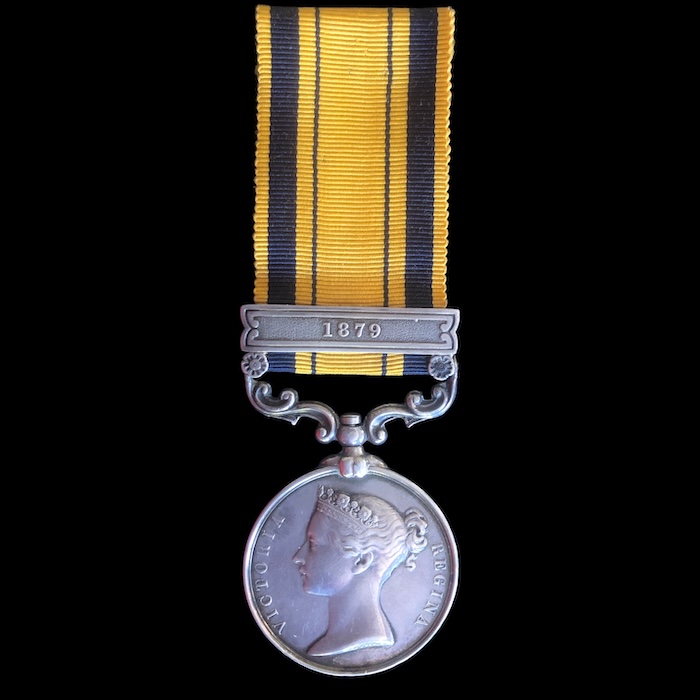
South Africa, clasp, 1879 – 91st Foot (Argyll and Sutherland Highlanders)
South Africa 1877-9, clasp, 1879, 769 Pte R. Armstrong. 91st Foot.
Robert Armstrong was born in New Cumnock, Ayr in 1852.
He enlisted into the 91st on the 18th September 1876 serving until 17th September 1897..
He served at home to the 18th February 1874, South Africa to 6th November 1883, Ceylon to 5th December 1888, Hong Kong to 22nd March 1892, home to 17th September 1897.
This medal shown as his total entitlement.
Condition – GVF+
The 91st (Princess Louise’s Argyllshire Highlanders) Regiment of Foot was dispatched to South Africa in February 1879 as emergency reinforcements following the British disaster at Isandlwana. Arriving in Durban in March, the 91st was the sole Scottish infantry regiment deployed during the Anglo-Zulu War. To bring the unit up to full war strength, the battalion absorbed over 300 volunteers from eleven different regiments before embarking. Under Major Alexander Bruce, the 900-strong battalion marched north to join Lieutenant-General Lord Chelmsford’s column aiming to relieve the besieged garrison at Eshowe.
On April 2, 1879, the regiment fought its primary engagement at the Battle of Gingindlovu. Formed into a fortified wagon laager alongside naval brigades and infantry units, the 91st anchored the rear and eastern faces of the British square. When a Zulu impi of 12,000 warriors attacked in their traditional “chest and horns” formation, the Highlanders held the line against the left horn. Maintaining controlled discipline, the 91st unleashed continuous Martini-Henry rifle volleys that, combined with Gatling gun fire on the corners, broke the Zulu charges within an hour. The decisive victory enabled Chelmsford to relieve Colonel Charles Pearson’s trapped force at Eshowe the following day.
Following the relief, the 91st Foot was assigned to Major-General Henry Crealock’s 1st Division along the coastal sector of Zululand. The battalion spent the remainder of the conflict engaged in arduous engineering and logistics operations. They constructed vital outposts—including Fort Chelmsford and Fort Crealock—and guarded critical supply lines across difficult, disease-ridden terrain. Although they did not take part in the final battle at Ulundi, the 91st’s control of coastal Zululand prevented enemy incursions into Natal, maintaining strategic stability until the war concluded in August 1879.


