
Lake Nyassa 1893 : Campaigning on the Great Lakes of Central Africa
- Posted by Peter Duckers
- 0 Comment(s)
Lake Nyassa 1893
Campaigning on the Great Lakes of Central Africa

Sikhs in Fort Johnston. Most of the soldiers deployed in east and central Africa were volunteers from Sikh regiments
Some Victorian military campaigns impress one with the sheer ‘can do’ attitude displayed by the military authorities. On numerous occasions, they chose to undertake operations under circumstances of distance, climate and terrain which were ‘difficult’, to put it mildly. At a time when Britain was expanding its areas of influence into central Africa and the area around the African Great Lakes, there were numerous small-scale ‘punitive expeditions’ or anti-slavery campaigns largely employing volunteers from the Indian Army, most of these being Sikhs. In the midst of a fairly extensive and complex series of campaigns, one stands out as an extraordinary example of determination and enterprise, waged in central Africa in 1893 on the shores of Lake Nyasa (now Lake Malawi) – just about the most difficult and remote place you could choose to undertake a ‘punitive expedition’, let alone one which involved naval operations!

The gunboat HMS ‘Adventure’. She remained in use until 1915.
It was decided in 1892 to put an end to the extensive slave-raiding and slave-trading activities of chief Makenjire, whose territory lay on the eastern shores of Lake Nyasa. It was deemed better to attack him and his allies from the lake itself and to achieve this difficult objective, two small 35-ton gunboats, HMSs ‘Adventure’ and ‘Pioneer’, recently built by Messrs. Yarrow of Poplar on the Thames specifically for service on the African Lakes, were broken into sections and shipped out. They reached Chinde at the mouth of the Zambesi in October 1892, the sections then being carried by German lighters 300 miles up the Zambesi to Ishikwawa and then man-handled in wagons to Mpimbi across 200 miles of ‘difficult’ country largely unknown to Europeans – a truly epic journey in itself. The boats were then re-assembled in June 1893 at Fort Johnston on the shores of Lake Nyasa, with the aid of artificers from Messrs. Yarrow, who must have had an interesting ‘working trip’!
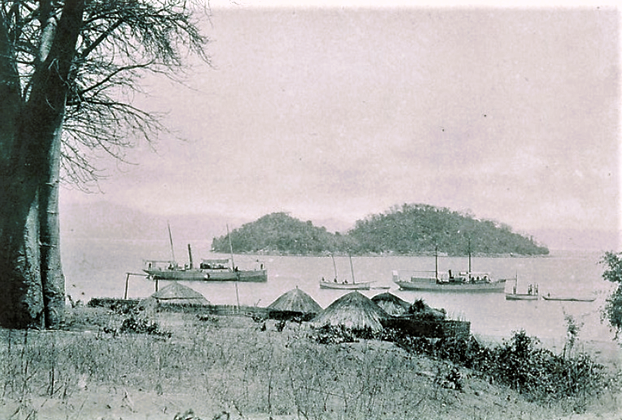
A later flotilla, with gunboats, on Lake Nyasa
Each boat had two 3-pdr quick-firing guns and a .303 Nordenfelt /Maxim machine-gun and were manned by small crews of RN personnel. They were accompanied by a contingent of approx. 110 Sikh soldiers, carried in the unarmed lake steamers ‘Domira’ and ‘Ilala’. All were under the overall command of H. H. Johnston, the Commissioner for Nyasaland, and initially sailed to the north east shore of Lake Nyasa to attack the stronghold of one of Makenjire’s allies at Kisamba. Defences in the area were quickly assaulted and the town itself occupied with only light casualties. Fort Maguire was built on the site nearby soon afterwards and manned for some time by a Sikh garrison.
Both gunboats then took part in an attack on a prominent slaving centre belonging to Makenjire’s mother near Leopard’s Bay. While HMS ‘Pioneer’ covered a landing by the Sikhs in Rifu Bay, HMS ‘Adventure’ shelled the position from the flank; the defenders fled and Makenjire’s mother was captured.

Naval Gardner gun.
For the attack on Makenjire himself, the gunboats crossed from a scratch naval depot set up at Monkey Bay, towing armed ‘flats’ carrying the troops. On 19th November, the small flotilla lay off Makenjire’s coastal territory and the gunboats shelled enemy positions for half an hour before the Sikhs and local levies were landed and attacked the main defensive positions. Both gunboats kept up machine-gun fire to support the landings but the fighting was nevertheless very severe and not until the 20th was the large town effectively occupied. At one point, the attacking force was just about surrounded and might have been destroyed had not HMS ‘Adventure’ quickly come close to shore and poured machine-gun fire into the enemy, who broke up and dispersed. The town was then burned and HMS ‘Pioneer’ seized the only remaining slaving dhow in the area. Makenjire initially fled into Portuguese territory, but continued to be a thorn in the side of the British until his capture following an unsuccessful attack on Fort Maguire in 1894.
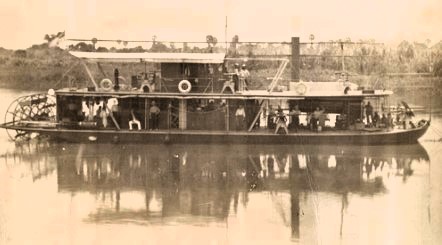
A stern-paddle gunboat c. 1899 – as used on the Lakes
The gunboats were handed over to the British Central Africa authorities later in 1894 and served alongside other local craft in further operations on Lake Nyassa and its hinterland. The whole campaign, brief as it was, serves as a precursor to or even perhaps the inspiration for the more famous naval expedition to Lake Tanganyika in 1915.
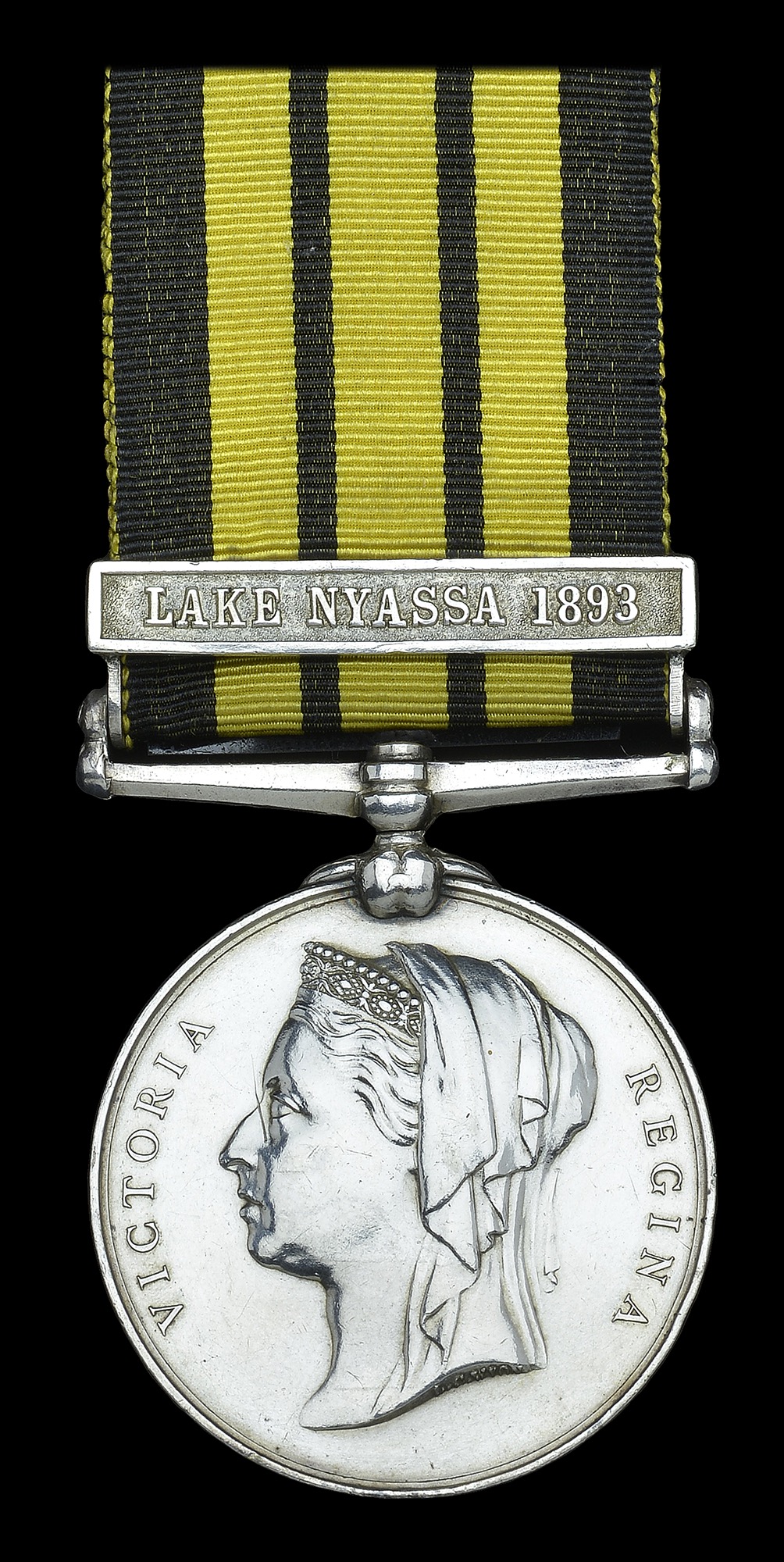
A very unusual feature of the medals associated with the 1893 campaign is that the forces involved received two very different campaign medals – a highly unusual proceeding! The small Royal Navy contingent under Commander Robertson and Lieut. Villiers which manned the two gunboats was awarded the existing medal for ‘small wars’ in Africa, the East and West Africa Medal of 1888, with the clasp ‘Lake Nyassa 1893’, authorised in August 1895. The medal roll (National Archives, ADM. 171/46) shows that for HMS ‘Adventure’ only 22 were awarded (two of which were returned unissued) and for the ‘Pioneer’, only 38 (of which three were returned unissued) – a total of only 55 naval awards, which makes it one of the rarest medals for service in Africa.

The reverse of the medal with clasp ‘Lake Nyassa 1893’ – re-using the reverse of the Ashantee medal of 1873-74
Medals to naval ratings appear on the market at around £4,000-5,000; those in groups or to officers are of course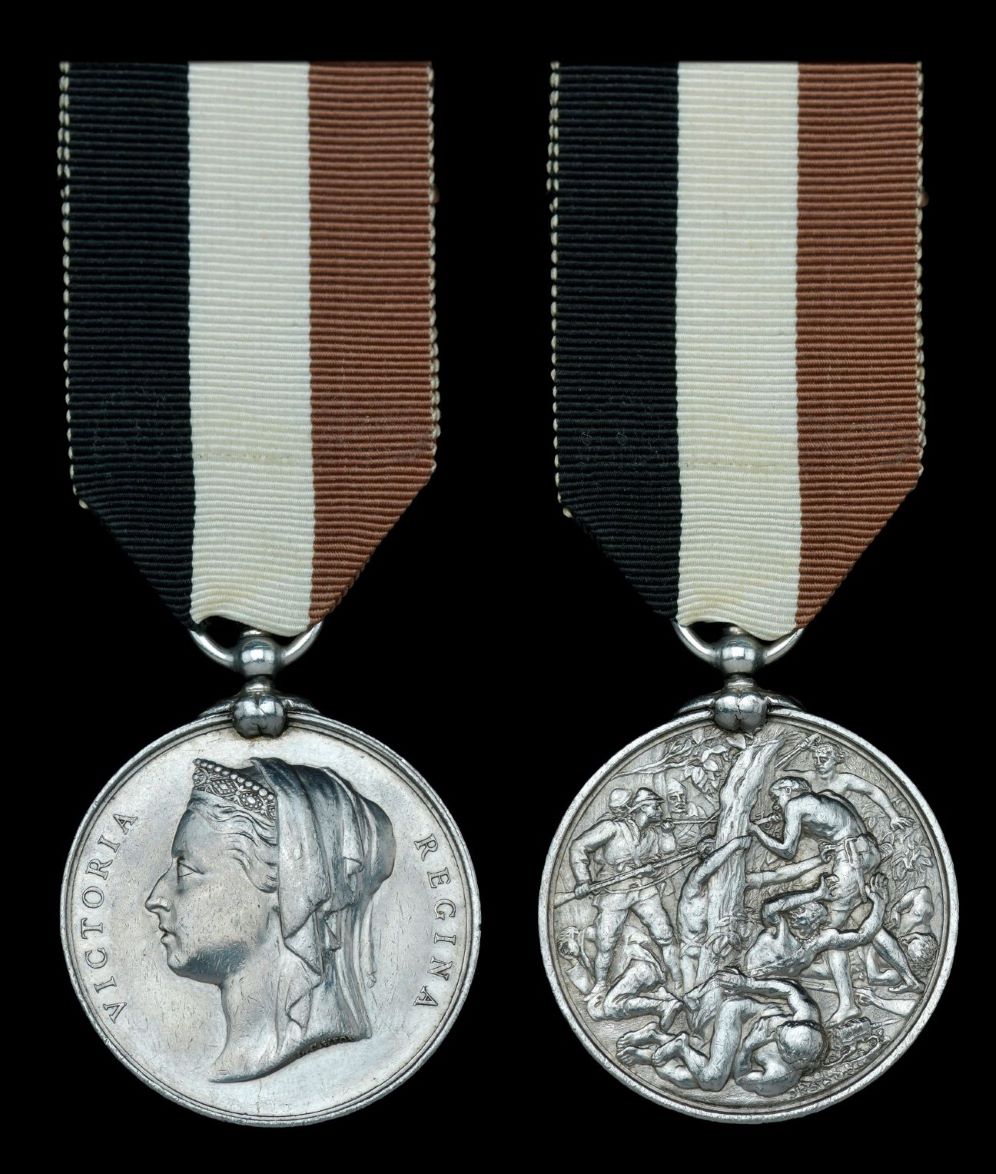 much more expensive. It is worth noting that some RN recipients of the East and West Africa medal in general are noted on the rolls as receiving second or even third awards as replacements – i.e. they claimed ‘lost’ medals and duly received another. It is also worth noting that at the time of its issue of this clasp, there were press reports that medal collectors and dealers were ‘waiting at the dockyard gates’ to try to buy these and similarly ‘desirable’ medals off their recipients, such was their rarity and the interest in them from the start. As an example, A.B. G. Powell, of HMS ‘Pioneer’ is recorded as receiving three medals for ‘Lake Nyassa 1893’ over time! Any collector wanting to spend the considerable amount of money that one of these would cost should make sure that the recipient did not receive multiple awards, which tends to devalue the medal.

In contrast, the small contingent of Indian soldiers under Captains C. E. Johnston and E. A. Leach (only about 110 men, most of whom were from 1st Sikhs and all were volunteers) were given the Central Africa Medal (1895), largely because they were also involved in wider-ranging operations in the area and not just this one action; some received the Indian Order of Merit. The silver medal was initially awarded without clasp (as for this expedition) but those who served in later campaigns could also receive the dated clasp ‘Central Africa 1894-98’. A small number of bronze medals were given to Indian ‘followers’ but these are exceptionally rare. Only the medal rolls distinguish which soldiers got which award and for which campaign – some served in a number.