
‘O’ Battery, 6th Brigade, Royal Artillery, during the Anglo-Zulu War.
- Posted by Peter Duckers
- 0 Comment(s)
A Note on ‘O’ Battery, 6th Brigade, Royal Artillery, during the Anglo-Zulu War.
[This article – here slightly amended – first appeared under my name in the Journal of the Anglo-Zulu War Historical Society, No. 52, 22.11.2022]
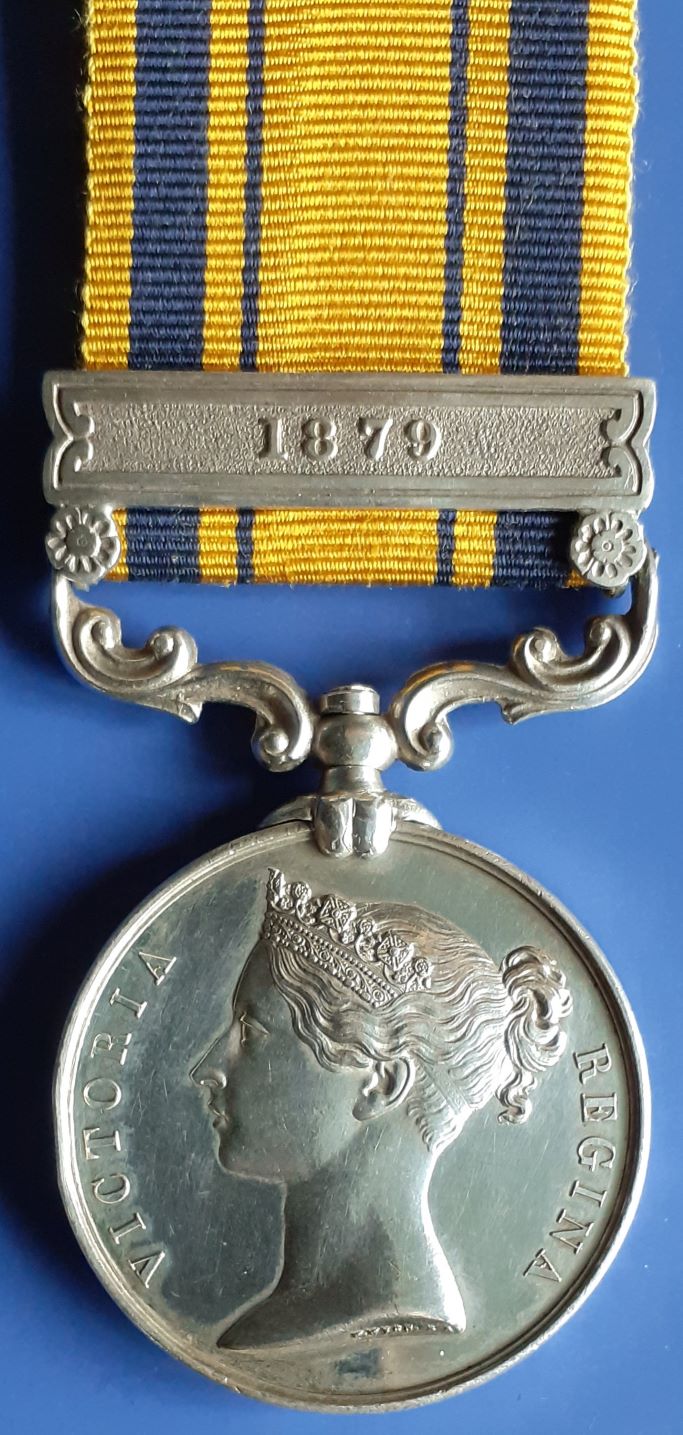
‘O’ Battery of the 6th Brigade, Royal Artillery, was one of the artillery reinforcements sent out to South Africa from England in the aftermath of the disaster at Isandlwana [1]. The battery was “suddenly” ordered in February “to hold themselves in readiness to embark for the Cape in a few days” [2] and made up to campaign strength with drafts from other artillery units. Assembling at Aldershot early in March, they left aboard the Andean for conveyance to Natal on 11 March [3] . Under the command of Major A. W. Duncan [4] , the battery landed at Durban in April 1879. However, it was not to see what one might regard as conventional artillery service during the campaign. The field battery was instead sent out from the UK specifically set up as an Ammunition Reserve Train, without its guns or horses – “an unsound expedient” according to General Sir John Headlam [5]. Newspapers reported that “it has been determined to send out as part of the Cape reinforcements a complete, if not extensive, ammunition train, similar to that which was organised at Woolwich during the preparations of last year but smaller in extent. This addition to the army in Zululand will consist of the various waggons [sic] necessary to wait upon large columns of troops and will be formed by the O Battery of the 6th Brigade, Royal Artillery” [6]. The reduction of a trained and equipped field battery to an ammunition supply column was much criticised.
On arrival in South Africa, the battery was broken up to form a series of ammunition columns supplying other batteries and units. Immediately after landing, the right section marched to the Lower Thukela to join General H. H. Crealock’s newly-constituted 1st Division to serve as its ammunition column. A detachment was sent to Fort Chelmsford to supply ammunition to units moving back and forth to the fort and the battery also provided a depot on the Thukela to arm or re-supply troops proceeding from there. The battery was united after the division’s forward movement towards Port Durnford on the coast and following the capture of Cetshwayo returned to Natal from where late in October 1879 it proceeded to Bellary in India.
Of the six officers with the battery, Major Duncan and Lieut. W. H. F. Turner took part in the advance on Ulundi with Clarke’s Flying Column, with Duncan commanding the artillery of that force.
The medal roll of O/6 [7] lists six officers and 155 NCOs and men who were to receive the South Africa medal, all except one with clasp 1879 [8], but makes no reference to other service by members of the battery. However, the medal roll for 10 Battery, 7th Brigade , presents a different picture. [9]
In 1879, 10/7 was a Royal Garrison Artillery battery based on Mauritius and half of it, with three 9-pdr guns, formed part of the reinforcement hurried from the island to South Africa. This component of 10/7 landed at Durban at the end of March 1879 under Capts. Maclean and Evans, with Major J. F. Owen [10], the battery’s commanding officer, then on special duty in Malta, arriving in Natal slightly later. He set about the establishment of a ‘Gatling Gun Field Battery’ – the first Gatling gun battery formed in the British army [11]. Interestingly enough, those Gatlings had been brought out to South Africa by O/6 [12]. To a great extent the Gatling Battery based on 10/7 was a ‘scratch’ unit made up of what could be put together ‘on the spot’ with guns on light field carriages and with limbers and other equipment drawn from wherever they could be found in the colony. The guns were drawn by Cape ponies and the ammunition carried in mule carts.
Leaving Pietermaritzburg on 5 May, the new battery rapidly moved to join General Newdigate’s 2nd Division shortly before it left Landman’s Drift. Posted to Brigadier General Evelyn Wood’s ‘Flying Column’ at Munhla Hill, what became famous as ‘Owen’s Gatling Gun Battery’ served throughout the subsequent operations of that force after 26 May.
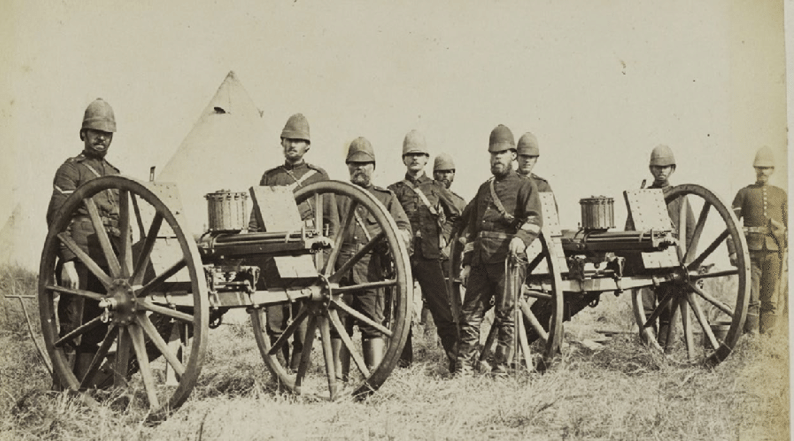
The well-known photo of Owen’s Gatling guns in Zululand [National Army Museum]
While two of its Gatlings under Capts. Maclean and Evans were left at the newly-established Fort Newdigate, the remainder of the battery served with the Flying Column in its advance into enemy territory, later covering the retreat of the cavalry reconnaissance across the White Mfolosi on 3 July and playing a well-recorded part in the battle of Ulundi the next day. Evelyn Wood’s dispatch recorded that “[the Gatling guns] … came into action a little in front of the square; combined with the fire of the infantry, they effectually checked the daring attempt of the enemy to come to close quarters” [15]. British and colonial newspapers also recorded the effectiveness of the Gatlings during the action [16].
When British forces were re-organised later in July, after the arrival of Sir Garnet Wolseley to supersede Lord Chelmsford, Owen’s battery joined Col. Mansfield Clarke’s Column and served through the rest of the operations with that force. When the column was broken up on 5 September, 10/7 marched from St. Paul’s to Durban, returning the horses, mules and ‘borrowed’ equipment into store, while the personnel returned to Mauritius.

What has this got to do with O/6? The medal roll for O/6 Battery makes no particular reference to its personnel seeing anything other than service with that battery – implying that they all saw the same ammunition column service – but interestingly enough, the roll for 10/7 gives a different picture. As a ‘scratch’ battery, it drew at least some its personnel from other batteries and units [17], as well as all its equipment, horses etc. The roll shows a complement of 42 Gunners who were presumably mainly men of the Garrison Artillery component as initially landed, but has no Drivers of its own. Instead, the original roll of 10/7 [18] identifies all the Drivers as men drawn from O/6 Battery, to the number of 20. In addition, the 10/7 roll shows that O/6 also provided two Shoeing Smiths and a Collar Maker. These 23 men are of course named on the ‘parent’ roll of O/6, but with no comment as to their employment with any other battery. Three of them show “no trace of issue” of the medal on the 10/7 roll and another medal was shown as “returned to Mint”.
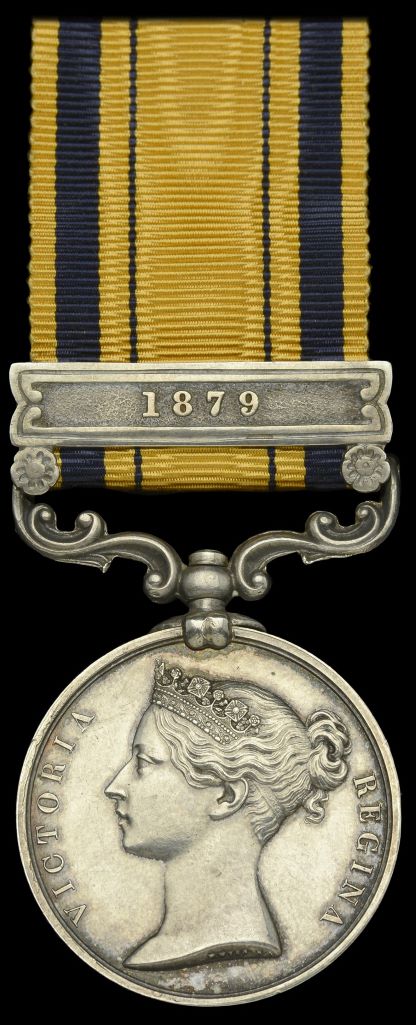
Medal to Driver Nelmes, O/6 and 10/7
These 23 men, serving with the army’s first Gatling Battery and fighting at Ulundi, would have had a very different experience of the war than their colleagues remaining with the ammunition columns!
Men of O/6 serving with the Gatling Battery.
According to the 10/7 medal roll, all received the medal with “1879” clasp except for Drivers Ashmore and O’Donnell. The medal roll for O/6, however, does not show that any of the medals were unissued.
2328 Shg. Smith James Green Also as 4109
4372 Shg. Smith R. McDonald
506 Collar Maker John Lineham
3025 Driver Wm. Ashmore
4321 Driver J. Barker “No trace of issue”
4338 Driver Wm. Brown “Returned to Mint 23.11.97”
4211 Driver Wm. Callan
4320 Driver Thos. Cox
4339 Driver Peter Dixon
4341 Driver Thos. Glover
4340 Driver Jas. Hafford Also as 8286
4306 Driver Gus. Hilliard “No trace of issue”. “Killed at Bellary [India] 19.1.80”
4307 Driver Jno. Humphrey(s)
4318 Driver Rich. Jackson
4341 Driver Thos. Milton
4369 Driver Robt. Morris “No trace of issue”. “Died at Pinetown [Natal] 25.10.79″
4290 Driver Edwd. Murray
4347 Driver Thos. Nelmes
1019 Driver John O’Donnell
4310 Driver Geo. Ringwood
4316 Driver Geo. Fk. Sibun “No trace of issue”. “Disch. by Purchase, Bellary 27.7.80”
4312 Driver Silas Tyler
4314 Driver G. Wilson Also as 774
Notes.
1. Basic information on the artillery units which follows is taken from Mackinnon, J.P. and Shadbolt, S.H. The South African Campaign of 1879, Eyre and Spottiswood for J.B. Hayward [reprint], 1973; Sir John Headlam, The History of the Royal Artillery from the Indian Mutiny to the Great War, Vol. III, Royal Artillery Institution, Woolwich, 1940. For officer services, see List of Officers of the Royal Regiment of Artillery from June 1862 to June 1914, Royal Artillery Institution, Leng & Co., Sheffield, 1914, and appropriate Army Lists.
2. The Western Times, Exeter; 22 February 1879, p.3.
3. The Globe, London, 11 March 1879, p.5.
4. Arthur William Duncan. Served 1855-80, with campaign service in the Transport Dept. in the Asante War 1873-74 (wounded, despatches, Bvt. Major) and Zulu War 1879 (Bvt. Lt. Col.). Retired in 1880 and died in Edinburgh in 1896.
5. Headlam, op. cit., p. 294.
6. The Bury and Norwich Post , 25 February 1879, p.3.
7. The National Archives, Kew, WO.100.46
8. Lt. W.C. Anderson received the medal without clasp. Two Drivers of O/6 are listed on the 10/7 roll as receiving the medal without clasp but are shown with clasp on the O/6 roll.
9. The National Archives, Kew, WO.100.46
10. John Fletcher Owen. Served 1856-1900, the Zulu War representing his only campaign service (despatches, Bvt. Lt. Col.). Later Lieut. General (1899) and C.B., he went on to a distinguished military career in Australia and became Colonel Commandant of the R.A.
11. The weapon itself, as a naval armament, had been used in Asante/Ashantee in 1874 and in Zuluand at the Nyezane on 22 January and again at Gingindlovu on 2 April. Gatlings were used by the army later in 1879 in the Afghan War (e.g at Charasia). They were prone to jamming.
12. The Morning Post, 5 March 1879, p.6
13. The London Evening Standard, 4 July 1879, p.3.
14. ibid.
15. The London Gazette, 21 August 1879, p. 5109. Repeated in a number of British newspapers
16. Bombr J. R. Clark and Gunner E. Dumbleton of 10/7 suffered gunshot wounds during the action.
17. It also refers to volunteers from the 1/24, 2/14, 88th and 90th “who are no doubt included in nominal rolls of those regiments which they rejoined in South Africa”. They don’t actually seem to be identified in those rolls. One officer (name deleted) and two men of the R.H.A. are also included with 10/7, but a footnote indicates that they did not actually serve with the Gatling Battery.
18. The National Archives, Kew, WO.100.46