
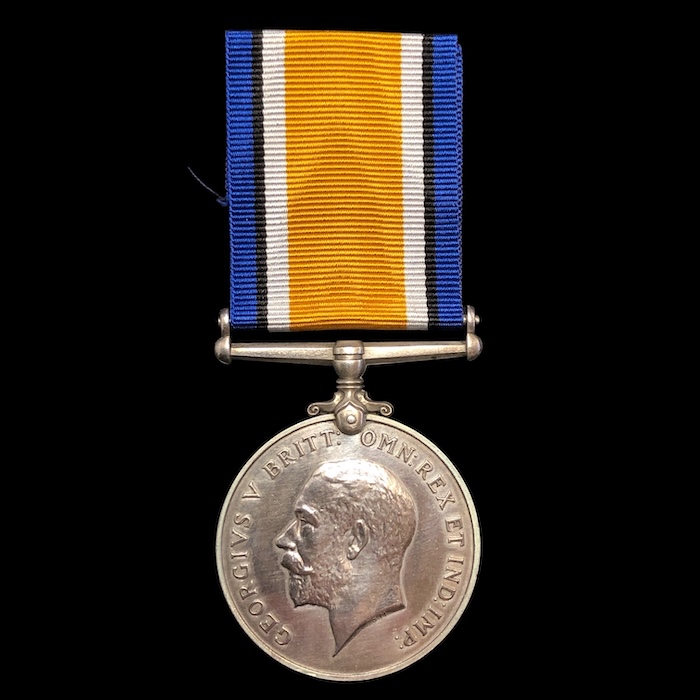
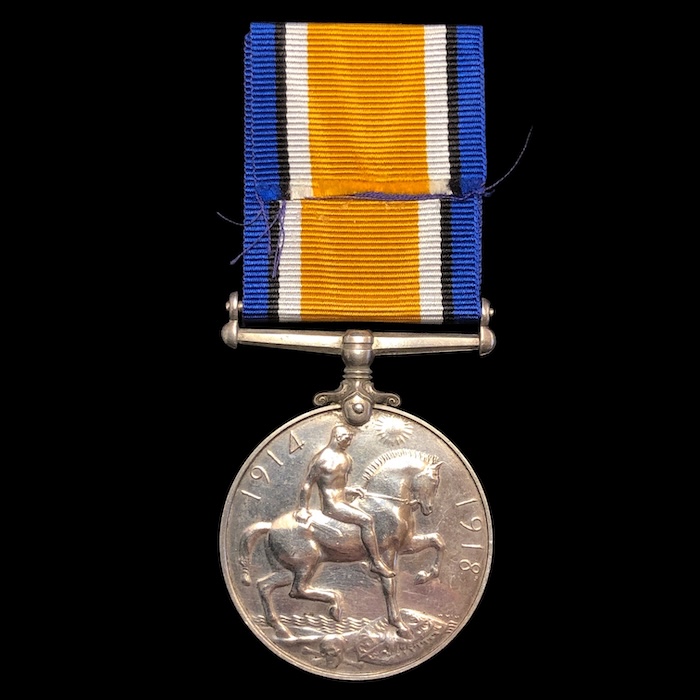
Description
British War Medal – 4th battalion Kings Shropshire Light Infantry (Killed in Action 23rd March 1918)
British War Medal, 31508 Pte B.P. Evans. K.S.L.I.
Benjamin Philip Evans was born in George Town, Merthyr Tydfil in the 1st quarter 1899.
He enlisted on the 02nd November 1015 into the 8th Welsh, being discharged on the 24th December 1915.
He is buried at Beaulencourt cemetery, Ligny-Thilloy.
The 4th KSLI was initially dispatched to India, arriving in Bombay in December 1914. They spent two and a half years performing garrison duties in Hong Kong, Burma, and Singapore. In Singapore, they played a vital role in quashing the 1915 Singapore Mutiny, an uprising by Indian sepoys.
Returning to Europe in July 1917, the battalion moved from tropical kit to the trenches of the Western Front. By early 1918, they were part of the 19th (Western) Division. When the German Spring Offensive (Operation Michael) launched on March 21, the 4th KSLI was thrust into the path of the onslaught.
In March 1918, the 4th Battalion, King’s Shropshire Light Infantry (KSLI) faced its most severe trial of the war during the German Spring Offensive (Operation Michael). Their actions around the villages of Lebucquière and Bapaume are a testament to the chaotic, high-stakes nature of that retreat.
The Defense of Lebucquière (March 21–23)
On the first day of the offensive, March 21, the battalion was moved forward to support the front line. By the night of March 22, they occupied the front-line trenches at Lebucquière.
The following morning, March 23, they bore the brunt of a massive German assault. While “A” Company held a critical position at the Beetroot Factory on the Bapaume–Cambrai road, the rest of the battalion fought from Gaika Copse. By 10:00 AM, the units on their right were forced to retreat, leaving the Shropshires exposed. Under heavy fire and facing overwhelming numbers, they were ordered to conduct a fighting withdrawal toward Frémicourt.
The Fall of Bapaume (March 24–25)
The retreat continued through the ruins of the 1916 Somme battlefields. By March 24, the battalion had fallen back to Bancourt and eventually to the west of Bapaume.
This period was characterized by “absolute exhaustion.” The battalion fought without sleep or regular rations, often finding themselves surrounded or bypassed by German “stormtroopers” moving through the fog. The intensity of the fighting at Bapaume was so great that when the battalion was finally relieved on March 26, it had been virtually destroyed.
Condition – NEF
NOTE: Sorry we cannot accept payment by PayPal for this item, We can accept payment by Credit / Debit Card, Bank Transfer or Cheque.


