
Description
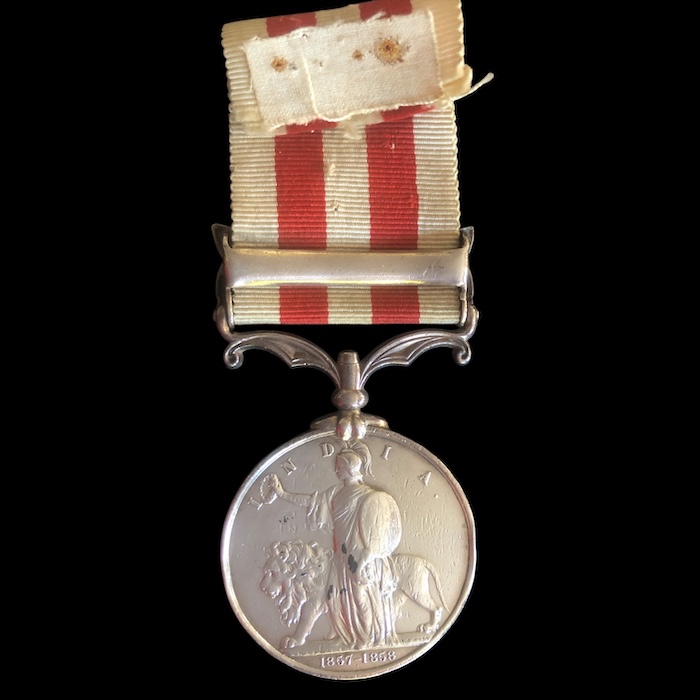
Indian Mutiny, Relief of Lucknow, 64th (2nd Staffordshire) Regiment – Wounded in Action, Cawnpore.
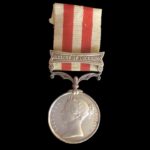
Indian Mutiny, clasp, Relief of Lucknow, Cr Sergt Hugh Mulholland, 64th Regt.
Hugh Mulholland was born in May 1830 in Belfast, Antrim, Northern Ireland.
He enlisted in 1847 serving until 1869. His papers record he was severely wounded at Cawnpore on the 16th July 1857.
An ancestry page for Mulholland contains a photograph of him wearing three medals, which we believe are a Sutlej, Punjab and this Mutiny medal.
Condition – GVF, VF, contact marked and wear to rank and regiment, but still readable.
Arrival in India and Havelock’s Column At the outbreak of the Indian Rebellion in May 1857, the 64th (2nd Staffordshire) Regiment of Foot was returning to India following service in the Anglo-Persian War. Disembarking at Calcutta, the regiment was rushed up the Ganges River to Allahabad, where it was assigned to Brigadier-General Sir Henry Havelock’s relief force. Alongside the 78th Highlanders and the 84th Regiment, the 64th formed the infantry backbone of Havelock’s column, tasked with relieving besieged British posts at Cawnpore (Kanpur) and Lucknow.
Marching in the brutal heat of the Indian monsoon season, the 64th fought its way along the Grand Trunk Road. Before reaching Cawnpore, the regiment saw heavy action at Fatehpur on July 12, routing rebel forces and capturing their guns, followed by sharp engagements at Aong and the Pandu Naddi river on July 15.
The Battle of Cawnpore: July 16, 1857 On July 16, 1857, Havelock’s force arrived outside Cawnpore to face Nana Sahib’s army of 5,000 men, who were strongly entrenched across the Grand Trunk Road with heavy artillery. Recognizing that a direct attack on the rebel artillery would be disastrous, Havelock deployed a flank movement under the cover of a grove of trees, sweeping around the rebel left flank. The 64th Foot, commanded by Major Thomas Stirling, advanced in column alongside the 78th Highlanders to force the rebels to pivot their line under fire.
As the battle intensified, the British infantry advanced across open ground under a devastating bombardment from former East India Company artillerymen. To minimize casualties from round shot and grape, the men of the 64th were ordered to lie flat on the ground while British field guns attempted to counter the rebel artillery. Despite taking cover, the regiment suffered heavy losses under sustained, accurate fire.
The crisis of the battle arrived late in the afternoon. Nana Sahib’s forces brought forward their massive 24-pounder reserve gun, which poured lethal grape shot directly into the exhausted British line. Seeing his men taking heavy casualties, Havelock ordered the 64th Foot to rise and assault the position.
In a famous and controversial action, Lieutenant Henry Marshman Havelock (the General’s son and aide-de-camp) rode out in front of the 64th Regiment. Positioned on horseback directly in front of the center of the unit and facing the muzzle of the 24-pounder, Lieutenant Havelock moved at a slow foot-pace, leading the regiment straight toward the battery. Inspired by this display of composure, the 64th rose and advanced steadily through a hail of grape shot before breaking into a bayonet charge. The regiment captured the gun, killed the crew, and broke the final stand of Nana Sahib’s army.
Lieutenant Havelock was later awarded the Victoria Cross for his actions leading the charge, though Major Stirling and officers of the 64th initially resented the young staff officer stepping in front of their regimental leaders. The victory gave the British control of the city, though the troops arrived too late to stop the Bibigarh massacre.
Subsequent Service in the Indian Mutiny Following the fall of Cawnpore, the 64th Foot remained active throughout the Central India and Oudh campaigns:
- First Relief of Lucknow & Bithoor (August 1857):The regiment participated in Havelock’s initial advance into Oudh and defeated Nana Sahib’s remaining forces at Bithoor on August 16, capturing additional artillery pieces.
- Defense of Cawnpore (November 1857):While Havelock and Outram advanced to relieve Lucknow, a detachment of the 64th Foot remained behind under Major-General Charles Windham to hold Cawnpore. In late November, Tantia Tope and the rebel Gwalior Contingent launched a major assault on the town. On November 28, the 64th mounted a desperate counterattack against rebel batteries dominating the position. The assault was carried out with extreme bravery, but cost the regiment dearly: Brigadier-General Nicholas Wilson (commanding the brigade), Major Thomas Stirling, and Captain McCrea were all killed in action.
- Second Battle of Cawnpore (December 1857):Reinforced by Commander-in-Chief Sir Colin Campbell, the 64th joined in the decisive defeat of Tantia Tope’s army on December 6, securing Cawnpore permanently.
- Rohilkhand Campaign (1858):In early 1858, the 64th Foot joined Campbell’s force in the pacification of Rohilkhand, fighting at the Battle of Bareilly in May 1858.
The 64th Foot served continuously until the final suppression of the rebellion, with its severe losses at Cawnpore remaining one of the most prominent chapters in the regiment’s history.