
Rebellion in Coorg – an East India Company medal for 1837
- Posted by Peter Duckers
- 0 Comment(s)
Rebellion in Coorg – an East India Company medal for 1837

During its long period of expansion by conquest in India, the East India Company (EIC) took the lead in issuing campaign medals to its forces of the Bengal, Madras and Bombay Presidencies. From the Deccan Campaign and its medal of 1784, through to the end of the EICs existence in 1858, it awarded medals for campaigns within the Indian Empire and on its margins but only to its Indian officers and soldiers, not to British officers or to the personnel of British regiments which served alongside EIC forces during some of the campaigns.
One rare EIC award was that given for the Canara Rebellion in Coorg in 1837, though it was not in actual fact an award to EIC armed forces. Coorg (or Kodagu) is now part of the Karnataka state of India, formerly Mysore and had been an independent kingdom since the C16th. In the 1780s, it was occupied by neighbouring Mysore but the Rajah was restored by British/EIC intervention in 1788 and signed a treaty bringing Coorg under British protection in October 1790.
However, in 1834, Rajah Chikka Virarajendra led a rebellion against British authority, seeking to reassert his independence and sparking the Coorg War. A brief campaign followed. In February 1834, an EIC force of 7,000 under Brigadier General Sir Alexander Lindsay began operations against the Rajah, his force divided into four columns, entering Coorg from different directions and intending to converge on the capital, Mercara. A severe action was fought on 3rd April at Soamwar Pettah (Somwarpet) but, unwilling to face further losses, the Rajah surrendered on 10th April.

A Coorg family in the later C19th
It is important, in the medallic respect, to note that the Coorg Medal was not awarded for this war, but for the later ‘Amara Sulya rebellion’ which followed the re-assumption of British control. It was largely incited by resistance to the unpopular re-distribution of territory and new forms of taxation imposed as a result of the EIC take-over. Under the Coorg rajahs taxes had been paid in kind but cash payments were now demanded in some districts and many poorer farmers simply could not pay in that form.
The insurgents, hundreds of largely peasant farmers described as “a mere rabble”, assembled at Sulya in April 1837 and made a successful attack on the Collector of Mangalore and his guard of two companies of sepoys at Puttur. With their numbers increased after this unexpected success, rebel groups advanced on Mangalore, tore down the Union flag, freed prisoners in the local gaol and burned and looted local stores and houses. The European population of the station were unsurprisingly seized with panic and fled onto ships in Mangalore harbour, from where they witnessed the burning of their own homes and businesses over a period of thirteen days.
The Chief Commissioner and commanding officer, Colonel (later Lt. General Sir) Mark Cubbon was ready to evacuate the garrison but since no boats were available, he turned to the offensive with the small force available to him and in the event had no difficulty in restoring order in the city. When reinforcements hurriedly sent from Cannanore and Bombay arrived at Mangalore, they found that the rebels had been dispersed, one of their problems being that many local people refused to support them and actually aided EIC forces in restoring order and rounding up ringleaders and rebels, some of whom were hanged.

The very rare medal in gold.
The Coorg Medal, authorised in August 1837 by the Governor General on the recommendation of Colonel Cubbon, was actually an award for loyal Coorg civilians and a very few soldiers – in other words, it was not so much a campaign medal given to soldiers as a distinct reward to individuals for loyal service. As such, it was only issued in small numbers and surviving examples are rare.
The medal was not granted to all participants, but only to the most senior ranking loyal Coorgs and to others who rendered especially distinguished service. Europeans and members of the armies of the Honourable East India Company from outside Coorg were not eligible. As was common Indian and indeed EIC practice, other types of reward were also presented to selected Coorgs, including gifts of horses, jewels, presentation swords and money.
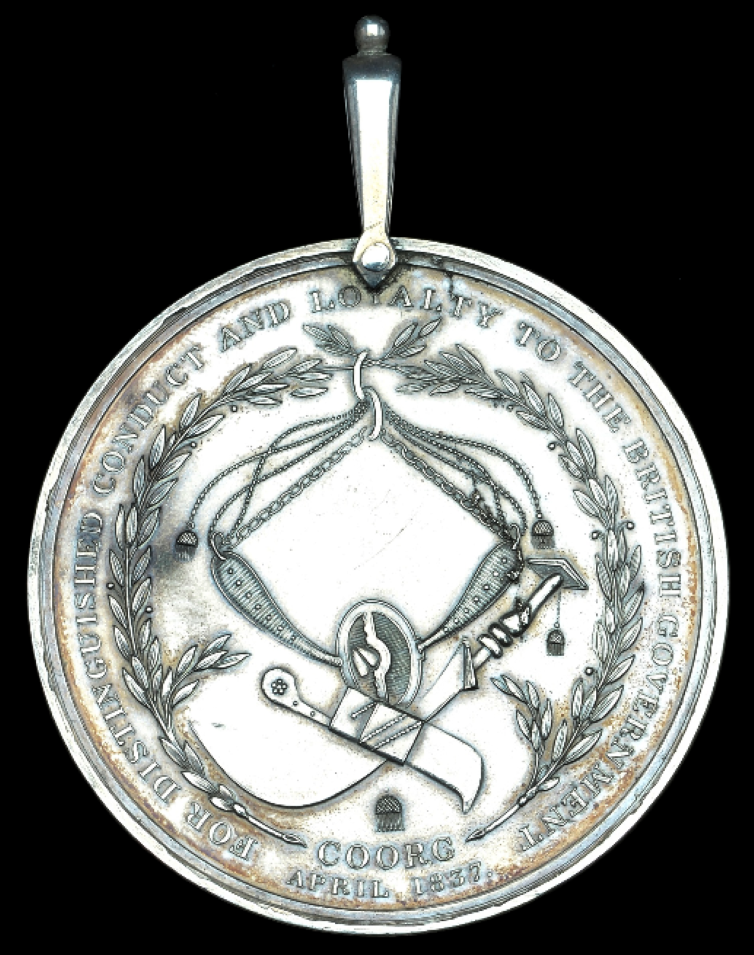
The reverse of the medal.
Despite its limited circle of recipients, it is nevertheless a rather complex award – typical of the EIC system. Gold medals were conferred in three classes, weighing 9, 7 or 4 tolas. The first class, valued at 400 Rupees each, was awarded with a gold chain to two Dewans (chief ministers), 12 of the second class, valued at Rs. 200, were awarded with chains to principal chiefs and Subahdars (leading government officers, not to be confused with the army rank) and 20 of the third class, valued at Rs. 120, were awarded without chains for Parpattigars (revenue collectors) and others. A further ten gold medals of Rs. 50 in value were awarded to Ryots (tenant farmers) who specially distinguished themselves. Forty-four gold medals were awarded in total and approx. 300 in silver were given to those of lesser-rank. This gives a total award of the Coorg Medal of approx. 344 in both metals.
The medals, all types being just under 2 inches (50 mm) in diameter, were designed and struck at the Calcutta Mint. The obverse depicts a Coorg warrior holding an Indian musket in his left hand and raising a knife in his right hand, ready to strike. The perimeter carries an inscription in Canarese: ‘A mark of favour given for loyalty to the Company’s Government in suppressing rebellion in the months of April and May 1837’. The reverse displays an array of Coorg knives and ornaments within a wreath, surrounded by an English inscription: ‘For distinguished conduct and loyalty to the British Government. Coorg April 1837’. The medal was issued unnamed and named examples are not known.

A later restrike, showing clear die flaws to right hand side.

Later restrike of the silver medal with a variant suspension.
The medal was suspended from a flattened loop, pinned at the base, and all types were to be worn around the neck. No ribbon was specified but, as with other EIC awards, they are sometimes seen worn from a length of cord, with the fourteen in gold awarded to senior recipients worn from a gold chain.
Examples of the medal in bronze or even copper are seen but they were not issued in these metals and may be die trial strikings or simply later copies. In common with other EIC awards, the medal was re-struck from its original dies later in the C19th and collectors should beware of good copies which may not be original issues. Many of the later issues have more variable flans (noticeably thicker or thinner) and may have visible die flaws on the obverse, showing clear crack marks in the design. Also, as a result of wear to the dies, the knife wielded by the warrior tends to be polished away where the blade meets the background field, rather than showing a distinct edge.
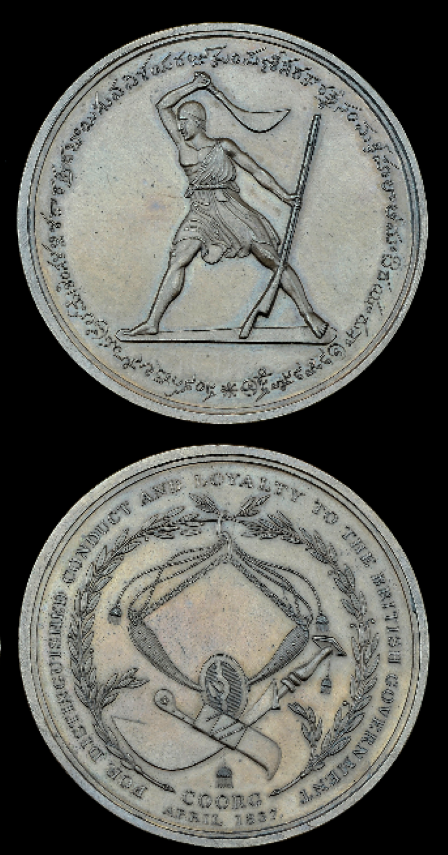
A bronze version, probably a mint trial striking. Never issued in this metal.
Original silver awards appear on the market at round £600-800 depending on condition, but the rare gold medals (examples without the gold chain) are far harder to find and can fetch £5000-6000. Good restrikes of the silver medal are collectable – as simple examples of the type – and sell for around £300-400. Bronze trial or specimen pieces fetch around £200.