
The Zaila Field Force 1884 – the Egypt medal that wasn’t !
- Posted by Peter Duckers
- 0 Comment(s)
The Zaila Field Force 1884 – the Egypt medal that wasn’t !
by Peter Duckers
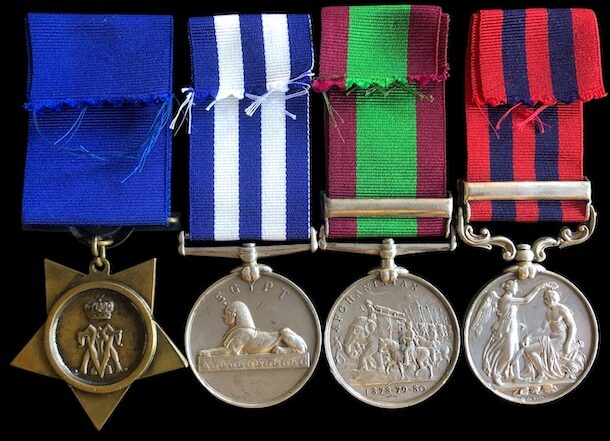
There recently appeared on this site an interesting Royal Artillery medal group. It comprised the India General Service 1854 with clasp Jowaki 1877-8 , the Afghan War medal with clasp Ali Musjid and an undated no-clasp Egypt medal and Khedive’s Star.

The attractive-looking group was awarded to Gunner/Bombardier Frederic Stewart, who served between 1876 and 1889. He was with 13th Battery, 9th Brigade RA – a Heavy Battery equipped with powerful 40-pounder Rifled Muzzle Loading siege guns – on the northwest frontier of India in operations against the Jowaki around the Kohat Pass in 1877-78 and then in Afghanistan in the attack on the Khyber Pass fortress of Ali Musjid. The battery, part of the Peshawar Valley Field Force under Lieutenant-General Sir Sam Browne, used its heavy guns to inflict considerable damage on the fort. The bombardment, combined with an infantry attack, forced the Afghan garrison to abandon the fort under the cover of darkness and won access to the vital Khyber Pass route to Afghanistan. The battery subsequently served in advanced positions along the route to Kabul at Jelalabad and Gandamak until withdrawn at the end of the first campaign.
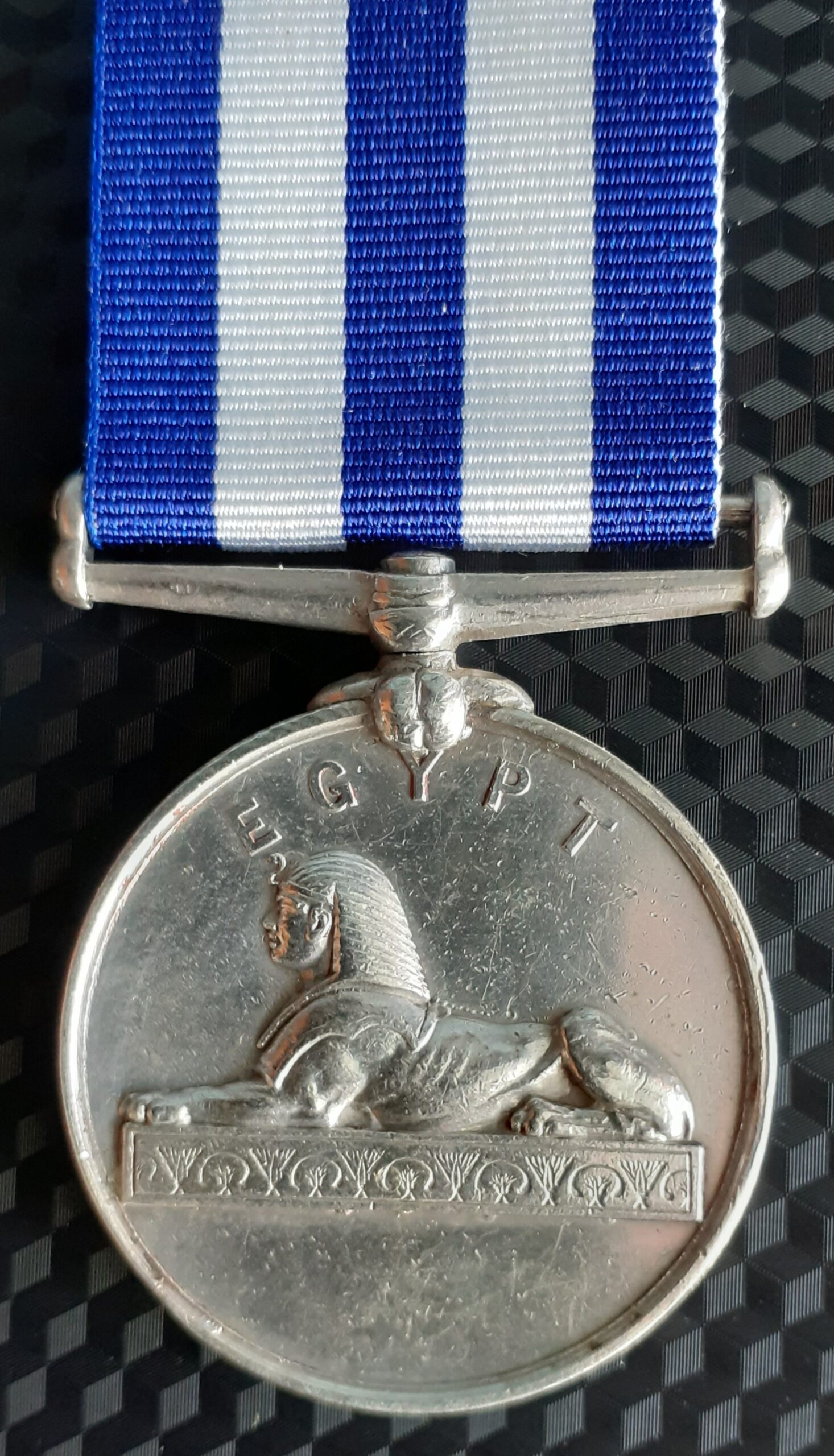
By 1881, Stewart had passed into 7th Battery 1st (London) Brigade and it was in this battery that he earned his undated Egypt medal. Many collectors don’t think much of this award – no date, no clasps, no action – though some were awarded for naval duty or interesting frontier service, such as at the battle of Ginnis late in 1885. The Egypt medal to 7/1 Battery awarded to Stewart and his comrades falls into the “much more interesting” category.
The Egypt medal roll for 7/1 states :-
“These NC [Non-Commissioned] Officers and men served at Zaila south of Assouan, during the evacuation of Harrar by the Egyptian garrison, which they were sent from Aden to protect, during August, September, October, and November 1884.”

This refers to service with the Zaila Field Force and the operations to evacuate the Egyptian garrison at Harar, deep in the mountainous hinterland of the Somali coast.
The occupation of Harar was part of Khedive Ismail’s (ruled 1863–1879) ambitious vision for Egyptian expansion. This would take Egyptian forces deep into the Sudan, towards its frontier with Abyssinia and on to the Somali coast during the 1860s–1870s, to seize important trading centres and Red Sea ports. However, the Khedive’s occupation of Zeila, Berbera, Harar and its environs were the only successes of the Egyptians in the Horn of Africa. The Khedive’s armies were defeated in an Egyptian-Ethiopian war, which reached its climax with the Egyptian defeat at Gura in March 1876. From then onwards and during the years of the Egyptian regime in Harar, Egypt fell into a rapid and dramatic economic and political crisis which resulted in the British invasion and occupation in 1882.
At much the same time, the growing Mahdist threat sweeping through the Sudan led to the Gordon mission to Khartoum early in 1884. General “Chinese” Gordon was meant to ‘rescue’ Egyptian garrisons (with wives and families in many cases) strung out along the Nile north and south of the capital. But Gordon chose instead to confront the Mahdi head on, put Khartoum onto a war footing and stand a long siege. Egyptian garrisons still in situ to the south were left to their own devices.
In 1866, as part of the ambitious policy pursued by the Khedive for the extension of Egypt’s dominions, the port of Massowah (“the “Pearl of the Red Sea”) was purchased from the Turks for £16,000 and a later firman from the Sultan gave the major port of Zaila to Egypt, all secured by British recognition of their jurisdiction at points along the Somali coast, it being stipulated, however, that none of this territory should be ceded to a foreign Power and that British Consuls should be appointed at various places on the coast. Important trading centres like Berbera, Harar, Tajura, Bulhar and others, were garrisoned by Egyptian troops. The Egyptian commander, Raof Pasha, at the head of 4,000 men, had occupied Harar in 1874. Rauf killed the ruling emir and the local Oromo leaders who did not surrender and actually declared himself emir of Hararghe. He then set about subduing the local Oromo tribes, suppressing uprisings against Egyptian rule. After solidifying their control in the area, the Egyptians then proceeded to appoint Oromo administrators in the surrounding areas of Harar city, including at Garads, Malaks and Damins.

Zaila from the sea, 1884. Drawn by Lieut. Ducrot, 7/1 RA.
But following the collapse of Khedivial government in Egypt by 1882, the threat from Mahdist supporters spreading through the Sudan by 1884 and the resulting proposal to withdraw scattered Egyptian garrisons, there would be a potential power vaccuum on the Somali coast which might induce foreign intervention – especially by the French from their nearby territories to the north – and possibly by the Italians. The British were anxious to retain some control of the coastal area, since it lay directly opposite Aden territory and supplied most of Aden’s food and other commodities. There was also the insistent need, much emphasised in British reports, to combat the slave trade, still very much in evidence in the region:
“it ought to be within the power of the British government, holding such a position as that of Aden, and with treaty rights of interference long since conceded by Turkey and Egypt totally to suppress the maritime slave-trade of the Gulf of Aden.”

The Somali coast – Harrar/Harar towards bottom, far left
By October 1883, 7/1 Battery was part of the garrison of Aden at the mouth of the Red Sea, a vital link in Britain’s imperial strategic and commercial network. It turns out that Gunner Stewart and the other men of 7/1 Battery were to form part of a force of only about 250 to be sent from Aden across the Red Sea to the Somali coast at Zaila [Zeyla/Zeila], an ancient trading port. It was the western-most Somali port and had been one of the main coastal bases of the British Abyssinia (Magdala) expedition in 1868.
The dynamic British agent in Aden and ‘Consul for the Somali Coast’ was the remarkable ex-Indian Army officer, Major Frederick Mercer Hunter (1844-98), later C.S.I. and Governor of Somalia 1887-88. He was a dynamic and important and colonial administrator who has largely been forgotten but who really sowed the seeds for the British seizure of the Somali coast and what became ‘British Somaliland’. Major Hunter was not overly-concerned with remote inland regions which could not be easily sustained and recommended that the Harar should return to Somali rule. His main concern was the major ports of Zaila and Berbera, especially as rumours spread about the Egyptian disaster in the Sudan and a collapse of their local authority. Under his auspices in the 1880s, with Egyptian authority being withdrawn, Britain quickly took control of Zeila, Bulhar and Berbera, with detachments of Hunter’s Aden Police being posted initially to Zaila and Berbera. The aim was to secure under British control both coasts of the Red Sea around Aden because of the vital route to India and the Far East, and to safeguard supplies of food and fuel for Aden. The Ottoman Sultan was given the option of resuming possession of Zeila when the Egyptians withdrew but declined. At the same time, France annexed the Danakil and other parts of the Somali coast, to form what would become French Somaliland (Djibouti) – a worrying example of possible foreign intervention.
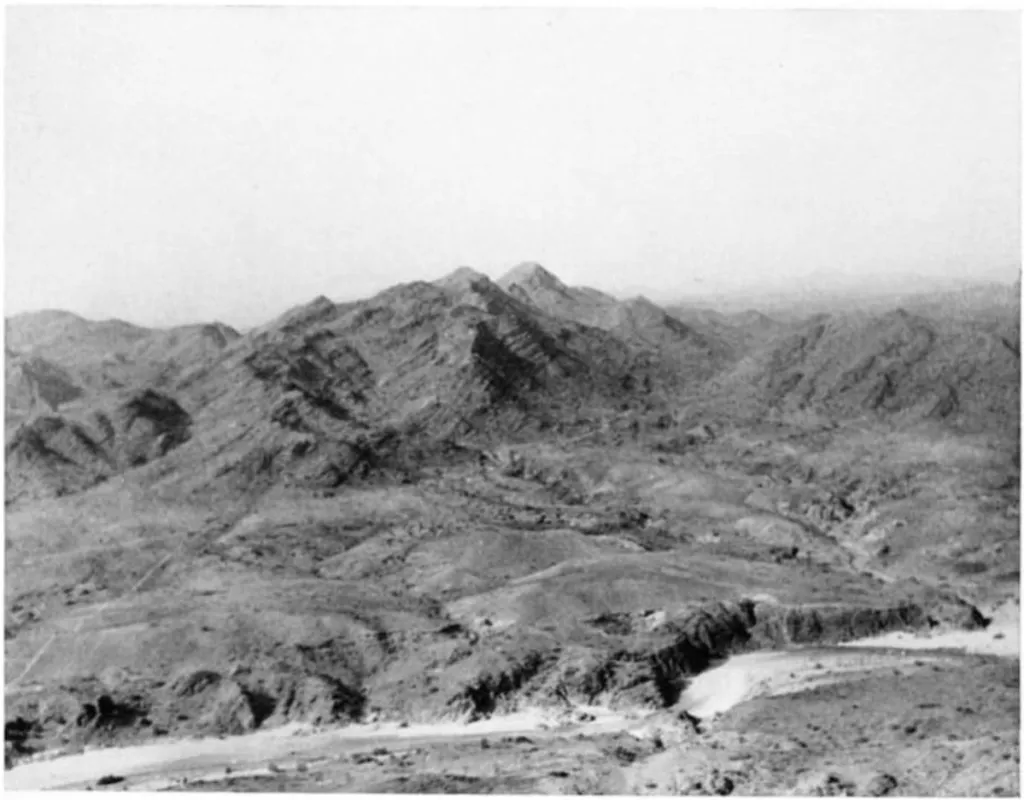
Inland beyond Zaila
Harar was a large and important inland trading centre and walled city, once the administrative and commercial centre of a large province within the Harar Highlands, with an estimated population of 35,000 in 1875. Foreign knowledge of Harar was relatively recent – it had first been visited by Europeans only in 1855 when the famous explorer Captain Sir Richard Burton made a difficult and dangerous journey to the town, against sound advice, and spent ten days there before returning to the coast. His mission, on behalf of the East India Company, was to examine the port of Berbera (“A far better place than Aden”) and then go to the inland regional capital, Harrar, “A most difficult place … the country being inhabited by a most dangerous race to deal with”. His account of the long journey, with its detailed report on Harar, its people, its religion, its trade and politics, and his arduous return journey to the coast, was published as First Footsteps in East Africa in 1856 – the first detailed report on the Somali hinterland.
Under Egyptian rule – the subject of hostile reaction by local Somali tribes – the city’s effective authority over the hinterland had shrunk to a radius of only about 15km beyond its walls. It nevertheless retained a very important religious significance (Burton commented on the number of mosques and religious students), its status in the long-distance caravan trade to the coast and its productive agricultural output -its coffee was said to be especially fine! Harar was also notorious – in British eyes – as “the chief market of the infamous Galla [Zaila] slave-trade”. Combatting the regional slave trade was a major British concern.
The Egyptian garrison, traders, shop-keepers and settlers who came to Harar during its brief occupation came to comprise a remarkable 25% of its population, based there to ‘pacify’ and govern the city and its hinterland and transmit revenues and taxes back to Cairo. The Egyptians, in their ten-year rule, made some attempt to modernise the administration of the area and the city’s infrastructure, including the building of a hospital, and there is plenty of evidence to suggest that Egyptian merchants and shop-keepers who had had time to build up a decent living were distraught at the thought of an Egyptian withdrawal and faced the awful choice of giving up their livelihoods and leaving, to start all over again somewhere else, or staying in the city and seeing how things turned out. It is also interesting to note that at this time Harar became the home of the famous French poet, Arthur Rimbaud (1854-1891), who set up as a coffee and weapons trader in the town.

Harar from ‘the coffee stream’ – Richard Burton (1855)
This meant that, ultimately, with some 3,500 Egyptian troops and their families, perhaps more than 9,000 people (some suggest 11-13,000) would have to be removed safely and escorted to the coast for transit to Egypt. The ‘foreign’ Egyptian occupation had never been popular and there was little doubt that a withdrawal would lead to Somali attacks on any straggling columns as they took the long and difficult overland route to the coast, most probably by the hostile Ossa tribe whose territory lay around the main Harar-Zaila route. They would need a powerful military escort to reach the coast safely and it was felt that actual British troops (or mainly Indian in this case) would be more effective and more of a deterrent than the local police or levies.

A view of Harar from the south – 1884. Drawn by Lieut. Ducrot, 7/1 RA.
British intervention at Harar meant acting in agreement with the Ethiopian king, Yohannes/John V, to allow military movement through his territory. The evacuation was formalised by a treaty negotiated by Rear Admiral Sir William Hewett (known as the Hewett Treaty or Treaty of Adwa), signed on 3 June 1884. This agreement between Great Britain, Egypt and the Emperor Yohannes, allowed, amongst other terms, a land-locked Ethiopia to be given access to ports to use as trading bases on the Somali coast and it allowed a British force to rescue Egyptian soldiers and their families isolated by the repercussions of the Mahdist uprising and the ending of Egypt’s commitment to the region.
In July 1884 it was reported (by “a Reuter’s telegram”) that “the British Political Resident at Aden [Hunter], accompanied by Her Majesty’s gun vessels Arab and Ranger and an Indian government steamer had proceeded to Berbera in order to annex that place… It is a seaport town in the Somali country, nearly opposite Aden, on the southern side of the Gulf of Aden, 160 miles east-south-east of Zeilah … Berbera is really an Egyptian territory and it is absurd to speak of its being annexed by England. When our representative interviewed General Gordon at Southampton, the General, after deprecating the cession of Massawah to the Abyssinians said “A Commission might be sent down with advantages to examine the state of things in Harrar opposite Aden to see what iniquities are going on there, as also at Berbera and Zeilah.”” [Pall Mall Gazette, 16.7.84.]

Gateway at Harrar, 1884.
Not every commentator was anti-Egyptian: “People may argue that Egyptian rule of the Soudan was so deplorable as to render its continuance impossible. Bad as it was, it is always better than anarchy; and I will only cite two provinces to prove that portions, at any rate, of the Soudan were prosperous and happy under Egyptian rule – Kassala, in the first place … and 2ndly Harrar, now about to be ceded to Abyssinia and which formerly belonged to [the Ethiopian king’s] dominions… Major Hunter reports that the prosperity of the province has increased at least 100 per cent while under the rule of the Egyptians. And this is a Mahommedan province, so prosperous that last year there was a surplus of £15,000, [that] we are about to restore to barbarism and oppression by transferring it against its will, to the rule of our Christian friend and ally King John.” [In 1887 the city was indeed formally incorporated within Ethiopia].
The Hewett treaty specifically committed Ethiopia to assist in the withdrawal of Egyptian troops from the several outposts (“beleagured by tribes”) in the southern Sudan e.g. at Kassala (a major administrative centre near the Ethiopian border), Amadid/Amidib (a strategic outpost on the route to the coast), Senhil (including the fort of Keren), Gallabat (Metemma), Gira and Harar, via the port of Zaila.

The Field Force camp at Zaila in 1884. Drawn by Lieut. Ducrot, 7/1 RA.
What became known as the Zaila Field Force was assembled in Aden in August 1884, with Major F. M. Hunter as Political Officer, the military column commanded by Major F. F. Comyn, 4th Bombay Infantry. Its prime object would be the safe removal of the Egyptian garrison at Harar. The Royal Artillery contingent was provided by four officers and 46 NCOs and men of 7/1 RA (as on the medal roll) under their commander, Major J. F. Brough, with Captain D. E. Dewar, Lieuts. L. H. Ducrot and M. B. Bicknell. Interestingly, the medal roll states that they were “attached to the Aden Camel Battery”. They were supported by fifty men of the Aden Horse under Lieut. Geogheghan. Hunter had left Aden for Zaila on 18 August aboard the Arab and the troops and artillery followed “a few days later” on the Indian troopship Tenasserim.

Camel with ammunition – Aden Camel Battery.
The Illustrated London News reported:
“We hear of new movements in the province of Harrar and its seaport, Geila [Zeila], to which a force of 250 men was dispatched recently from Aden to rescue the Egyptian garrison, said to be beleagured by Mohammedan insurgents. The abandonment of the Soudan does not imply the abandonment of its seaports. If the tribes about Harrar are so hostile, there is every reason to place Geila [Zeila] in a proper state of defence. [But] merely because a body of 250 men have been shipped from Aden to that port, people must not conclude that the Government are embarking on an expedition into every corner of the Soudan.” [6.9.84]
The newspaper went on to state later in November –
“An expedition has recently been sent across from Aden to Zeylah for the immediate purpose of relieving the Egyptian garrison at Harrar, a body of 3500 troops who have been long in occupation of that town … it was apprehended that their retreat, unless aided and protected by a British force, would be exposed to the vengeful fury of their enemies throughout the country. The force dispatched on this service, which is styled the Zeylah Field Force, consists of a half battery of light field artillery, with three seven-pounder guns, on camels, 150 men of the 4th Bombay Rifles under the command of Major Comyn, of the 4th Bombay regiment, the artillery being commanded by Major Brough, RA , with Lieut. Geogheghan as staff officer. The force left Aden on 20 August, landed at Zeylah two or three days afterwards and encamped in the neighbourhood of that town. Many weeks have been passed in compulsory inactivity, the correspondence with the garrison at Harrar not being conclusive. It appears, in this instance, as in the case of several of the garrisons in the Soudan, and possibly of some with whom General Gordon has had to deal, that the troops and their officers, having taken to themselves property, families and slaves in the country, are not very desirous of leaving it. Whether the sense of any danger in remaining where they are is sufficiently real or urgent to induce the Harrar garrison to accept the offer of a safe escort and free passage from the seacoast, we may hereafter be informed and we shall know, some day or other, much more than we yet do of the actual state of affairs at Khartoum, at Senaar, at Kassala and other places from which Egyptian troops have shown no great hurry to depart.” [ILN 22 Nov 84]
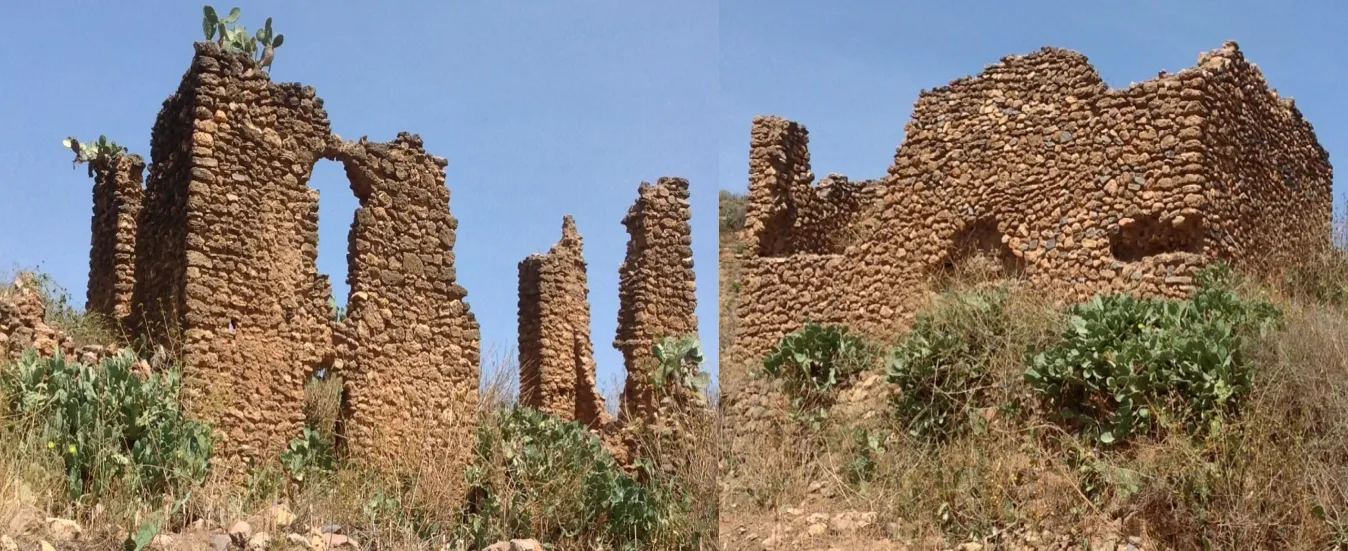
Ruins of the citadel at Harar
So the men of 7/1 RA took the long, hot march of 200 miles (320 km – fourteen days of marching),through the desert and hills into Harar, dispersed themselves around the town’s defensive walls and then escorted the Egyptians out of the city. Apparently, only a few hundred were escorted out at any one time, to reduce the size of the column and the supplies it would need, and make it easier to defend against attack. So many people had to be moved that it actually took until May 1885 to get them all to the coast, by which time 7/1 had long gone – it left Aden for England in November 1884. There don’t appear to have been any actual attacks on the long road back – perhaps the sight of the Bombay Infantry escort and the British guns was enough of a deterrent – and the Egyptian garrison and its followers were all gradually moved to the coast; some of the Egyptian troops actually refused to leave, since they had married local women, and others from the Harar garrison chose to remain in local service once they had reached the coast and became part of the garrisons of Zaila and Berbera.
In August 1886 – two years later – the men of 7/1 engaged with the Field Force, as named in his return by their commanding officer Major Brough, were duly awarded the “Soudan” medal without clasp and its associated Khedive’s Star, as in Stewart’s medal group. But things began to go wrong with the fact of the award. The medal roll has the additional comment:
“Through a mistake on the part of the Commanding Officer, the men were granted the Soudan medal and have been allowed to keep it”.
It seems that in 1889, three years after issue of the medal, the operations of the Zaila Field Force were deemed not to come under the terms of award of the “Soudan” medal (General Order 97 of 1885). Initially the War Office sought simply to cancel the award to the battery and reclaim the medals. However, they came to the understandable conclusion that, since so long had passed and many of the men would have left the service or be dispersed and potentially hard to locate – again as referred to on the medal roll – the medals were “not to be withdrawn from the N.C. officers and men … even though they are not entitled to wear them”. They also made it clear that the recipients would not be entitled to any “special campaign pension” in respect of their service with the Field Force. Gunner J. E. Smith – and he can’t have been alone – applied for a pension late in life and received a letter as late as 1933 telling him outright that “while [he] was allowed to retain the 1884 Egypt Medal, although awarded in error, it has been decided that this cannot be regarded as qualifying him for a special campaign pension”.

 As far as retaining the medal was concerned, the same allowance was not granted to the four unfortunate battery officers, who were no doubt easier to trace! Their commanding officer at the time, Major James Brough, received a very curt note from the War Office explaining that since it would be difficult to locate the “other ranks” who had wrongly been given the medals, they would not be required to send them back. But Brough was brusquely ordered to return his to the War Office, “since the responsibility for the award of the decorations in the first place lies with you”. The other officers of the battery – Captain Dewar, Lieuts. L. H. Drucot and M. B. Bicknell were also required to send back their medals and presumably did. It seems a very petty attitude! Their official records and Army List entries duly show service in the Zaila Field Force in 1884 – but with no medal shown. The Indian Army officers and soldiers, the Aden Horse and Camel Battery, Political Agents and others also received no medals for this particular service.
Despite the recipients of the medal being “not entitled to wear them”, from the contact marking it it does look as if Gunner Fred Stewart did actually wear his – good for him!
Other examples of the Egypt medal to 7/1 would be interesting finds.